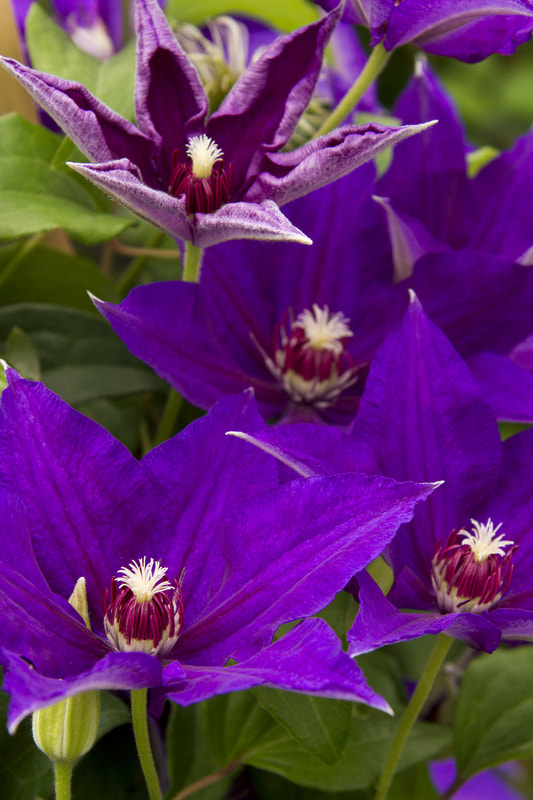
 Clematis 'Danielle' photo credit: photo credit: DoreenWynja.com for Monrovia Color in the landscape at this time of year can be a rather limited palette. Various shades of white (depending how dirty the snow is) mix with shades of brown and gray. No wonder we look forward to spring when the earth teems forth with life-giving greens and a Crayola box of color. While we wait, it's encouraging to look at the hues that have been chosen as Pantone's colors for 2018. As a gardener and manager of a garden center, imagine my delight at the color of the year selected by Pantone: ultra violet. Purple has a regal and majestic meaning to it, but ultra violet was chosen to reflect "originality, ingenuity and visionary thinking" according to Pantone VP, Laurie Pressman. "It leans more to blue than red and that speaks to thoughtfulness, a mystical quality, a spiritual quality." Hmmmm . . . thoughtful, mystical, and spiritual sound great, but what if you just like the color purple? For those of you kindred lovers of all things purple, here is a sampling of new perennials and annuals to add to your garden in spring: 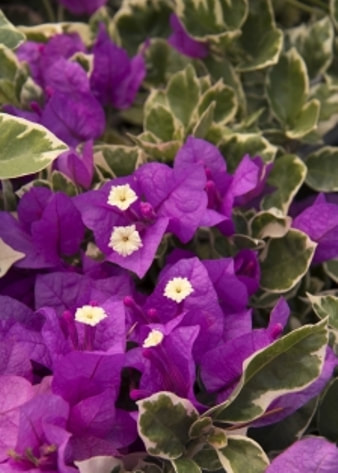 photo credit: DoreenWynja.com for Monrovia ‘Blueberry Ice’ Bougainvillea (shown above) is compact and perfect for small, sunny spaces. The cascading lavender-blue flower-like bracts are offset by its second-best feature - variegated green and white foliage. This tropical will slowly grow 2 to 3 ft. tall and 5 to 6 ft. wide. 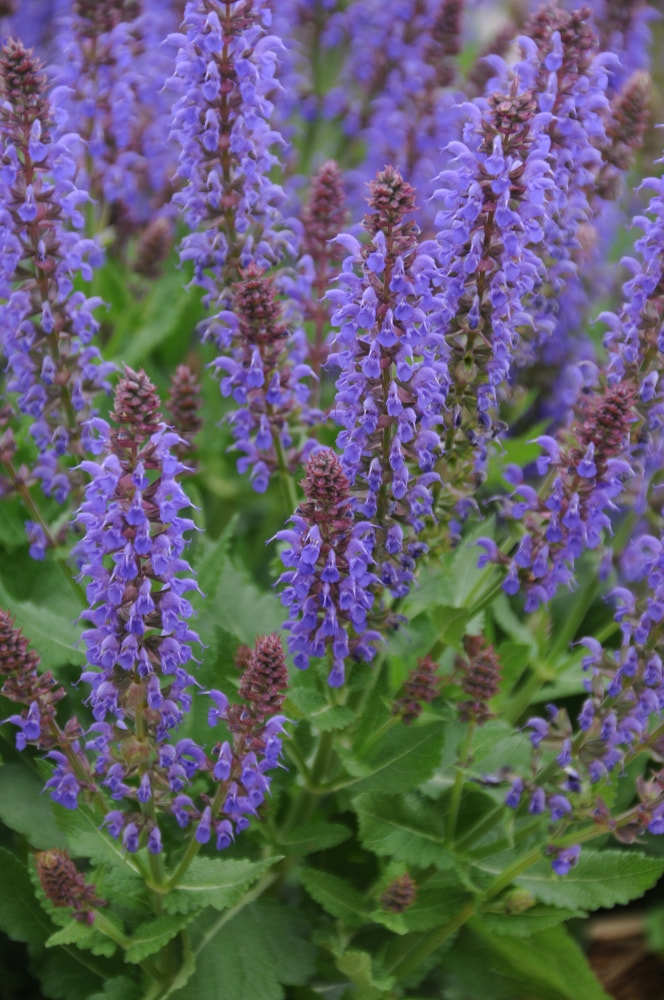 photo credit: Monrovia.com ‘April Night’ Salvia x sylvestris is a new salvia that blooms a month earlier than its relative ‘May Night’. Its longer bloom time of blue-violet flowers and compact, dense habit make it perfect for the garden or in patio containers. ‘April Night’ is hardy in zones 4-10. 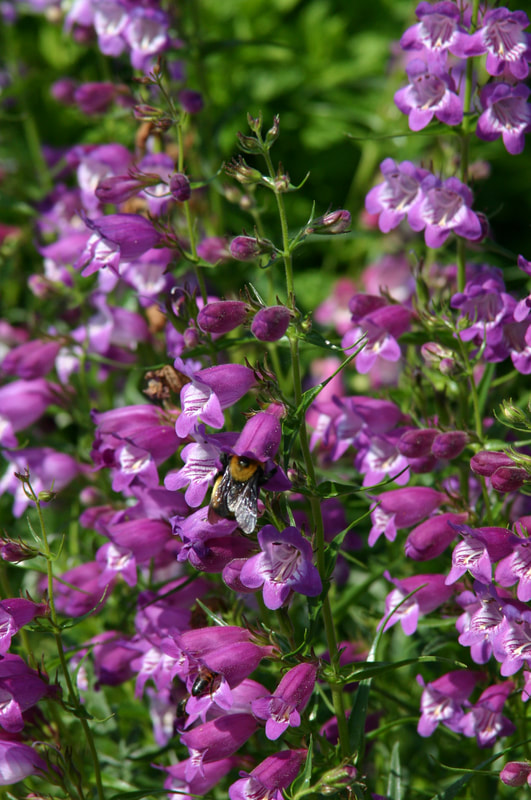 photo credit: plantselect.com ‘Pikes Peak Purple’ Penstemon x mexicali is a hummingbird magnet! The tall spikes of grape-colored, nectar-rich flowers bloom throughout summer. This adaptable and versatile Plant Select® winner will reach 3 ft. tall when flowering, 2 to 3 ft. wide, and is hardy in zones 4-7.
Will we see more originality, ingenuity and visionary thinking as the year unfolds? Will ultra violet live up to its expectations? Let’s be positive and hope that it does. At least we know it will in the garden. Tracy Hankwitz Horticulturist and General Manager of Burlington Garden Center For more 2018 Pantone colors, visit pantone.com .
1 Comment
4/4/2017 0 Comments New Annuals for 2017 Every spring we try to offer new varieties of petunias, geraniums, and other annuals. This spring is no exception. Read on as we share which annuals we are excited about this spring. 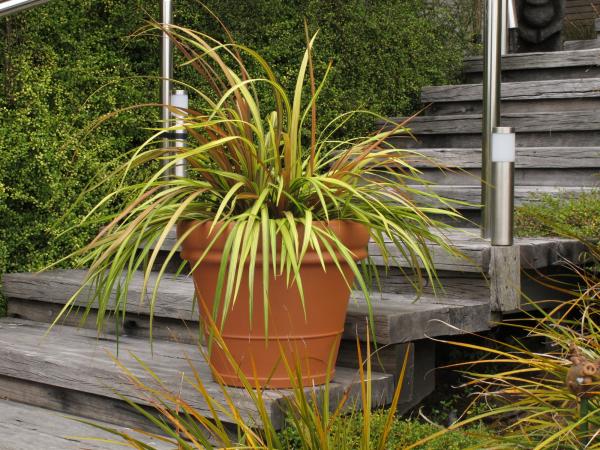 Cordyline ‘Dancing Cha Cha’ known as a Festival grass, grows 3-4’x3-4’ * 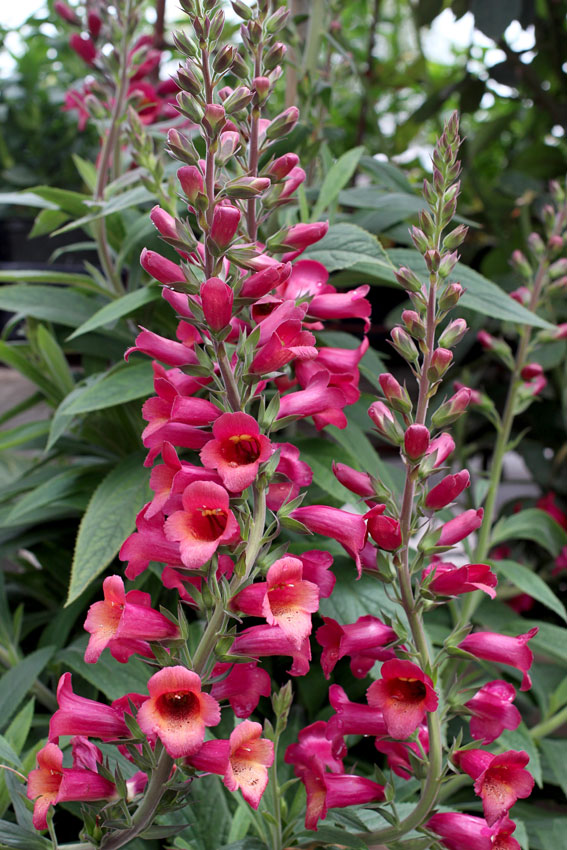 photo source: anniesannuals.com Digitalis ‘Digiplexis Illumination Raspberry’ a cross between the hardy foxglove and the annual ; full sun to pt shade, 20-23” tall, attracts bees and hummingbirds * 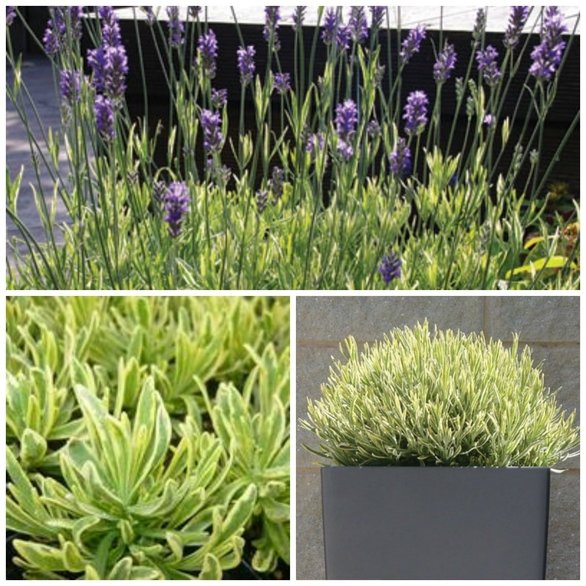 'Platinum Blond’ Lavender full sun, hardy to zone 6, 16-24” tall, attracts pollinators * 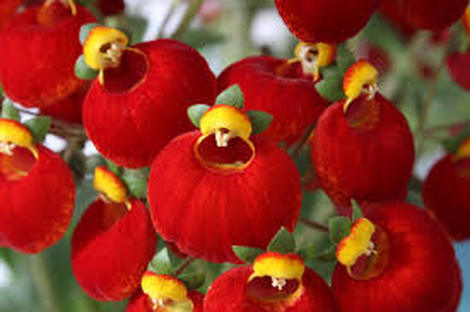 photo source: mastyoungplants.com Calceolaria calynopsis Red (Pocketbook Plant) early season annual, 12", provide part shade for best performance; also available in yellow * 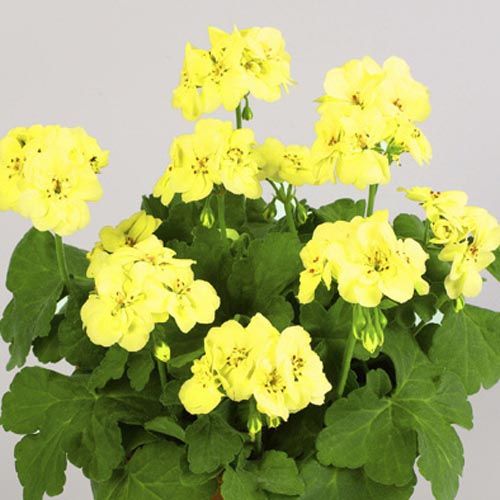 photo source: pinterest.com Geranium 'First Yellow' a true breakthrough, full sun, 15" x 18" * 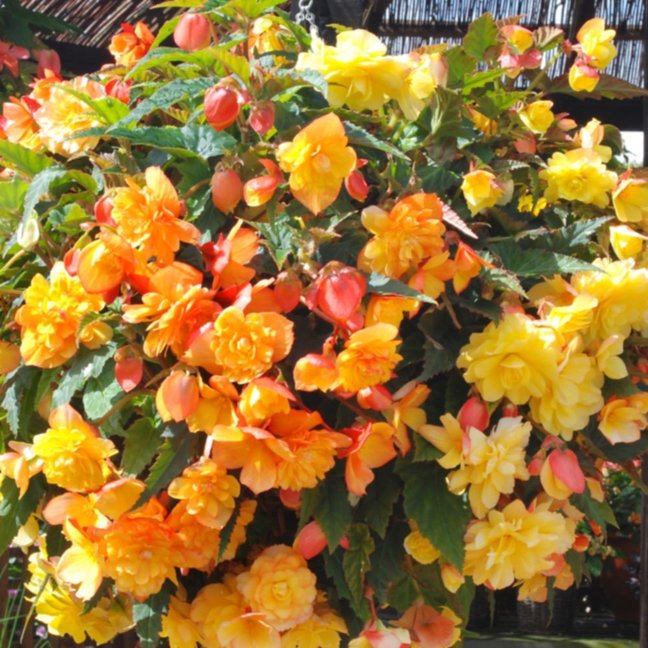 Begonia 'Apricot Shades' from the Illumination series, cascading habit, 12" x 18", part shade, flowers are edible and have a lemon flavor * 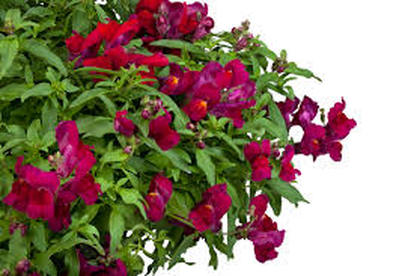 Snapdragon 'Candy Showers Deep Purple' Cascading habit, 8" x 18", perfect for hanging baskets, and is slightly fragrant * 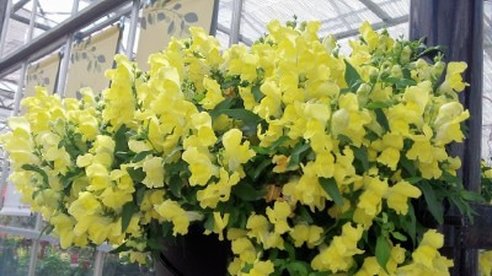 photo source: onlypremiumplants.wordpress.com Snapdragon 'Candy Showers Yellow' heavy flowering, cascading, sun or part shade, heat tolerant * 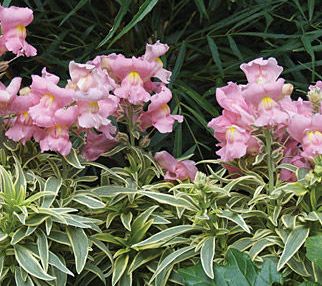 photo source: loghouseplants.com Snapdragon 'Snap Daddy Pink' full sun, heat tolerant, 18-24", good cut flower * 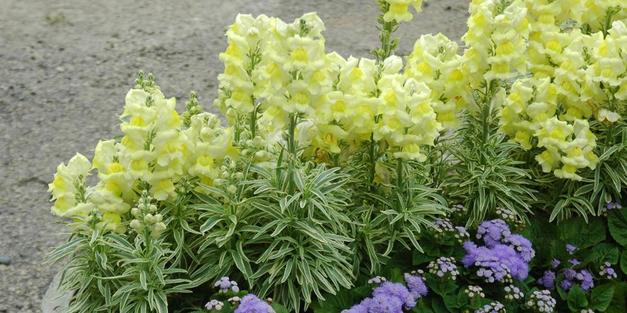 photo source: itsaulplants.com Snapdragon 'Snap Daddy Yellow' full sun, heat tolerant, 18-24", good cut flower * 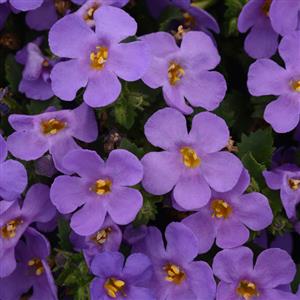 photo source: ballseed.com Bacopa ‘MegaCopa Blue’ large flowers, improved heat performance, 4-6”x12-18”, sun * 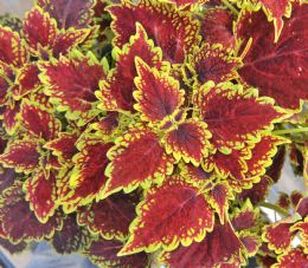 photo source: westwindgardens.biz Coleus 'Main Street Oxford St' cherry red and lime green foliage, 16" tall, part sun/full shade * 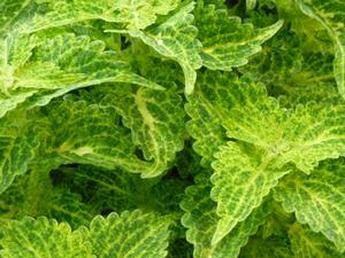 photo source: rushcreekgrowers.com Coleus 'Main Street River Walk' Upright habit, 16" tall, part sun/full shade * 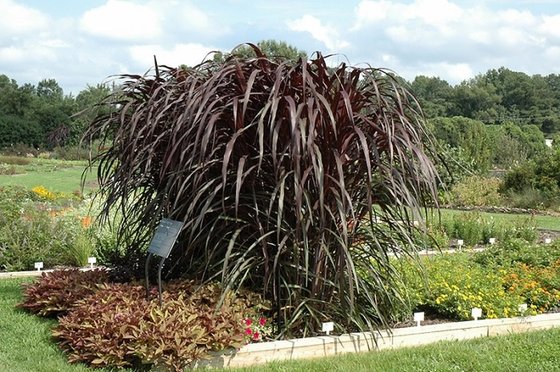 photo source: fermebedardblouin.com Pennisetum 'Black Stockings' fountain grass, 3-4' tall, full sun, black flower plumes * 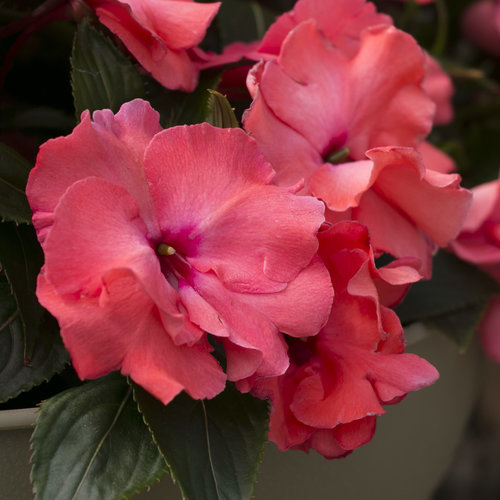 photo source: provenwinners.com New Guinea Impatiens 'Ruffles Peach' Proven Winner variety, part shade/shade, 10-14" * 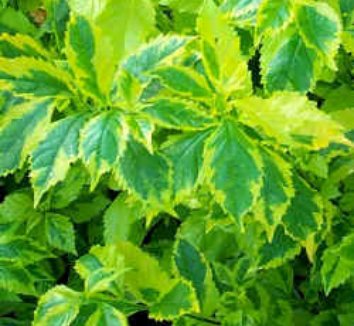 photo source: plantlust.com Duranta erecta 'Golden Edge' tall foliage annual, does best in full sun, has cascading clusters of light blue tubular flowers * 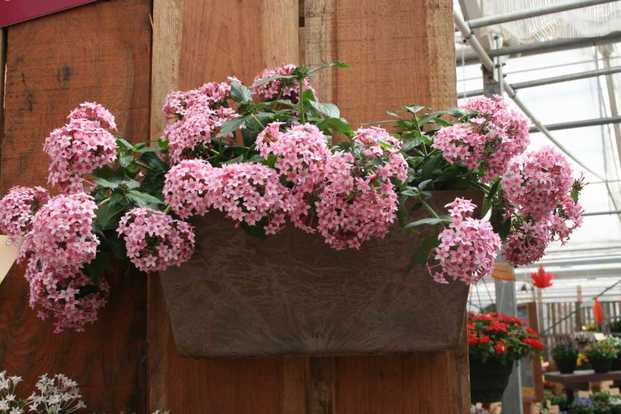 photo source: greenhousegrower.com Pentas 'Falling Star' trailing habit, good for containers, full sun * 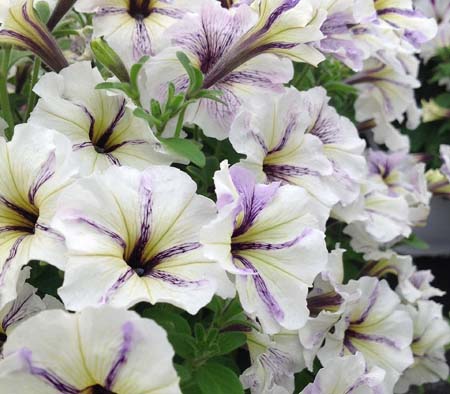 photo source: loghouseplants.com Petunia 'Crazytunia Cloud Nine' 10-15" x 10-12", upright-mounding habit, full sun, heat tolerant * 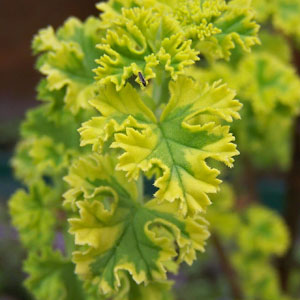 photo source: goodwincreekgardens.com Scented Geranium 'Cy's Sunburst' compact, smaller leaves, part sun, lemon scent, good for topiaries * 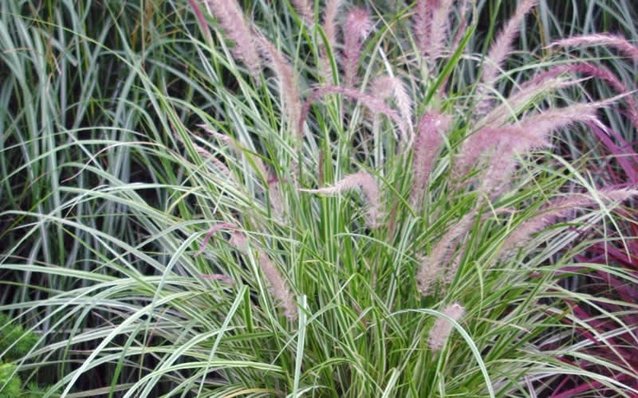 photo source: gardenality.com Pennisetum 'Sky Rocket' full sun, 24-30", Proven Winner, good for containers * 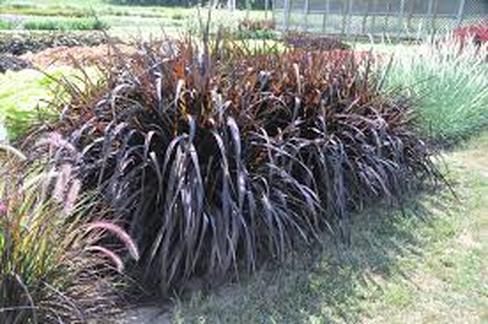 photo source: prairiestarflowers.com Pennisetum 'Vertigo' 4-7'x3', upright annual grass, full sun, Proven Winner * 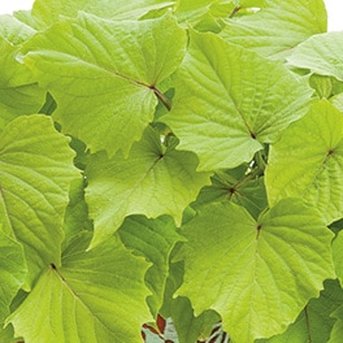 photo source: fourstargreenhouse.com Ipomoea 'Sweet Caroline Bewitch Green with Envy' Proven Winner, great accent in containers, 16" x 18-30", sun or shade but better coloring in the sun * 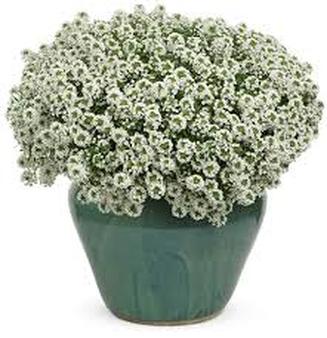 photo source: provenwinners.com Lobularia 'Frosty Knight' Sweet alyssum, part sun to full sun, heat tolerant, fragrant, 6" tall and trails up to 24" * 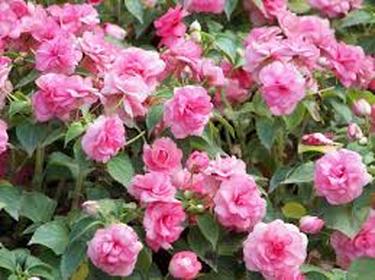 photo source: americanfarms.com Impatiens Double 'Fiesta pink Ruffle' morning sun, afternoon shade, bicolor *  photo source: mastyoungplants.com Stachys 'Lilac Falls' hardy to zone 5, 8-12" x 18"-20", full sun, great for hanging baskets are as a ground cover * 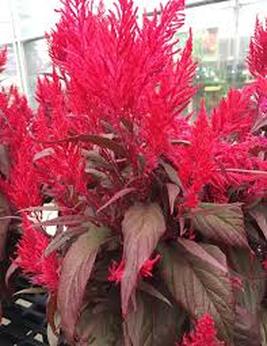 photo source: bordines.com Celosia "Dragon's Breath' full sun, likes the heat, 24" x 16" * 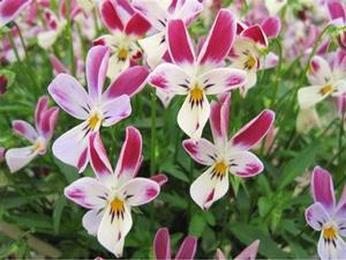 photo source:saundersbrothers.com Viola 'Cranbunny'
5-8" x 5-8", cold tolerant * 3/30/2017 5 Comments Ferns: Awakening the Shade Garden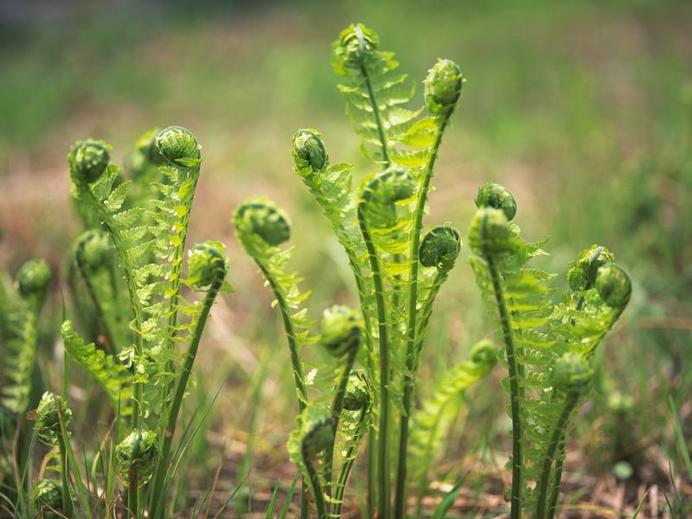 livestrong.com Our focus this spring is 'Renewal' in the garden and what better example of that are ferns unfurling their fronds every spring. Ferns have been a staple in the shade garden for a long time - a very long time. Dr. Oliver Sacks who spent his life hunting for and documenting rare varieties of ferns said the following: ‘Ferns had survived, with little change, for a third of a billion years,'' he notes. ''Other creatures, like dinosaurs, had come and gone, but ferns, seemingly so frail and vulnerable, had survived all the vicissitudes, all the extinctions the earth had known. My sense of a prehistoric world, of immense spans of time, was first stimulated by ferns and fossil ferns.' 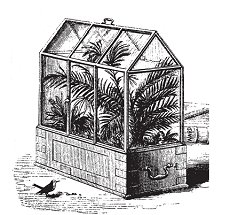 Another interesting part of fern history involves Dr. Nathaniel Ward, a surgeon who lived in London in the early 1800's. Dr. Ward was also interested in botany and entomology. Quite by accident, he discovered that although ferns could not survive the polluted London air, they could thrive under glass. So he made the first terrarium in the early 1800’s for his personal fern collection. His discovery made it possible for English explorers to collect species of plants from around the world and ship them back to London. And the first plants to be successfully shipped? Ferns. So how about you? Do you have a case of pteridomania, also known as fern craziness? We hope you will after reading about the following varieties of ferns. 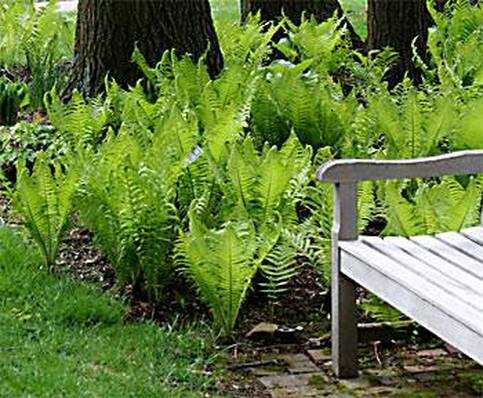 How to Grow Ferns In general, ferns prefer moist soil and part shade to full shade. Ferns are also deer-resistant and rabbit resistant. * 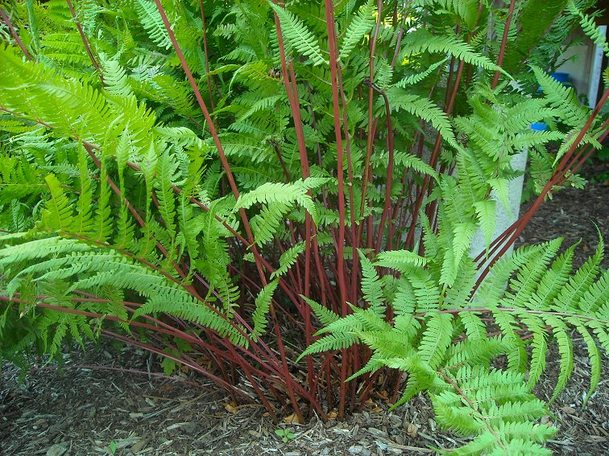 pinterest.com Lady in Red (Athyrium) •Tolerates dry soil as well as full sun in moist soil • Grows 18-30” tall * 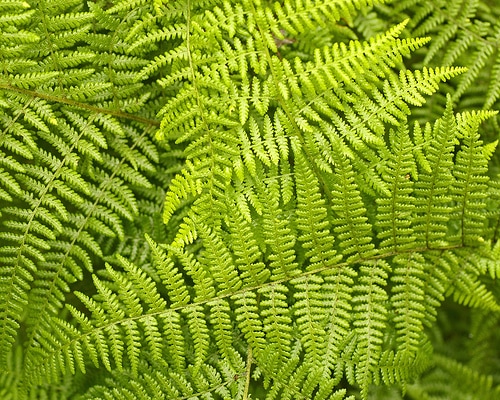 gardenguides.com Lady Fern (Athyrium felix-femina) Grows 2-3’ x 2-3’ * 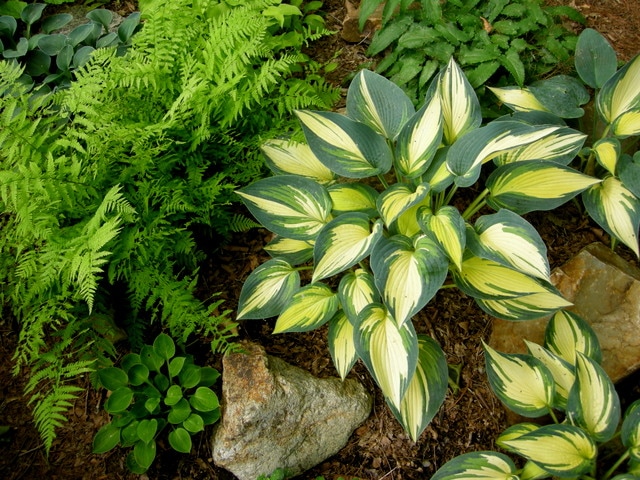 carolynsshadegarden.com Ferns pair well with the broad leaves of hostas. In the photo above, Hosta 'Remember Me' and a miniature hosta give a nice contrast with the Lady Fern. * 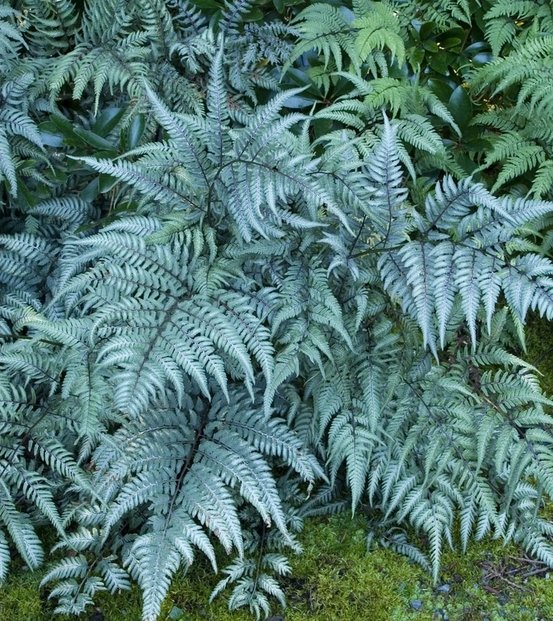 monrovia.com Japanese Painted Fern (Athyrium niponicum) Grows 18” tall and has silver foliage with hints of burgundy. * 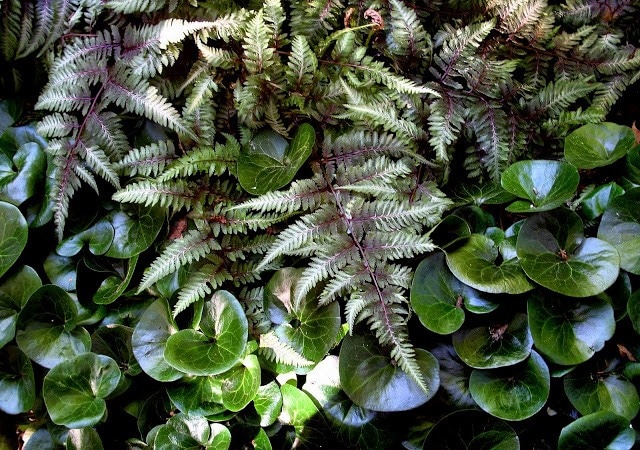 cottonarboretum.com Pair the Japanese Painted Fern with the glossy, broad leaves of Wild Ginger (Asarum canadense), a groundcover for the shade. * 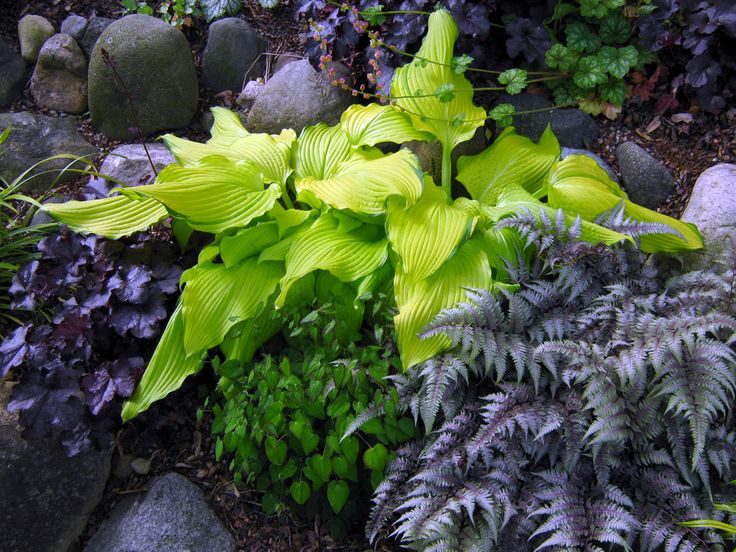 Try this great shade combination: (from left to right) dark leaf Heuchera, chartreuse hosta, Epimedium, and Japanese Painted Fern. * 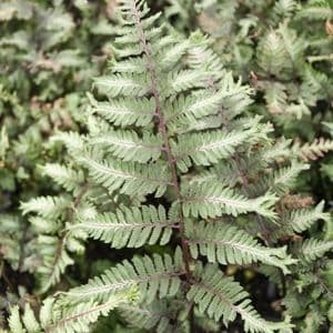 gardencrossings.com Japanese Painted Fern ‘Apple Court’ Fern with crested tips, grows to 12" tall. * 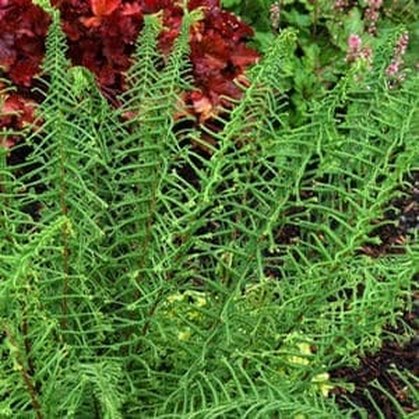 gardencrossings.com Dre’s Dagger Also known as Victorian Lady Fern, 'Dre's Dagger' is sport of Athyrium filix-femina. It is compact at 18" tall and wide and has upright stems. * 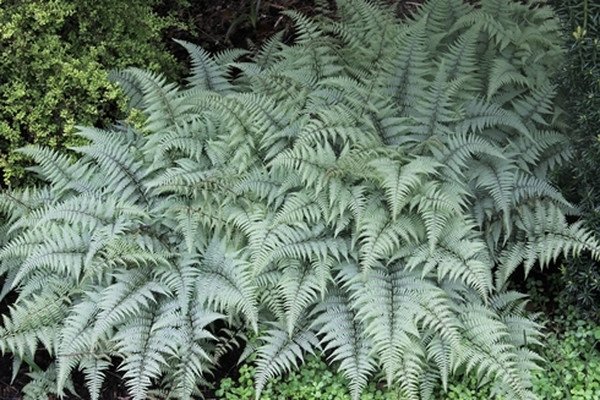 plantdelights.com ‘Ghost’ fern 'Ghost' is a cross between Japanese Painted Fern and the Lady Fern and grows 30” tall. * 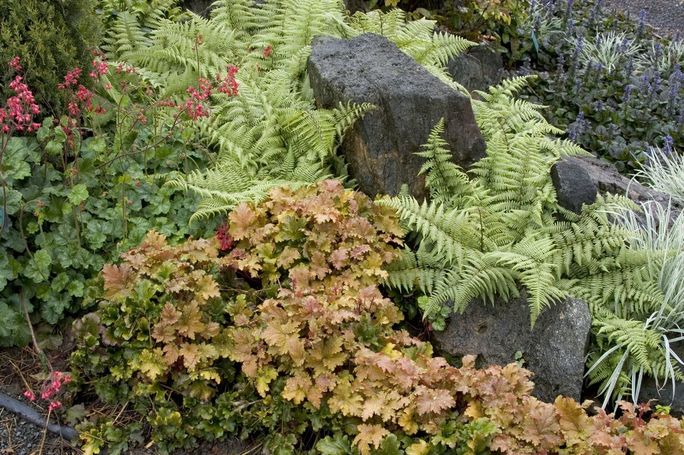 Monrovia.com An interesting combination for part shade: two varieties of Heuchera with 'Ghost' fern and blue blooming Ajuga. * 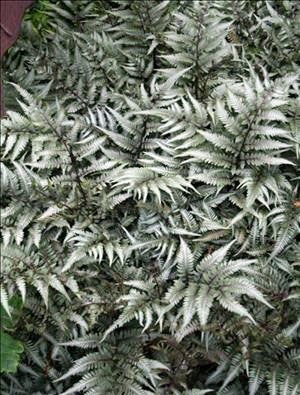 plantdelights.com Athyrium ‘Godzilla’ 'Godzilla' is a Japanese Painted Fern on steroids! It grows 3' tall and 4-6' wide. 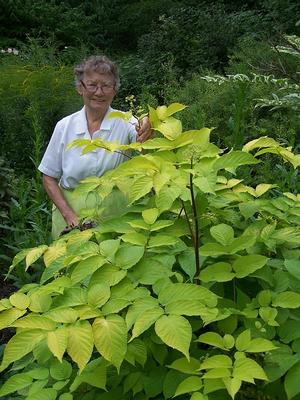 Quackingrassnursery.com Have fun with 'Godzilla' by pairing it with the large-growing 'Sun King' Spikenard (Arelia cordata shown above). * 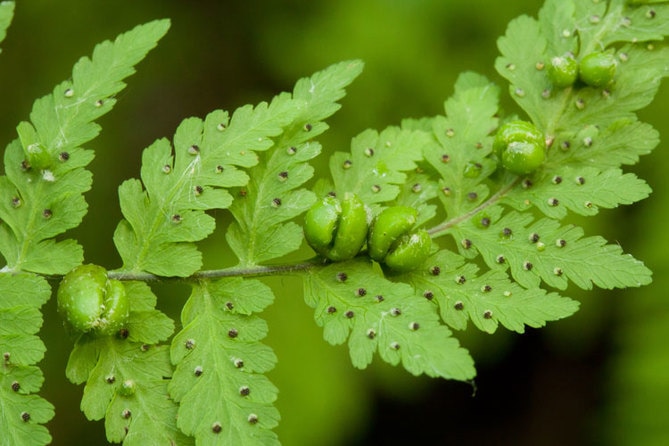 dixinary.com 'Bulblet' Fern (Cystopteris) Grows 12” tall x 24” wide It forms small bulblets in late summer that drop to the ground and grow new plants. * 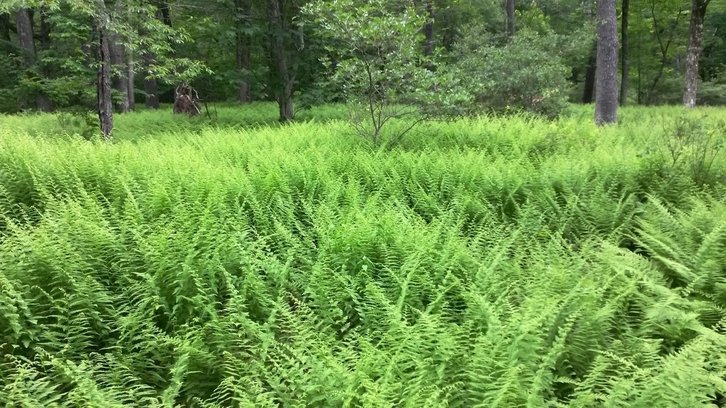 pinterest.com Hayscented Fern (Dennstaedtia punctilobula) This native fern grows 2’ x 3’. The fronds release a fragrance reminiscent of fresh mown hay when brushed with a hand, crushed or bruised. As a bonus, the fronds turn yellow in fall. * 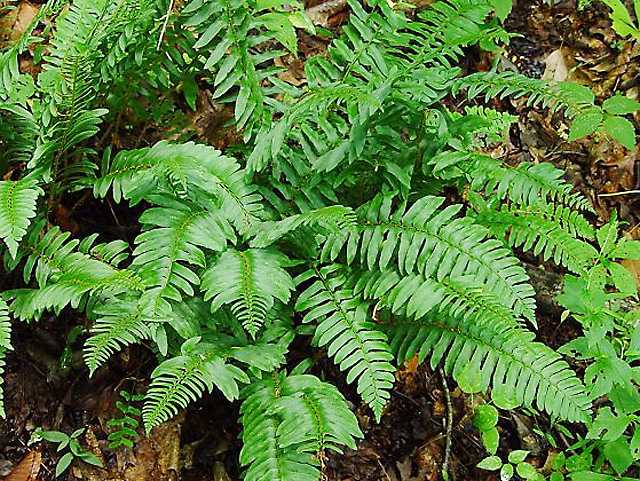 pinterest.com Christmas Fern (Polystichum acrostichoides) This dark green fern is called the Christmas fern for two reasons: in some zones it stays green at Christmas time and secondly, the pinnae are shaped like stockings. It grows 2’ tall and because it is native to North America it thrives in dry and moist wooded areas. * 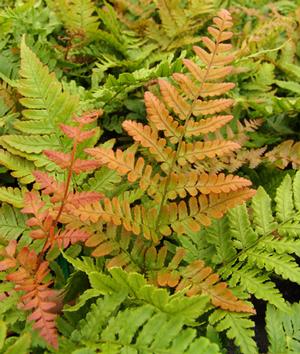 northcreeknursery.com Autumn Fern (Dryopteris erythrosora 'Brilliance') Grows 18" tall and wide in moist shade. * 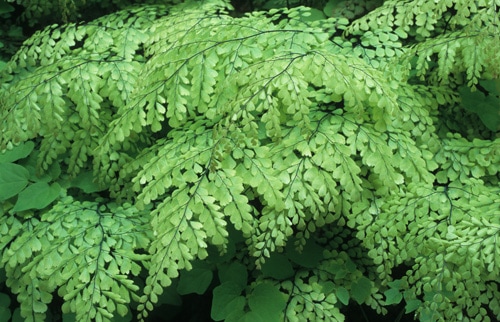 greatplantpicks.org An elegant lacy fern on black stems, this pretty Himalayan Maidenhair Fern is hardy to zone 4 and grows only 12" tall. * I'll close with a few landscaping ideas with ferns. 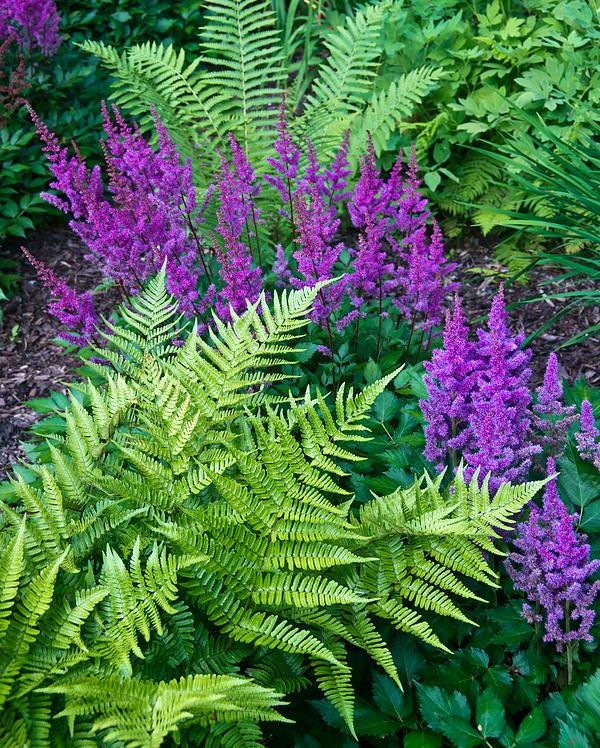 pinterest.com 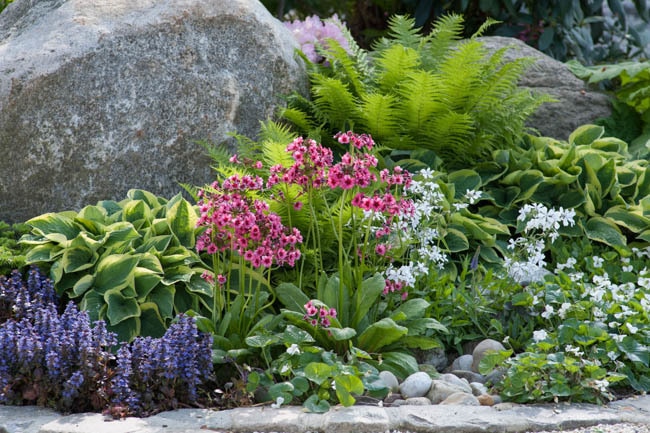 gardenia.net - Tracy Hankwitz Burlington Garden Center Horticulturist 3/16/2017 0 Comments Wake Up the Garden Wake Up the Garden
Saturday, March 11, 2017 Burlington Garden Center What to do in the garden in March & April to get your garden off to a great start and save time later. Vegetable Garden
Perennial Beds
Trees & Shrubs
Fruit Trees
Lawn
9/7/2016 1 Comment The Versatility of Sedum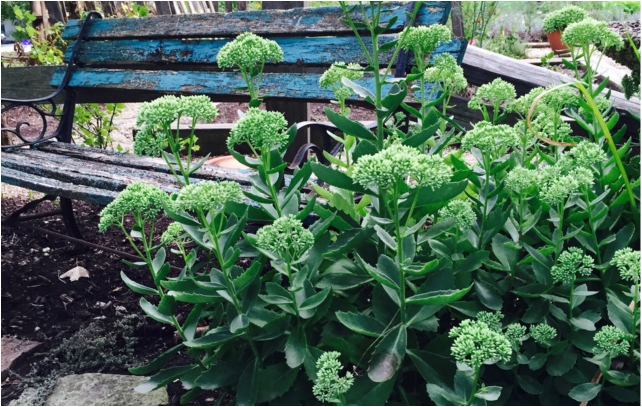 Happy fall! As we wait for autumn to put on it's magnificent show in full color, I've been contemplating the versatility of a rather common perennial - sedum. Although found in almost every back yard, upright sedum, also known as border sedum, has so many things going for it. It is easy to grow and it is not demanding. The sedum family in general doesn't need much water or much of your time. It's easy to propagate, and transplants well. It's a staple in the perennial garden, just hanging out rather unassumingly until fall, when it turns from lime green to shades of pink, red, and rust. This year I've begun to notice it more - appreciating it's clean, well-behaved habit in spring, admiring the lime green hue all summer, and enjoying it's transformation as it takes on it's fall color. 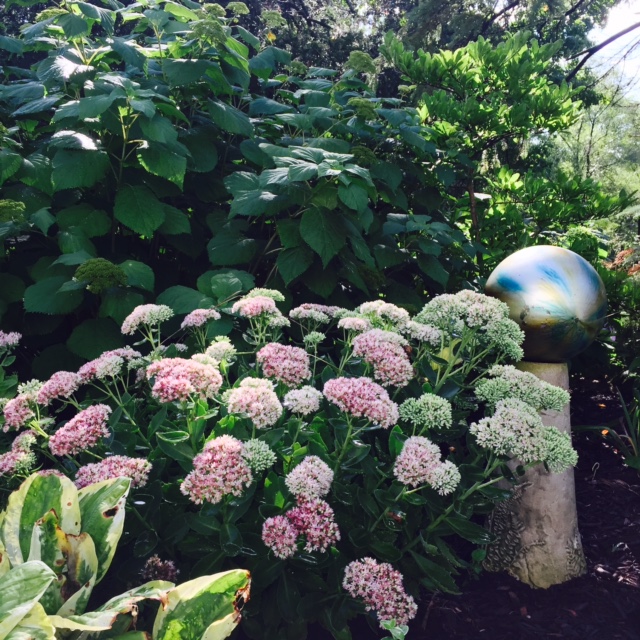 I've also been noticing how it goes with just about anything in the garden making it a versatile plant in the landscape. It mixes well with shrubs like this hydrangea above. Even next to the broad leaves of the hosta (even though flawed), it provides a contrasting texture in a part sun/part shade location. 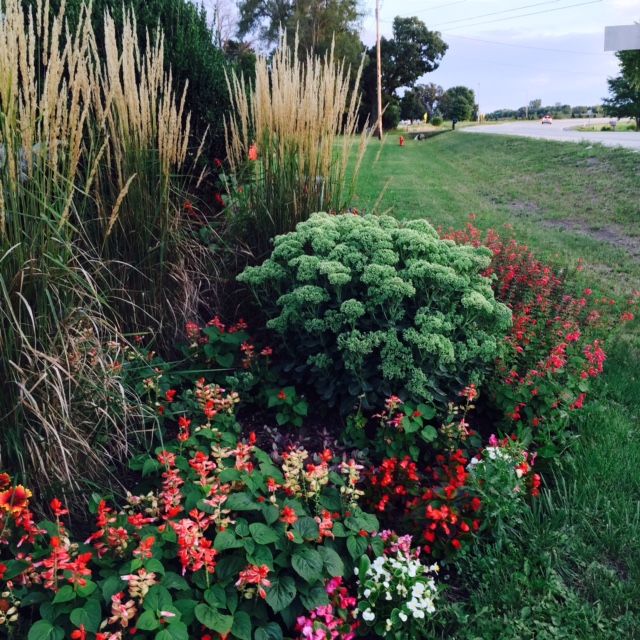 Here at Burlington Garden Center, it's planted with it's typical fall partner - 'Karl Foerster' Feather Reed Grass (photo above), but looks attractive all summer when skirted with red-flowering annuals. 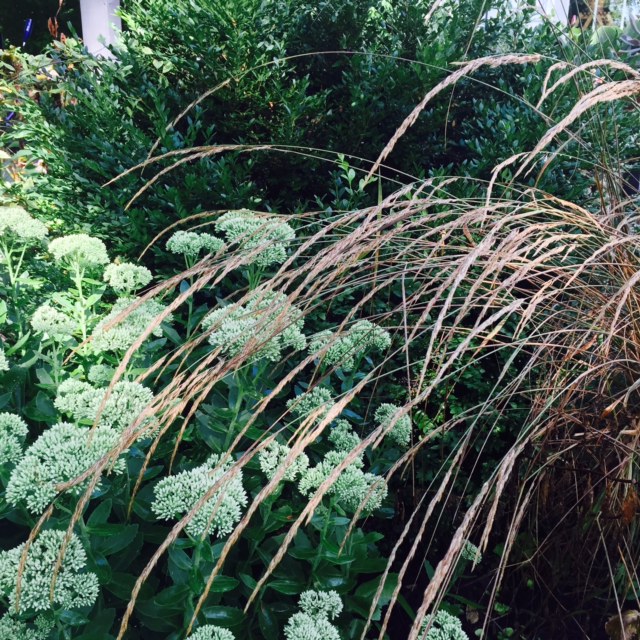 I love all the texture in the photo above provided by boxwood, sedum, and another 'Karl Foerster'. * The foundation planting below is a drift of sedum, Miscanthus 'Adagio' ornamental grasses, hardy geranium, and black-eyed susans. Instead of planting just one clump of sedum, several were planted together to balance the other plantings and the wide front porch. 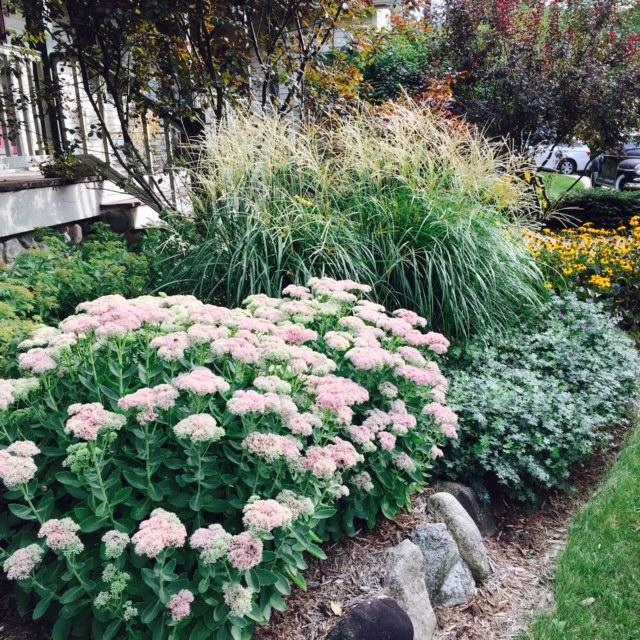 One of my favorite compositions in my yard is in the photo below. I've been watching it all spring, summer, and now fall and am enjoying the changes in color with each season. Conifers, like this weeping blue spruce, is a good match for sedum. 'Coppertina' Ninebark, 'Shenandoah' Switch grass, 'Autumn Leaves' coral bells, and a pot of annuals complete the colorful scene. 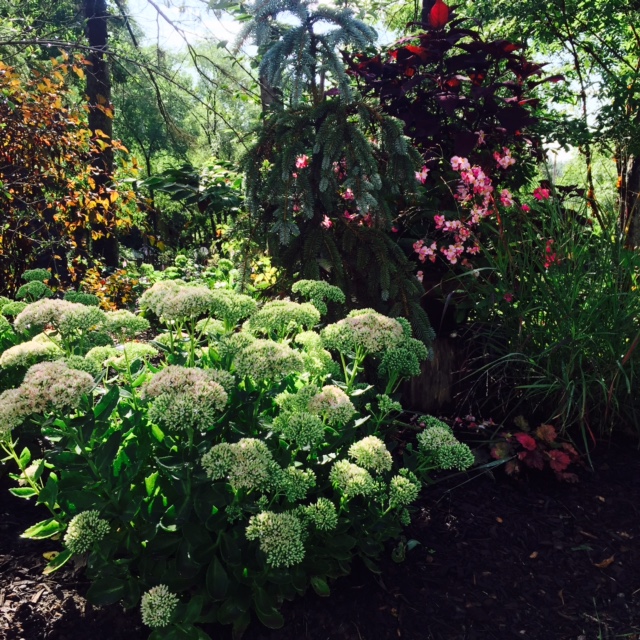 Sedum can even stand alone like it does in the very first photo next to the blue chippy bench. It can compliment a planting of coneflowers and daylilies. It plays well with just about any plant in a spot with at least 4-6 hours of sun. If you don't have a clump or two of sedum in your yard, consider adding it to your cart the next time you visit the Burlington Garden Center. * Learn more about the versatility of sedum in 'The Plant Lover's Guide to Sedum' by Brent Horvath. Pick up your copy here at BGC! 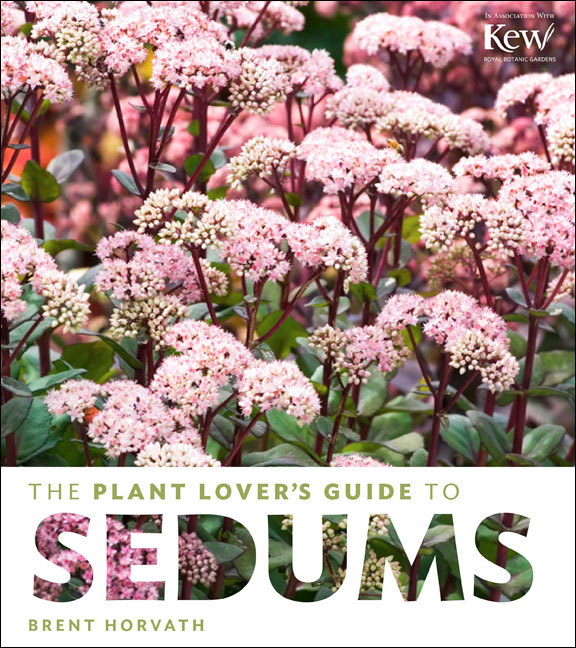 Happy planting!
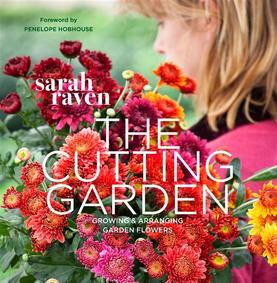
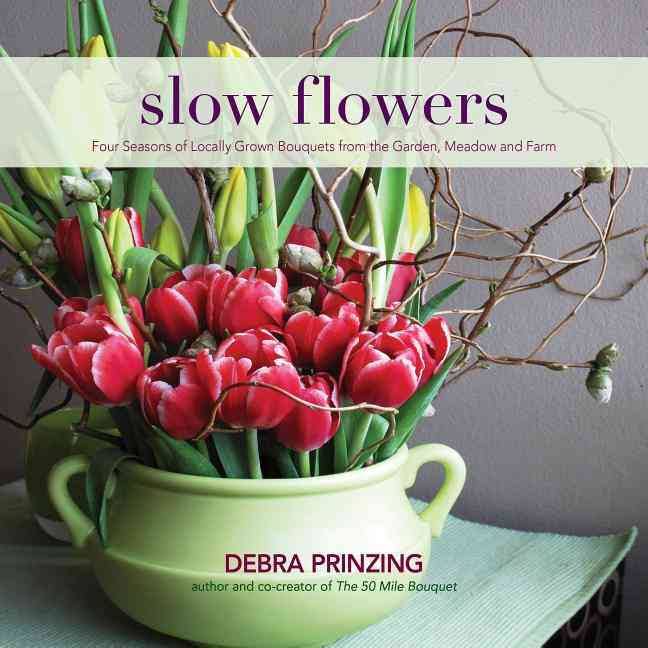
Tracy Hankwitz BGC Store Manager & Horticulturist  Lately there’s been a lot of buzz about pollinators. Over the last few years, awareness has grown of the important role they play in our daily lives. At the same time, we are seeing a decline in population due to many causes including the misuse of pesticides and loss of habitat. Bees are the most well-known pollinators with honey bees, bumblebees, and mason bees topping the list. But there are approximately 4,000 different species of native bees that also pollinate our plants. In addition, birds, butterflies, and bats also carry pollen from one plant to another aiding in the pollination of 75-90% of flower and food crops. That calculates to one out of every three mouthfuls of food we eat and beverages we drink is thanks to the work of pollinators. Think of that the next time you eat an apple, pepper, squash, or even chocolate. So knowing their importance as well as their struggles, what can we do to help the pollinators? Enter the Million Pollinator Garden Challenge. This nationwide call to action is designed to preserve and create garden spaces, big and small, that help revive the health of pollinators. Several non-profit organizations have formed the National Pollinator Garden Network and have a goal to register one million public and private gardens that support pollinators. You can be one of them! Here’s how: - Plant a Pollinator Garden. Use plants that provide nectar and pollen. A few that attract pollinators are asters, bee balm, butterfly weed, coneflower, lavender, and yarrow. Native perennials to grow are Joe Pye Weed, Liatris, and Penstemon. - Provide a water source. - Sunny areas with wind breaks. - Establish continuous blooms using perennials supplemented with annual flowers. - Plant a large area with native perennials and shrubs. - Minimize pesticide use. - Register your garden at www.millionpollinatorgardens.org. From a small planted container on a balcony to a five acre field planted with plants for pollinators, each of us can ‘BEE one in a million’. All you need to get started is a list of pollinating plants and you're on your way! Tracy Hankwitz Horticulturist and Store Manager of Burlington Garden Center 5/15/2016 0 Comments The Year of the Begonia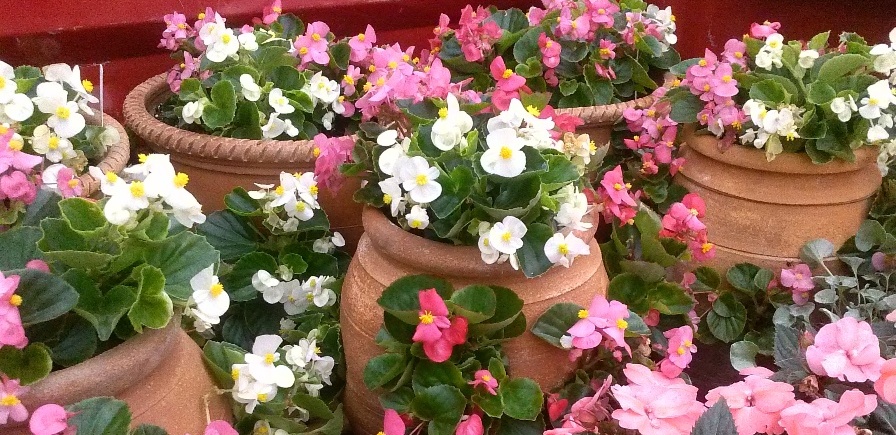 2016 has been declared the Year of the Begonia by the National Garden Bureau. We're so glad! Begonias are one of our favorite annual crops to grow here at BGC and according to our customers, we have the best ones in the area. There are over 1,700 different species of Begonias. With all the various types of Begonias, there are so many to choose from that it is often hard to decide which one to try. Following is a brief run-down of the different varieties we are growing this spring. Other than the rather common wax begonias (shown above in those fabulous strawberry jars), Non-stop tuberous begonias are probably most well-known. Non-stop begonias, with their large blooms in vibrant hues, provide a bright punch of color in a shady spot. In addition to the Non-stops, there are new series of tuberous begonias being introduced every year. Newcomers in our greenhouse include 'Pink Halo' and 'Unstoppable' Upright Fire. 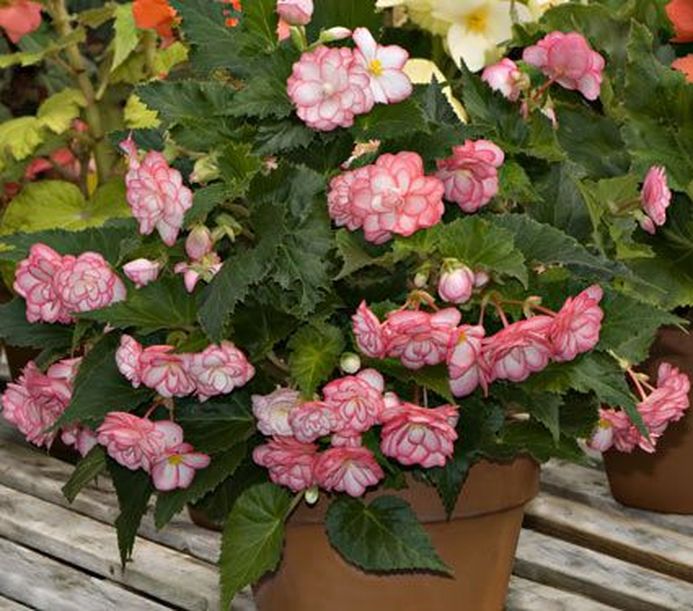 'Pink Halo' photo source: whiteflowerfarm.com 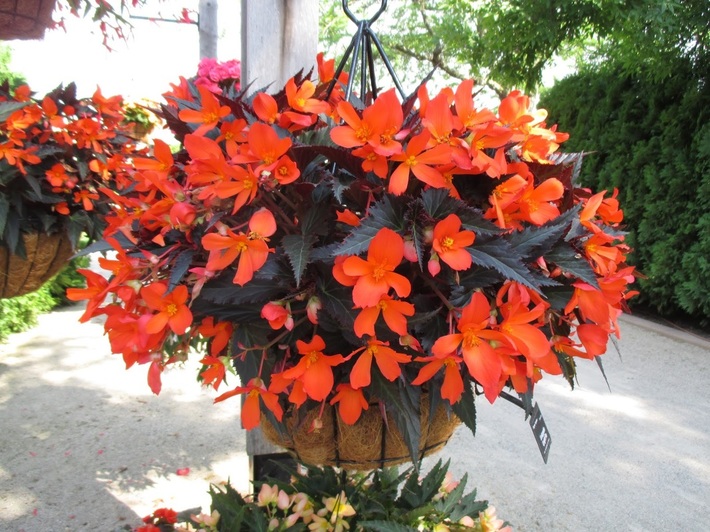 'Unstoppable Upright Fire' photo source: rotarygardens.blogspot.com * Those making a return appearance are 'Miss Montreal', 'Elegance', 'Devotion' (a more pink version of Elegance'), 'Sparks Will Fly' and 'Cherry Bon Bon'. They are lovely in hanging baskets and container gardens. 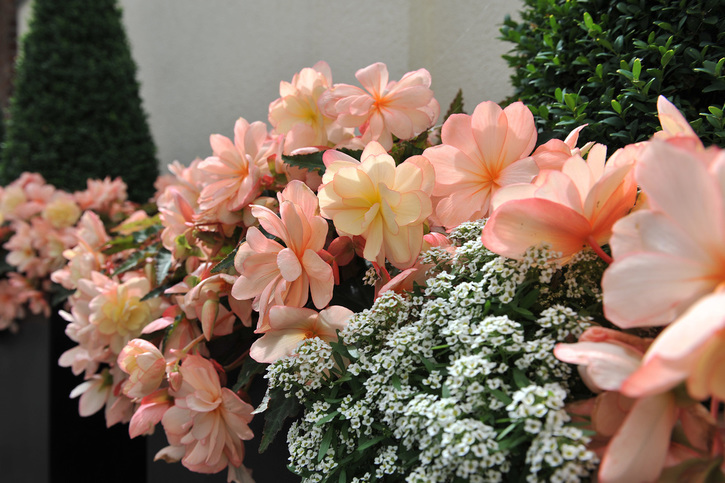 'Miss Montreal' photo source: nationalgardenbureau.com 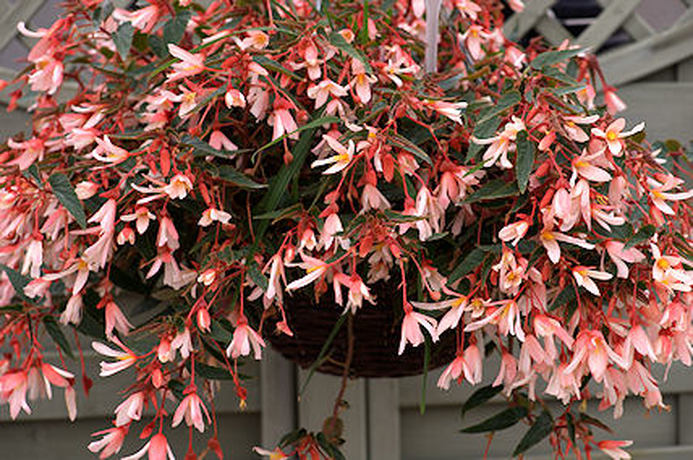 'Million Kisses Elegance' photo source: nickysnursery.wordpress.com 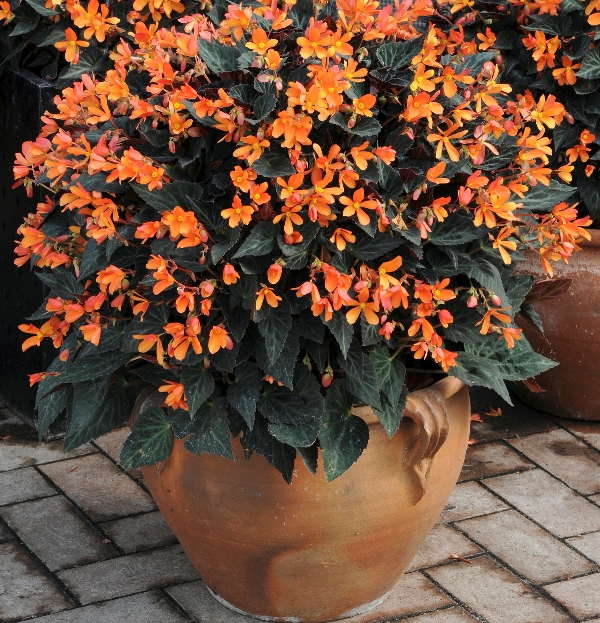 'Sparks Will Fly' photo source: nationalgardenbureau.com Looking for a heat tolerant begonia that brings continuous blooms? The boliviensis series looks stunning in a large container or hanging basket. Our favorites are quickly becoming your favorites: 'Santa Cruz Sunset', 'San Francisco', and 'Pink Glow'. 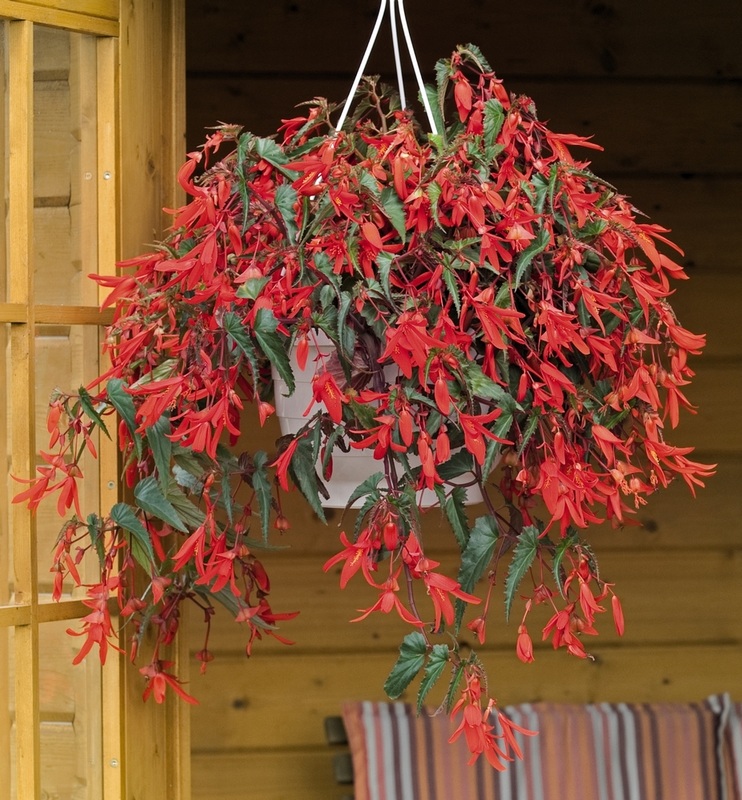 'Santa Cruz Sunset' photo source: nationalgardenbureau.com 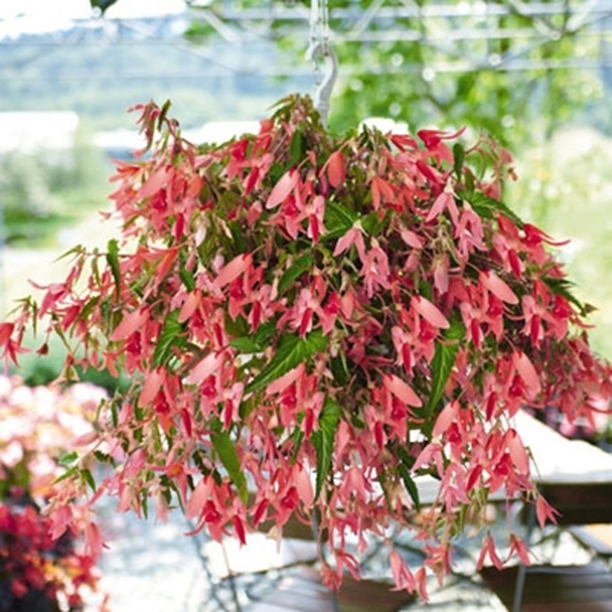 'San Francisco' photo source: harrisseeds.com 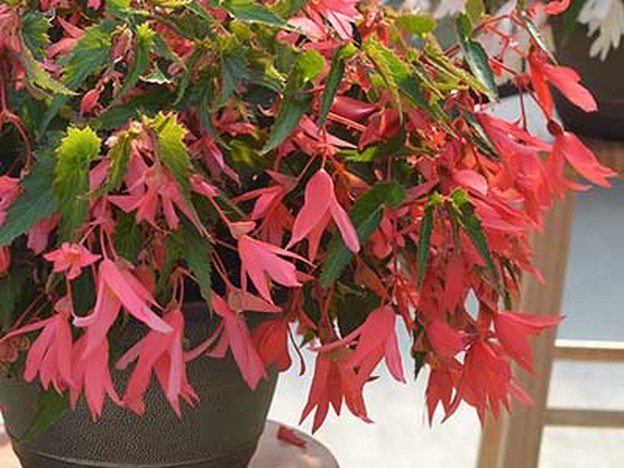 'Pink Glow' photo source: egmontseeds.co.nz. * Of course we can't forget the begonias known for their interesting leaves. Rex Begonias have bold patterned foliage that are perfect for adding color and texture to any container. They make wonderful houseplants once their watering needs have been mastered. 'Sophia', 'Gryphon' (shown below with silver foliage), and 'Escargot' are among the Rex Begonias found in our greenhouses this spring. 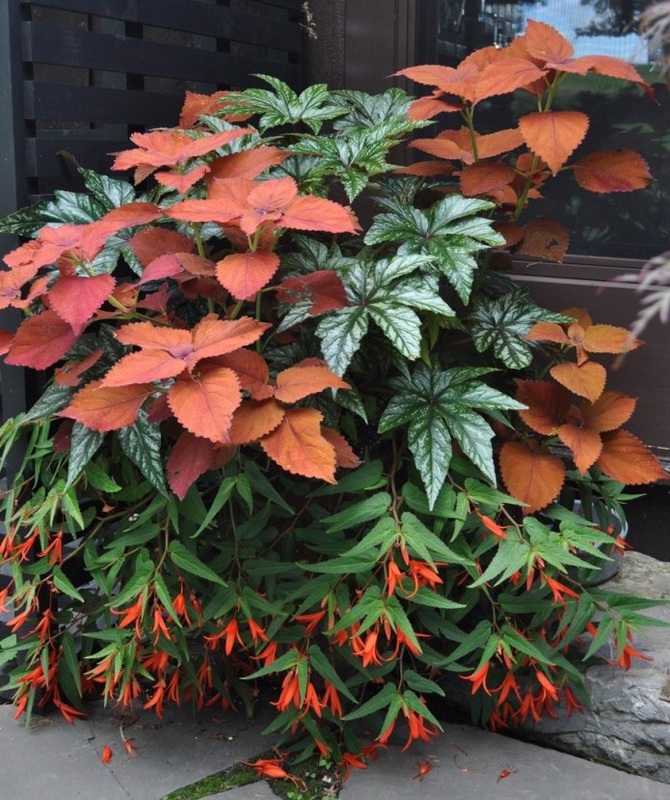 * Another series of hybrid Begonias that thrives all season with continuous blooms is Dragon Wing Begonia which is an AngelWing Begonia. AngelWings are go-to plants that give an outstanding performance in full sun or full shade. 'Dragon Wing Pink' is shown below. 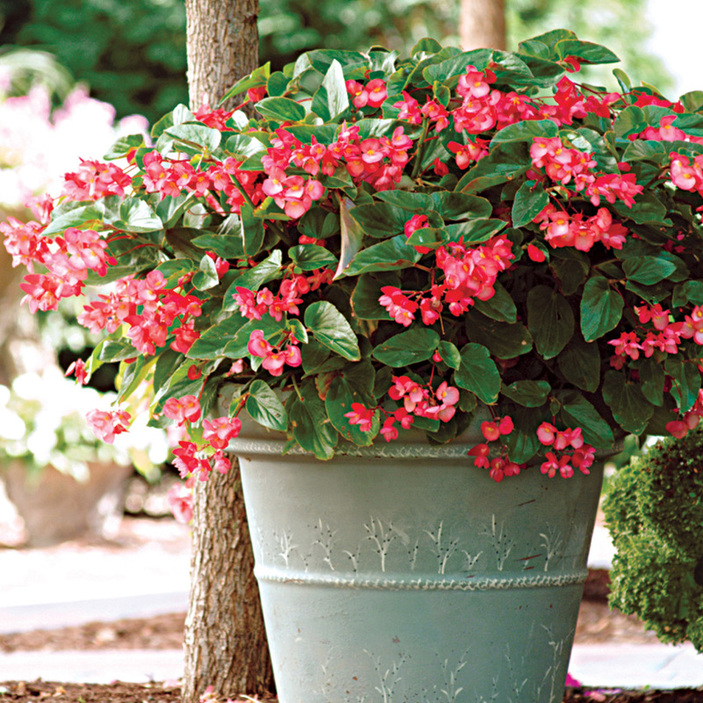 photo source: parkseed.com * Claiming to be the easiest annual you'll ever grow, we believe it! The BIG series can be grown in full sun, full shade, and everything in between. It's drought tolerant (aka it will be fine if you miss a watering), and like other begonias - no deadheading required. Choose from BIG Rose w/Bronze Leaf, BIG Red w/ Bronze Leaf, and BIG Green Leaf. 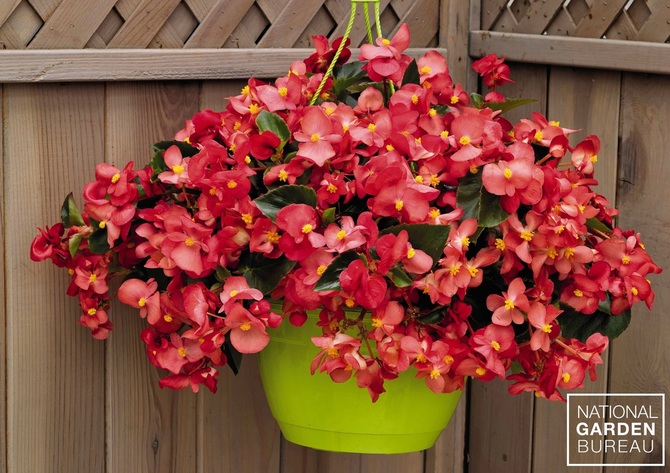 BIG pink w/ green leaves photo source: nationalgardenbureau.com 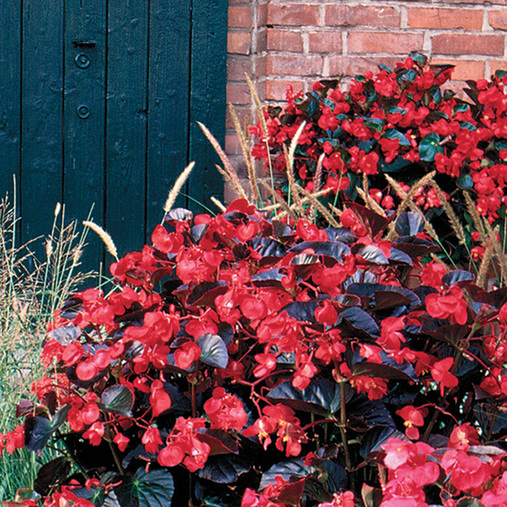 BIG Red w/ Bronze Leaf photo source: parkseed.com Come see all the varieties filling the greenhouse. Bet you can't leave without one. Happy planting! Tracy Hankwitz BGC Store Manager 4/27/2016 0 Comments The Cutflower Garden - Annuals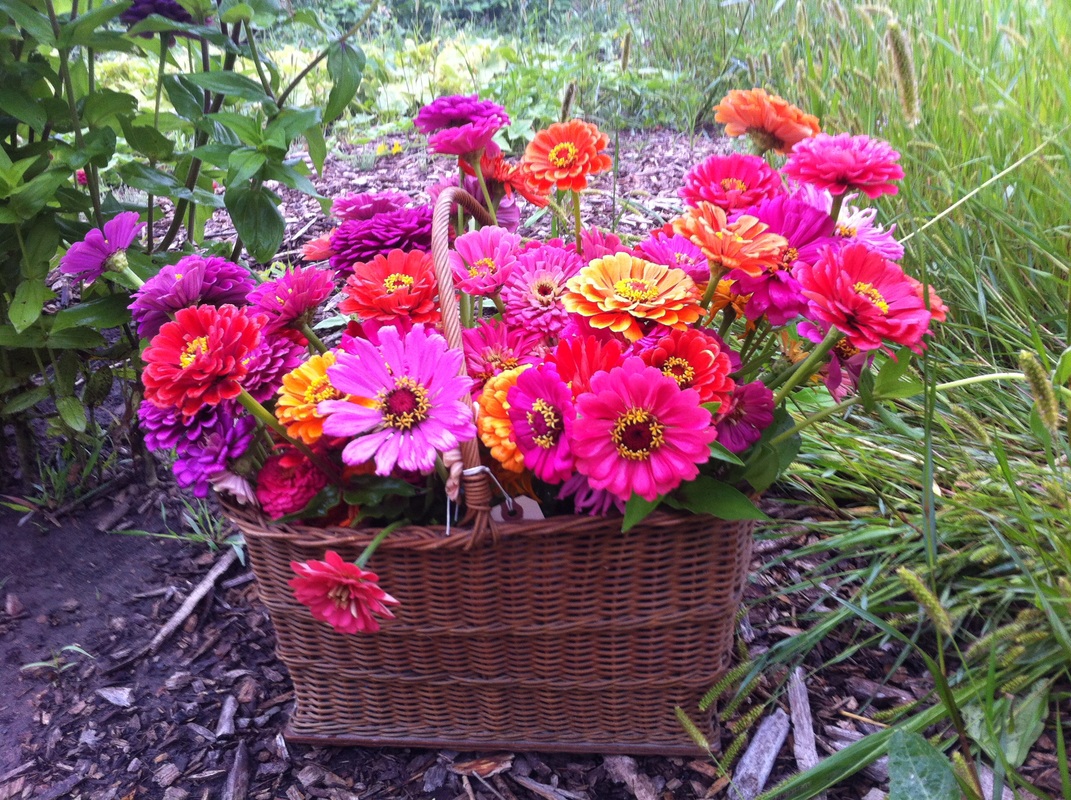 'I must have flowers, always and always' - Claude Monet Ok, confession time. If I could have, I would have been a flower farmer. Something about growing flowers, cutting flowers, and breathing flowers 24/7 compels and calls. Maybe it's in my blood - Tracy means 'harvester' and my maiden name, Bauer, means 'farmer'. Why not farm flowers? I know it's hard work, but the payoff? Imagine armfuls of beautiful blossoms arranged into gorgeous, breathtaking bouquets . . . Who knows, I'm only 47 - it could still happen. Until then, I'll be content to grow a few flowers for cutting in my small garden. Following are annuals that make wonderful cut flowers: 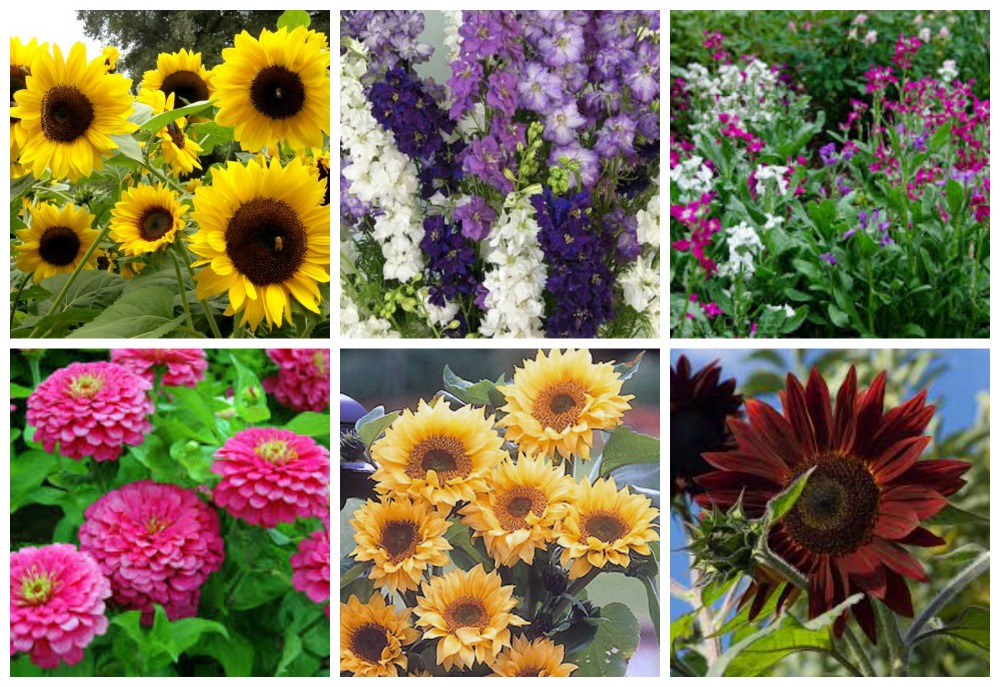 photo sources: pinterest.com, reneesgarden.com, hedgerowroses.com, gardeningknowhow.com, genesisgardens.net GROW FROM SEED: Many cutting annuals are easy to grow from seed, like those pictured above. From top left: 'Sundancer' Sunflower is early blooming, multi-branching and vigorous at 4 ft; 'Singing the Blues' Bouquet Larkspur are tall and graceful in the garden and in the vase; 'Fragrant Ten Week Stock' is the best branching variety with double flowers and a spicy-sweet fragrance; Bottom left: Zinnias - an endless selection available and every garden should have some - so easy to grow; 'Moulin Rouge' Sunflowers grow taller (6') but those rich velvety red flowers are pollenless and a must have for late summer & fall bouquets; 'Peach Passion' Sunflower is another pollen free, multi-branching sunflower standing 3-4'tall in the garden. And fortunately, we have all of them available in seed packets here at BGC. 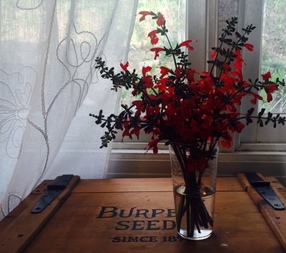 IN THE GREENHOUSE: Sometimes it's easier to let others start the growing process. I have my eye on the following cutting annuals growing in the greenhouses here at BGC: Salvias 'Faye Chapel' and 'Black and Bloom' are especially nice; snapdragons, Dahlias, Gaura, and Agastache are a few more among many. OTHER MUST-HAVES: Dahlias of all kinds, sweet peas, Ranunculus, and Lisianthus. Bulbs planted in the fall make lovely spring bouquets. Daffodils, tulips, hyacinths and grape hyacinths top the list. A few great resources . . .
Happy planning and happy planting!
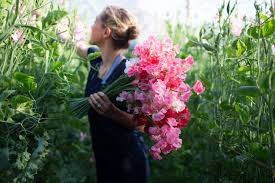
Tracy Hankwitz Horticulturist & Store Manager at Burlington Garden Center and flower farmer wannabe Watch for Part 2: The Cut Flower Garden - Perennials & Shrubs 4/8/2016 0 Comments Planting Sweet Peas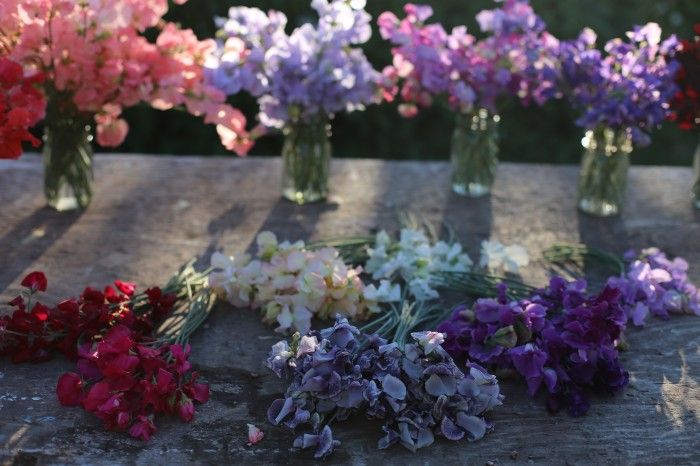 photo source: floretflowers.com Imagine armloads of sweet peas in a palette of watercolors and the intoxicating fragrance filling the room. Mmmmmm, I'm totally wanting to be there in that sweet world. So much so that I was out last night in the dark, prepping the bed and tucking seeds into the earth. * Here's how to grow your own sweet peas: 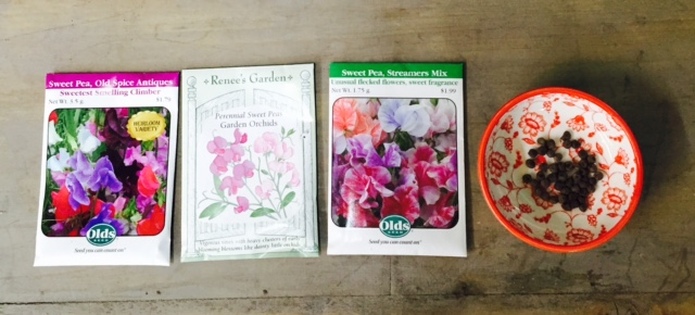 Seeds can be started indoors but they are easy to sow directly in the garden. They have a hard seed coat, so a soak in water for 8-10 hours before planting will speed up germination. Or nick the seed coat with a nail clippers. * While they are soaking, head outside to prepare the site. Choose a sunny spot (a little afternoon shade wouldn't hurt). Sweet peas are heavy feeders so it's important to amend the planting area. Work in compost or well-rotted manure (I used Purple Cow Compost), and a slow-release, natural fertilizer ( Happy Frog's All purpose is a good one). I also add a light dusting of bonemeal to provide an extra boost of phosphorus. Turn all the amendments under and mix well into the soil. Plan to fertilize the hungry sweet peas weekly, or at least twice a month with fish emulsion or compost tea. 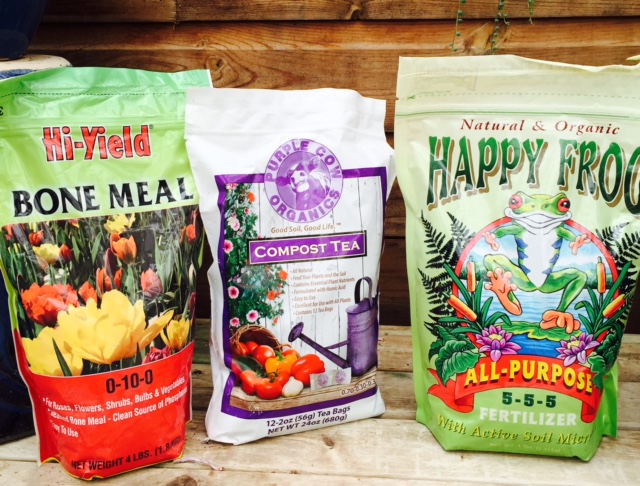 Sweet peas are climbers and will need a sturdy trellis to climb. Use garden netting or chicken wire between posts. Or try this fun, natural method: 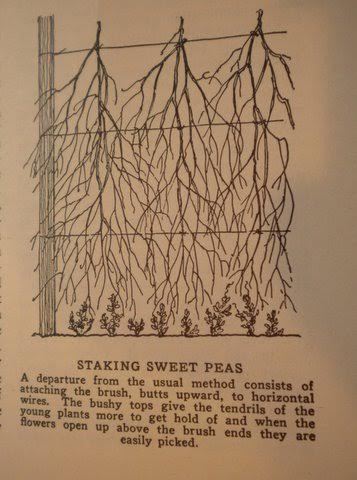 source: Wise Garden Encyclopedia Plant seeds/seedlings in two rows, one on each side of the trellis, 6-8" apart, 1 " deep. Then watch them grow! * Remember, the more you pick, the more you get! Prolong blooming by deadheading. Better yet, pick these sweet-smelling beauties to enjoy in a vase. TIP: for the longest vase-life, pick when there are at least two unopened flowers at the tip of the stem. - Happy planting! Tracy Hankwitz, Horticulturist & BGC Store Manager 3/29/2016 0 Comments Growing Edibles in Containers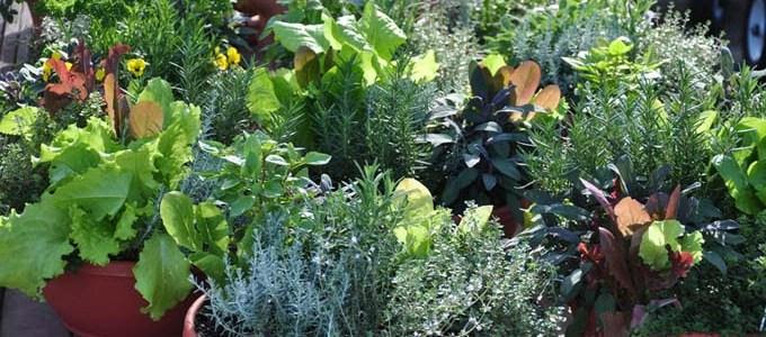 Growing in containers is the perfect solution when space or sun is limited or you want to grow something that is easy to maintain. Edibles offer their own visual appeal and can be just as pretty as flowers in containers. Here are a few things to consider:
Container gardening offers endless possibilities when it comes to growing edibles. If you are just starting out, try growing leaf lettuce or herbs in a 14" garden bowl. Experiment and try something new every year. "As the garden grows, so does the gardener." - Anonymous 3/17/2016 3 Comments Effective Weed Control Recently we held a seminar here at BGC on effective weed control. Walt Uebele, owner of the Burlington Garden Center, walked through different methods, products, and their time of use on the lawn, perennials beds, and vegetable gardens. Here are some of the highlights:
For crabgrass in the lawn, preventative measures can be taken in the early spring. Products such as Hi-Yield's Crabgrass Control effectively prevent weed seeds from germinating. If you miss spring's pre-emergent window, Walt recommends Fertilome's Weed-out with Crabgrass Killer in mid-May. This will control crabgrass as well as a long list of broadleaf weeds including dandelions, thistles, chickweed, and ground ivy. Liquid products applied with a hose-end sprayer (RTS - Ready-to-Spray) are easy to use, require no mixing, and result in good coverage. They also eliminate the need to time the applications with dew or rain. For dandelions, Walt recommends Hi-Yield 2,4-D. This concentrate should be mixed with Spreader Sticker which is a surfactant that improves absorption into the leaf of the weed. Dandelions are a sign of compact soil, so core-aerating in the fall will help improve soil structure. Other lawn tips: Proper fertilization can help reduce the number of weeds in a lawn. Use Milorganite as a lawn fertilizer in the spring (May) and again in the fall for a slow, even green-up, with no burning. For those who want to use an organic fertilizer on the lawn, corn gluten is the best option. To eliminate grass in asparagus beds, use Fertilome's Over the Top Grass Killer. It is absorbed by the grass foliage and travels through the entire plant working systemically. Over-the-Top will kill grass in perennial beds as well - see label for complete list. Walt has a warning when using products like Round-up and Hi-Yield's KillzAll - avoid purchasing the Extended Control versions by mistake. Extended-control products will kill everything and prevent any growth for up to 3 months. The dual-action formulas (pre-emergent and post-emergent) are designed to be used on driveways and sidewalks. Creeping Charlie can be a real nuisance in the lawn as well as in landscaped areas. Fertilome's Weed-free Zone works in well in the cool temperatures of spring and fall on creeping Charlie as well as 80 other problem weeds. If creeping Charlie has crept into your perennial beds, Weed-free Zone can be used taking care to avoid contact with the leaves of perennial plants. For those of you who use Preen, Walt suggests switching to products containing Dimension. This newer technology will suppress the germination of annual grasses and broadleaf weeds, can be used earlier in the spring (April), and has a longer window of control extending well into the growing season. Dimension can be used in perennial beds, ornamental landscape areas, and established lawns. Natural weed control in perennial beds and the vegetable garden can be achieved with a thick layer of mulch. Speaking of natural, a new line of natural products here at BGC is Natria by Bayer Advanced. In addition to natural insect and disease control products, there is a Grass & Weed Killer that uses naturally-derived, non-synthetic active ingredients to kill listed grasses and weeds. We hope this gives you a good overview of how to effectively manage weeds in your yard this year. Feel free to ask Walt or our knowledgeable staff questions you have may have about your specific situation. - Tracy Hankwitz BGC Store Manager Horticulturist & Landscape Designer photo source: gertens.com 3/3/2016 0 Comments The Secret's in the Soil "A garden is only as good as its soil."
A wise gardener once said this. While soil is not the most exciting part of gardening, it could be the most important. There are many things to consider about soil and it's rare to find the perfect soil without adding amendments of some kind. Here in SE Wisconsin, much of our soil structure is heavy clay - water tends to sit longer and plants struggle without air in the soil. Along the lake it tends to be more sandy which offers better drainage, but nutrients tend to seep away along with the water. The ideal soil is loamy rich in organic matter and beneficial microbes. If you have heavy clay or sandy soil, adding compost every fall or spring is the best thing you can do. In addition to good soil structure, soil pH is a key factor. If your plants aren't flourishing, it could be the wrong soil pH. Proper pH promotes plant growth by making it easier for roots to absorb essential nutrients. 7.0 is neutral; above that is considered alkaline (our native soil's tendancy); below that is acidic. Most garden plants grow best in slightly acidic soils (6.5). Adding peat moss will lower the pH as will other organic amendments as they decompose. Blueberries, for example, need a soil pH of 4.5-5.5, so planting in peat followed with an annual boost of aluminum sulfate will help. A simple soil pH test can be helpful in knowing what you need to add to sweeten or sour the soil. Speaking of soil tests, it's a good idea to test your soil in the spring to see what is lacking. Whether you are growing vegetables, shrubs, perennials, or turf, it's worth it! There are simple DIY tests available here at BGC that will give you a general idea. If you want more specific results, take a soil sample and send it in to UW Madison Department of Soil Science. We have the test kits here as well. If you only take two things away from this article, here is one of them: Feed the soil, not the plants! Just as we don't live on water alone, plants need food as well. The best thing you can do for your plants is to feed the soil. By building up the soil with minerals, nutrients, and microorganisms, you are also feeding the plants. We hear alot about NPK (nitrogen, phosphorus, and potassium) but minerals are just as important. Minerals make up 90% of garden soil and hold onto plant nutrients. The second is the soil is alive! It's alive with microorganisms (bacteria and fungi) that capture moisture and nutrients making them available to the plant roots. Our favorite things to feed the soil are worm castings because they add NPK, calcium, minerals, and beneficial bacteria. TIP: Add directly to the planting hole or row rather than to the entire garden bed. Composts, especially cotton burr compost, is another favorite amendment. Not only do they add organic matter and microorganisms, they lighten the soil. This means clay soils won't be so heavy and sandy soils will have better nutrient capacity. A personal favorite of mine is Nature's Blend with alfalfa and humates. I add it to every planting hole for trees, shrubs and perennials. It also makes a good top dressing for lawns. The benefits of compost tea have long been touted, but not everyone wants to mess with putting compost in a cheesecloth bag and letting it steep overnight in a 5-gallon bucket of water. Life just got easier with prebagged compost tea bags from Purple Cow. Drop one in your watering can and after steeping, water the soil around the plants or use it as a foliar feed. One last recommendation for improving soil is to sow a cover crop in the fall to till under in the spring. Winter rye and buckwheat are two that work well in our area. The tilled-under foliage becomes an instant source of nitrogen which the microbes will quickly breakdown making it available to the plants. As you make your garden plans for spring, include plans to improve your soil. Your plants will thank you! Tracy Hankwitz BGC Store Manager & Horticulturist photo source: redbeacon.com 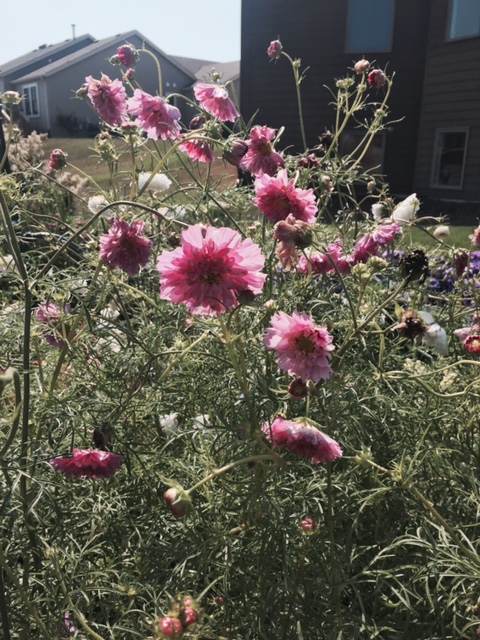 This past summer I had the opportunity to visit the cut-flower garden of Cheri Carlson. Located on a suburban lot in Kansasville, WI, I was impressed with the number of flowers she is able to grow in a relatively small space. A large swath of perennial and annual flowers greet visitors at the entrance to the property and extend to the back. 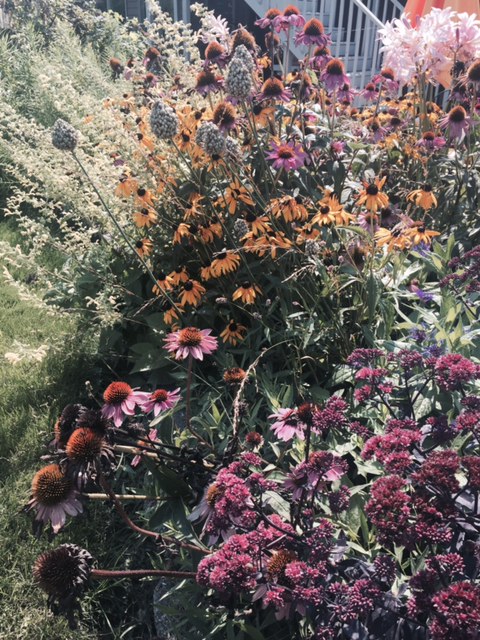 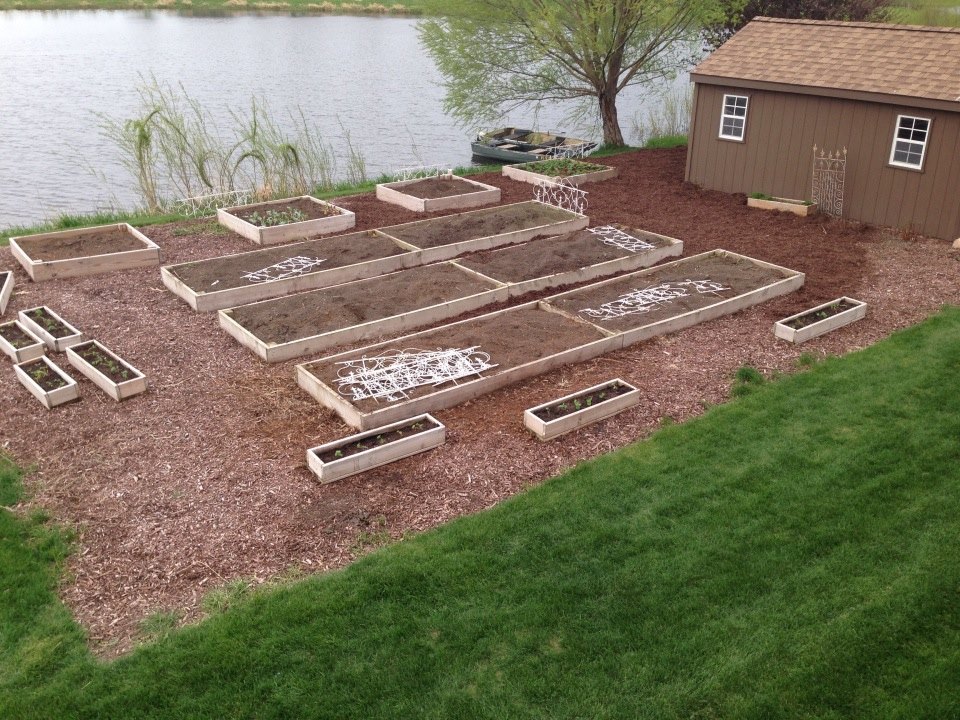 She grows most of her annuals in raised beds. This photo was taken at installation a few years ago. 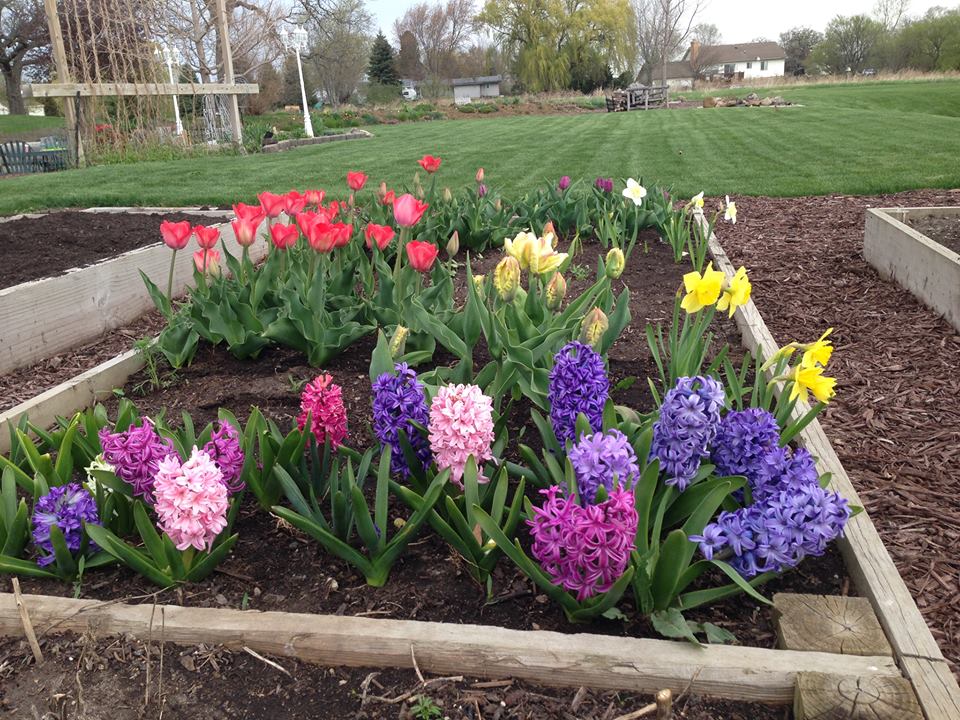 She extends the cutflower-season with bulbs that bloom in the spring. 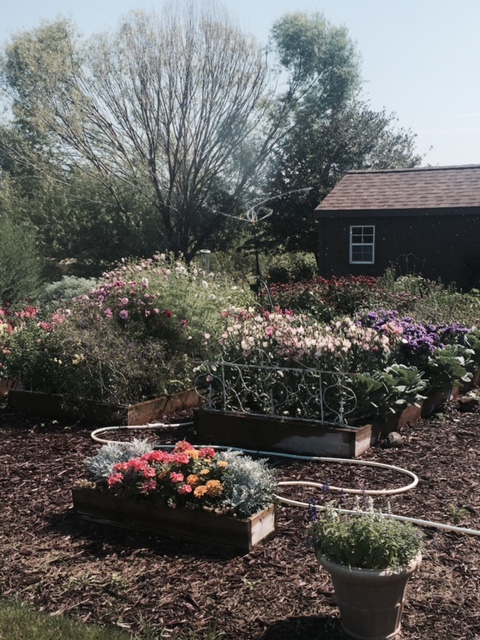 By August, the raised beds look like this (above) . Notice how even the sprinkler adds it's own artful touch to the garden. 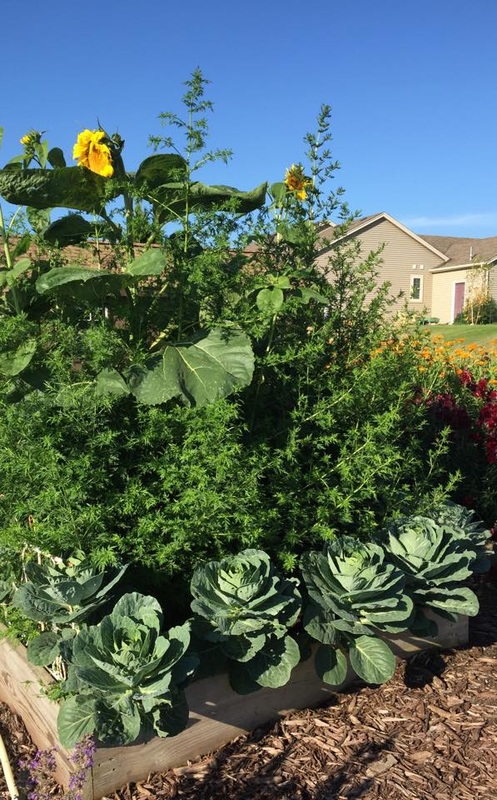 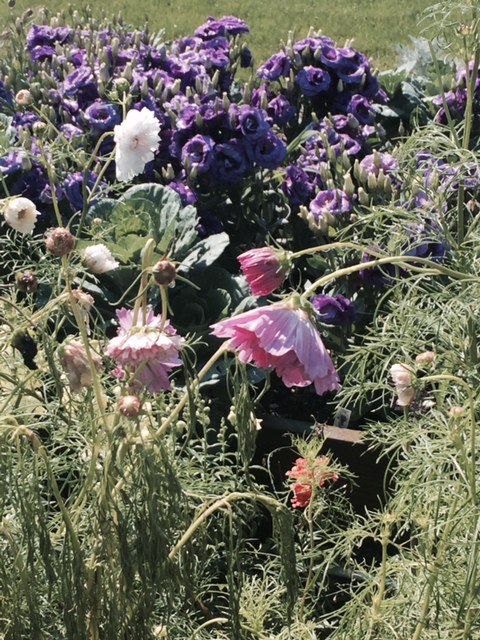 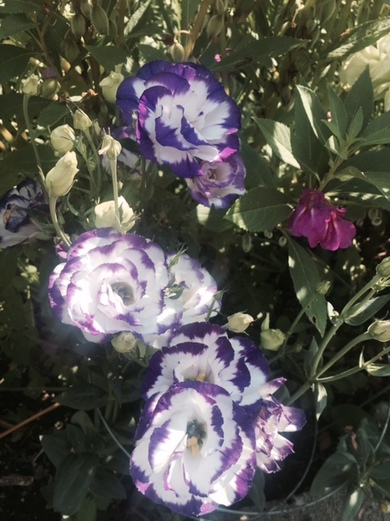 I was smitten with the Lisianthus. 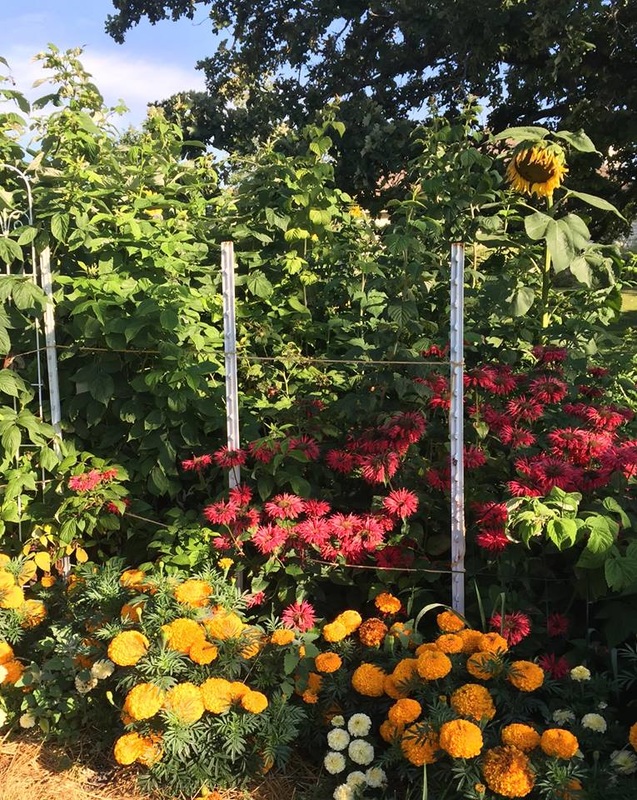 Cheri mulches with straw to help with moisture and weeds. Marigolds detour pests while the red bee balm attracts pollinators. She plants sunflowers to keep the birds busy and away from the nearby raspberry patch. 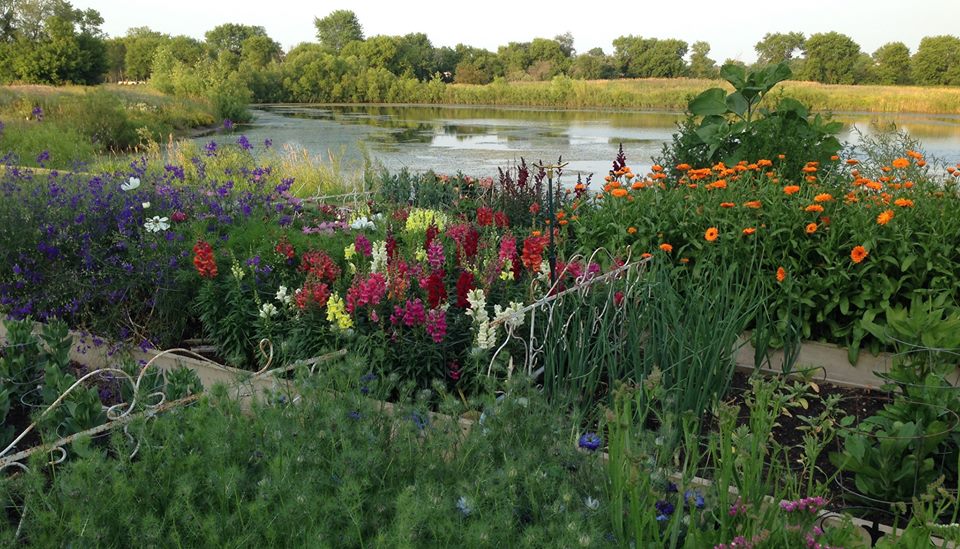 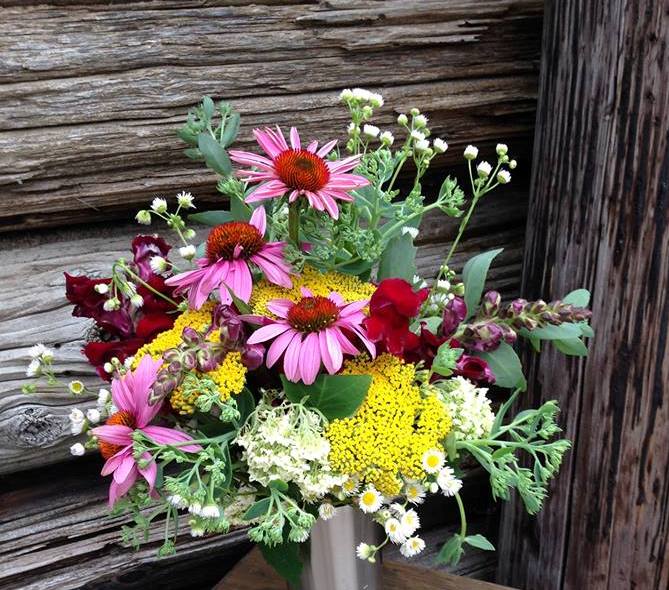 Most of Cheri's flowers end up in beautiful bouquets. 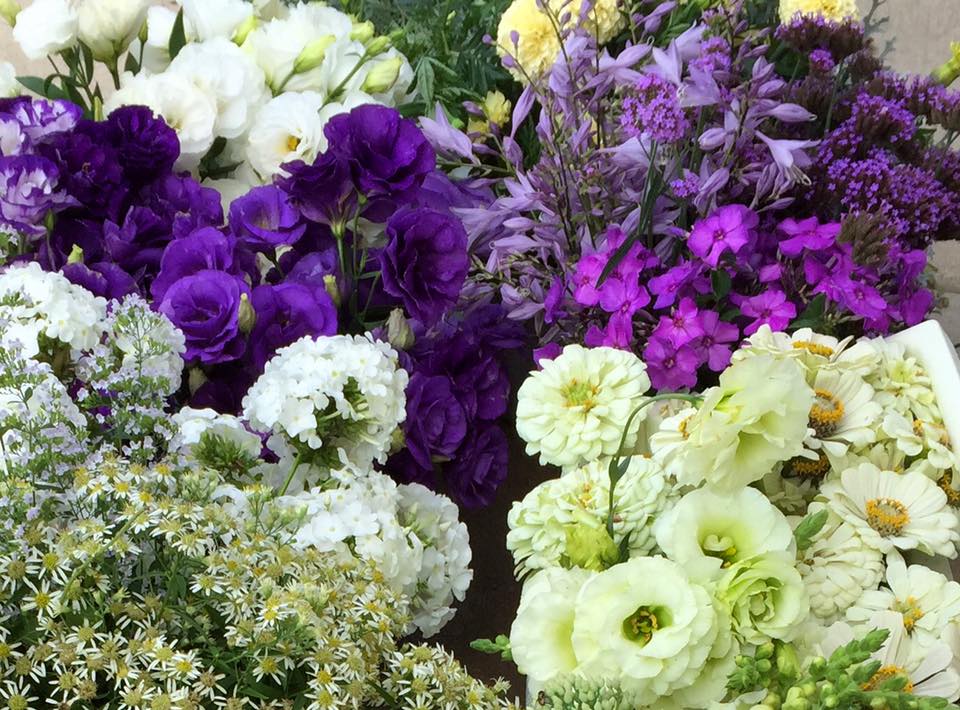 These lisianthus, phlox, zinnias, snapdragons, hosta, and verbena ended up in bouquets for my neice's September wedding. Just breathtaking! I'm inspired to grow my our cut flowers this year. Thanks, Cheri!
- Tracy Hankwitz Horticulturist & BGC Store Manager * some photos compliments of Cheri Carlson 2/12/2016 1 Comment How to Plant Woodies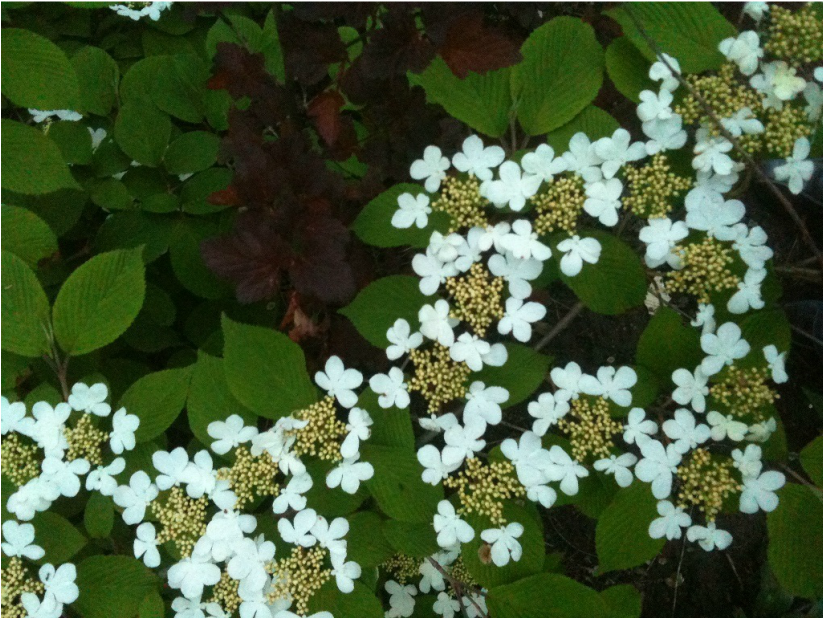 I know it's February and you would rather see pretty, inspiring photos of flowers and ornamental trees than a how-to-plant-a-tree post filled with boring brown, but spring is not far off and soon we'll be out there planting. There is a wrong way and a right way to plant, and when you do it right, you'll have many years of beauty like I have had with this Shasta Doublefile Viburnum pictured above. Sadly, there's always that one tree or shrub (woodies) that slowly looses it's vigor over a period of time. Leaves become more sparse every spring, unfurling to half their size. One might think fertilizer must be the answer, so we feed it and hope that we'll see some improvement. Sometimes that helps, but when it doesn't, we wonder if we should wait one more year, or just declare defeat and plant something new. My guess it that the tree/shrub is slowly strangling itself. 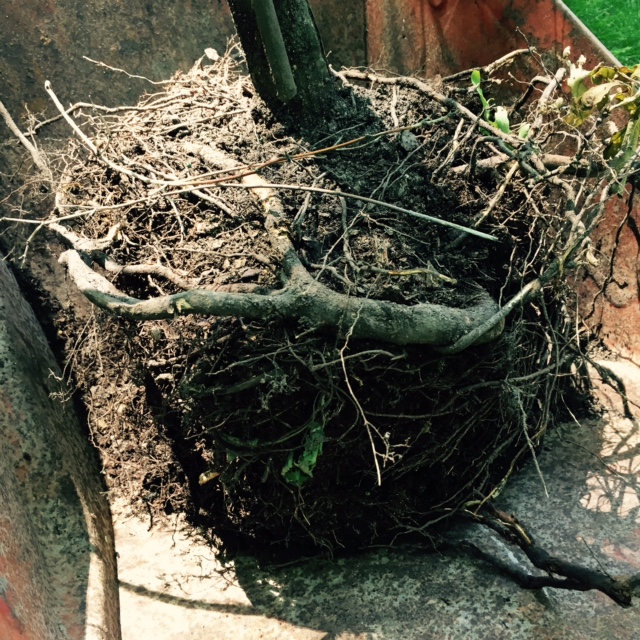 Here is the root ball from a Japanese Maple I dug up last year. It had been planted about three years ago, thrived the first year, showed signs of struggle the second year, then hardly leafed out the third. Look at that thick root and how its wrapping around the root ball - it looks like the hand of death! It most likely began to do this when it was growing in it's pot in the nursery. Actually, it looks like the roots haven't stretched out at all from the original pot shape! That's not good! 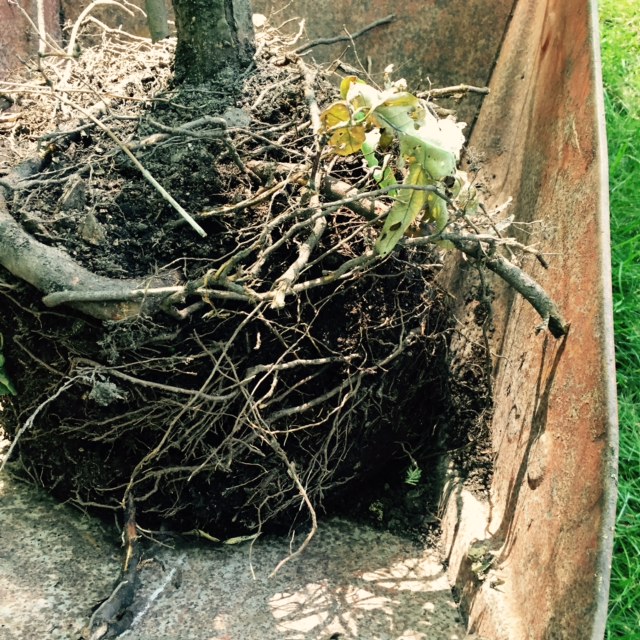 Even the smaller white roots are growing circular rather than stretching out to gather water and nutrients and to help stabilize the tree as it matures. Unfortunately, this tree didn't have much of a chance to flourish. The Right Way to Plant a Tree 1. Dig your hole the same depth as the root ball, but twice as wide. Most roots of trees and shrubs are shallow, within the top 12 inches. By digging the hole wider and loosening the soil, you are helping the roots by creating channels for air and water. And what about amending the soil? It depends on the existing soil. It's best to plant woodies in the native soil that already there. However, if your soil is extremely rocky or heavy clay, amend the soil with compost - I like to use a product called 'Nature's Blend' made with alfalfa, humates,and compost.  2. Before placing the root ball in the hole, I add water that has been mixed with a root stimulator so that it's available to the roots immediately. THIS IS SO IMPORTANT and the most neglected step. Root stimulator is NOT a fertilizer, it is actually a plant hormone that gets those feeder roots growing quickly. I like Fertilome's Root Stimulator - it's inexpensive, and I need only 3 tablespoons/gallon of water. Buy a big bottle because you'll need it all season. 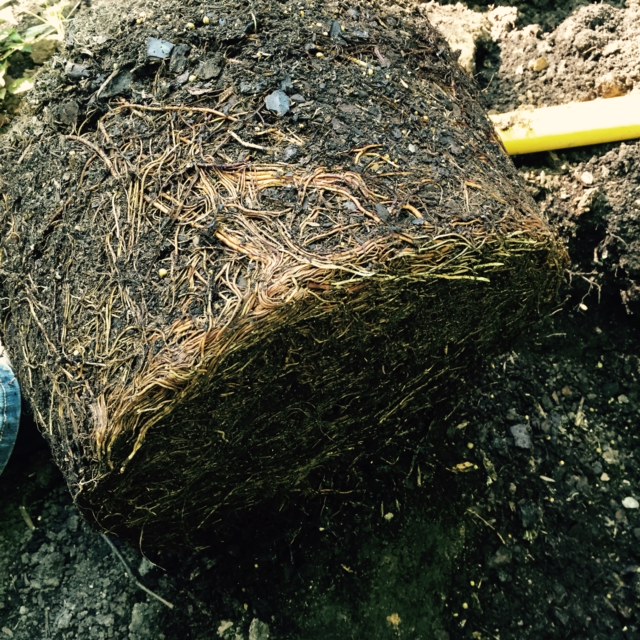 This is what most root balls look like when removed from the nursery pot. And this is where things can go wrong if planted just as is, without doing anything to those roots. 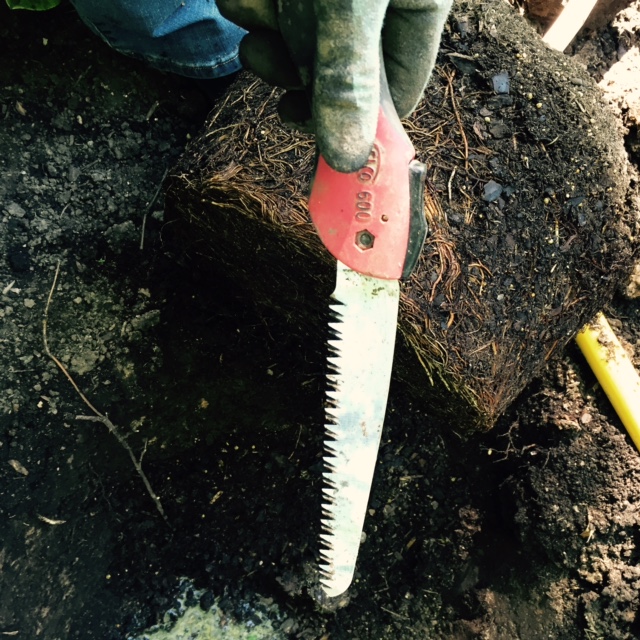 3. Don't be afraid! Really! Don't be afraid to loosen the roots. I use a small pruning saw to score them. 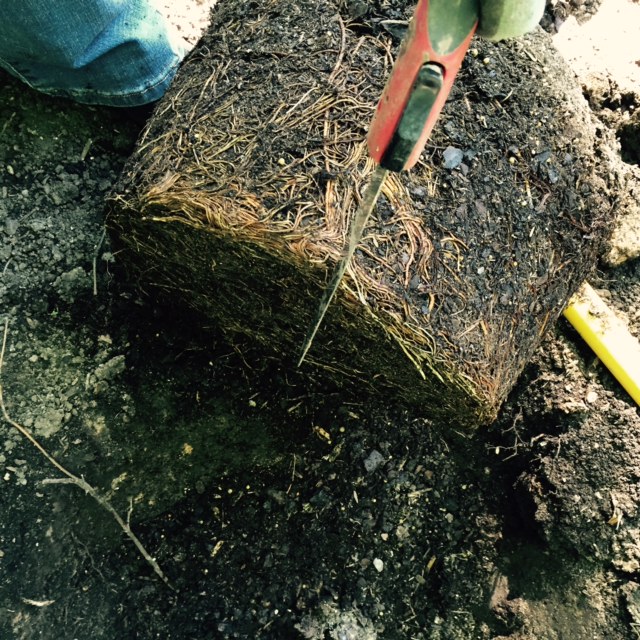 Make several cuts with the saw, then loosen the roots with your fingers. 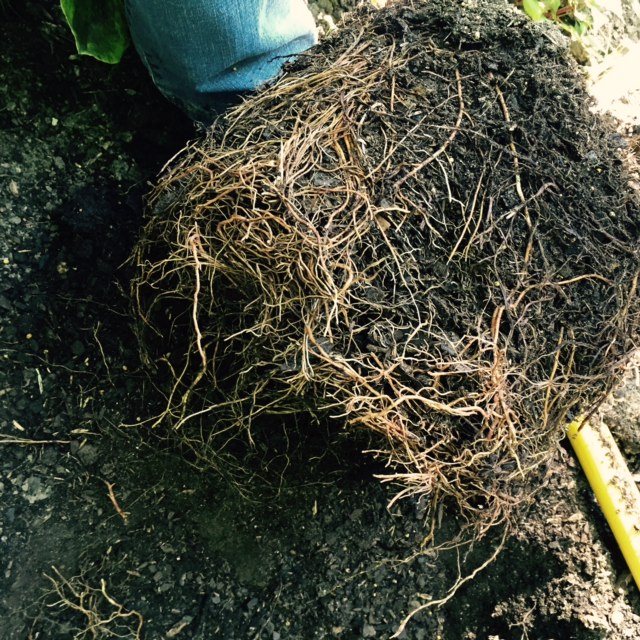 Now it's ready! 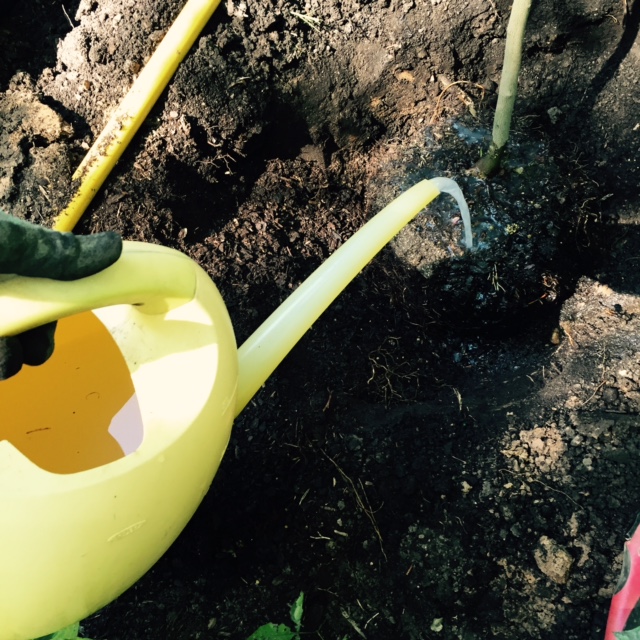 4. Place the root ball in the hole; water again with the root stimulator solution. Back fill with soil and tamp it down to remove air pockets. The other key step when planting a tree is to plant the root flare (where the root gets wider at the base) above ground. Water regularly through the first growing season - up until the ground freezes. The first 2-3 weeks after planting, water every other day, then back off to at least once a week, possibly more frequent when temps are over 90 degrees. I use the root stimulator solution every two weeks the first year. Mulch the roots of the tree/shrub, keeping the mulch away from the trunk - think bagel, not volcano. 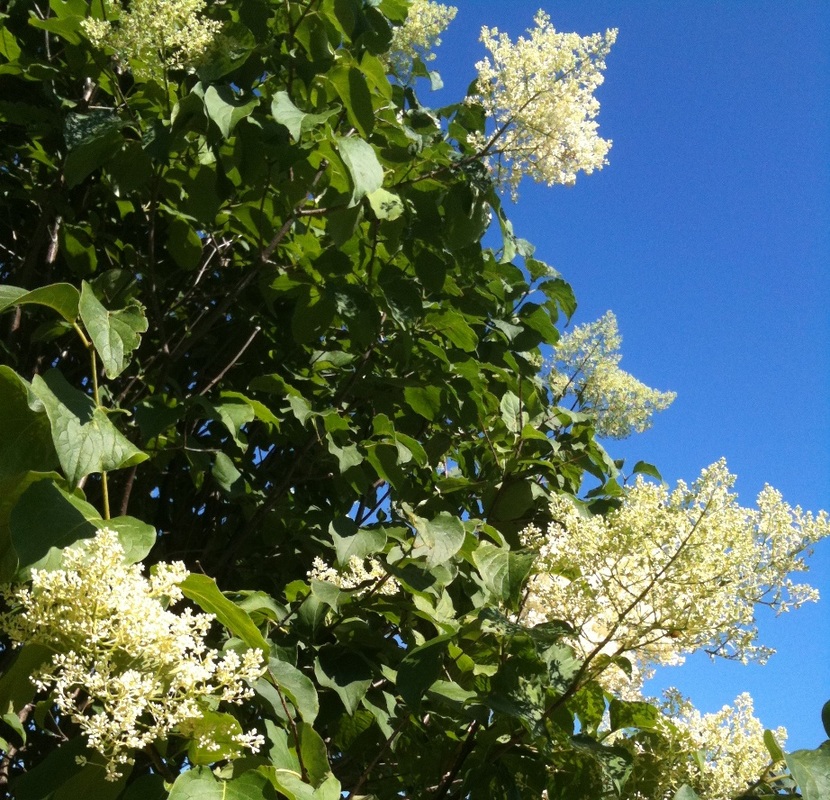 Enjoy many years of beauty knowing you gave it a good start. - Tracy Hankwitz Horticulturist & BGC Store Manager 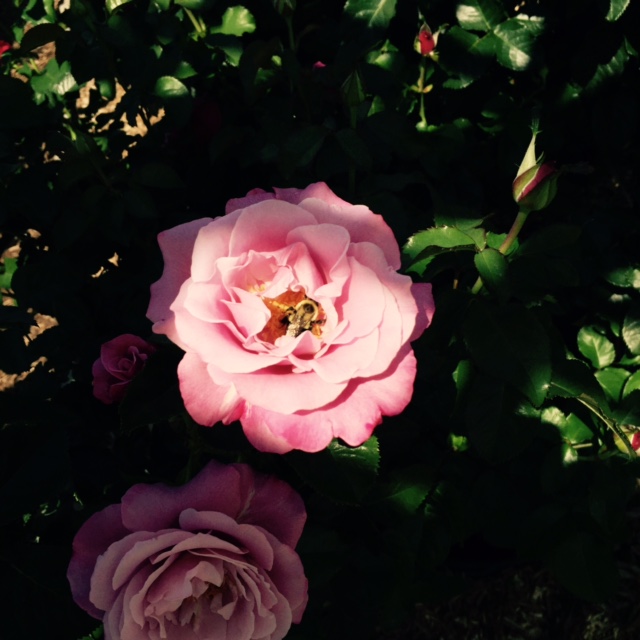 'Come. Come with me to see the roses! ' It was late July when a friend coaxed me away from my work at the garden center to visit an area rose farm called 'Stop and Smell the Roses' in Delevan. I wouldn't mind seeing a few roses, I thought to myself. I had no idea what was in store . . . 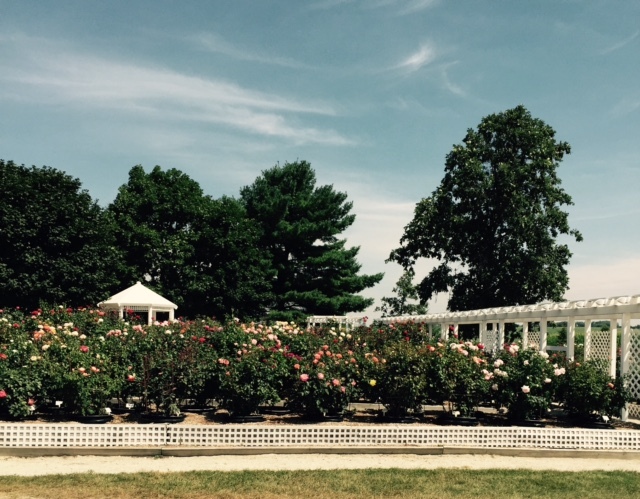 This is the view that greeted us. 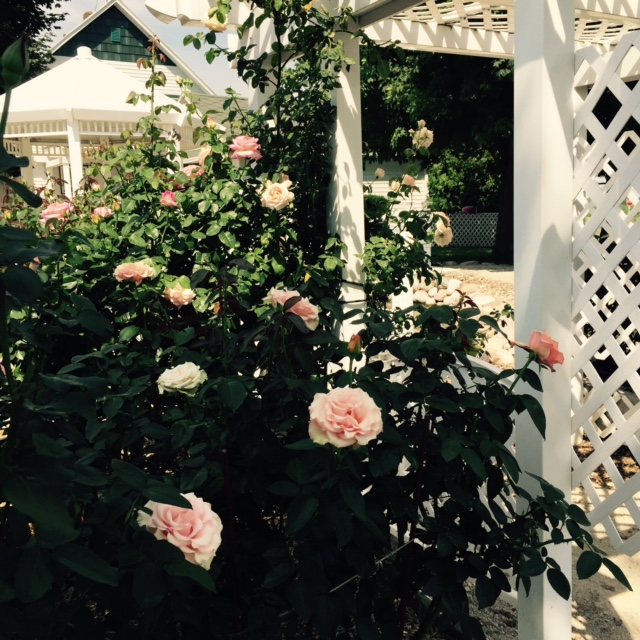 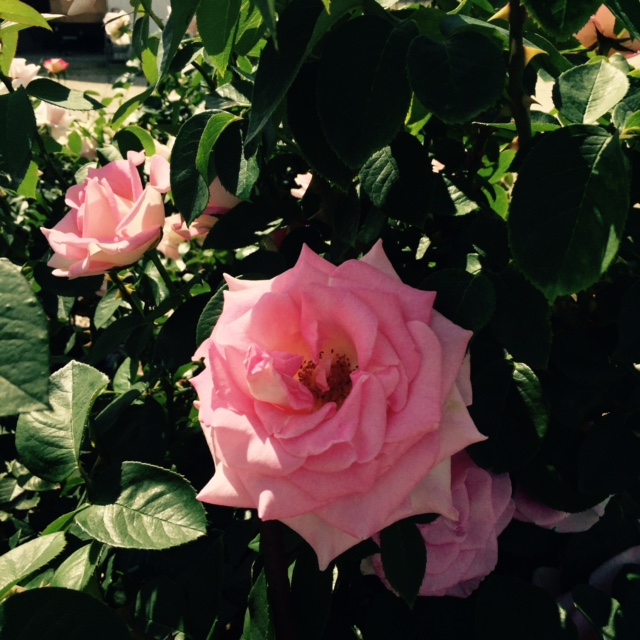 The owner, Doug Amon, gave us a friendly welcome. He tends this collection of hybrid tea roses on his farm in memory of his late wife. His collection has grown since he started 10 years ago. Now he welcomes hundreds of visitors every summer to walk among the 400 varieties. 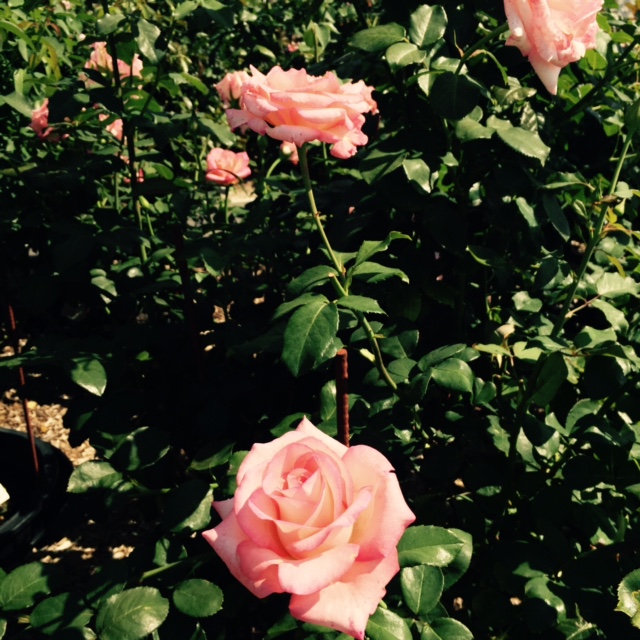 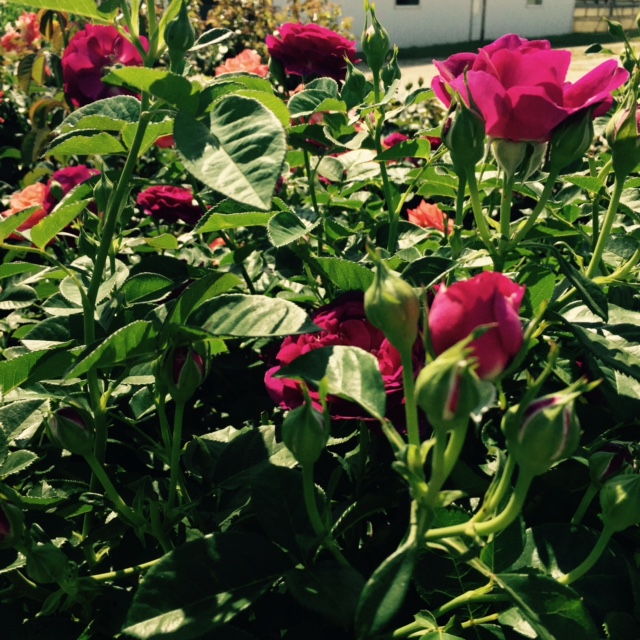 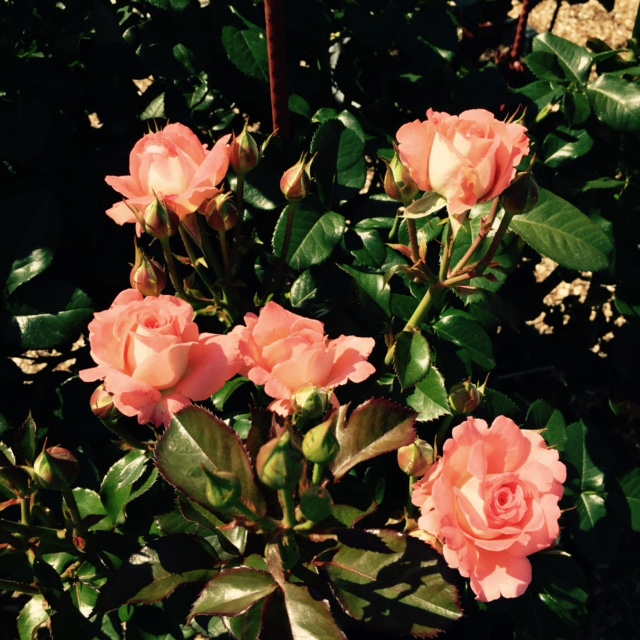 Each rose has it's own fragrance, some stronger than others. Doug told us he deadheads daily to keep the roses blooming all summer. And look at those leaves - no sign of insect damage anywhere. 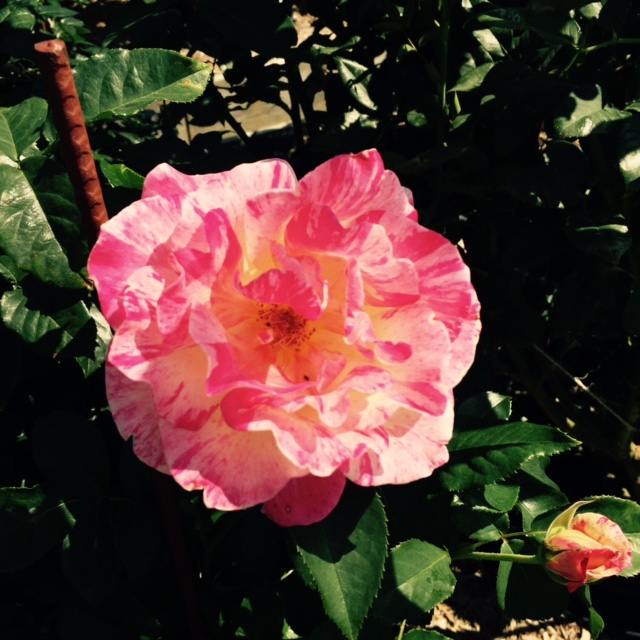 'A single rose can be my garden . . . ' - E.B. White 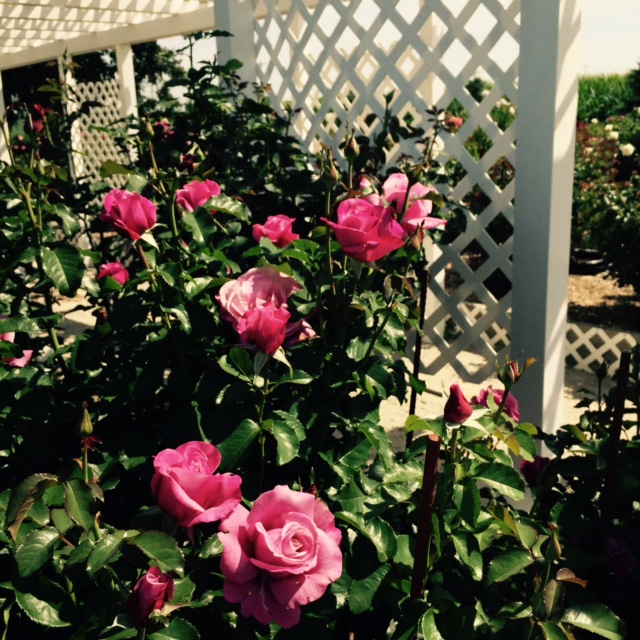 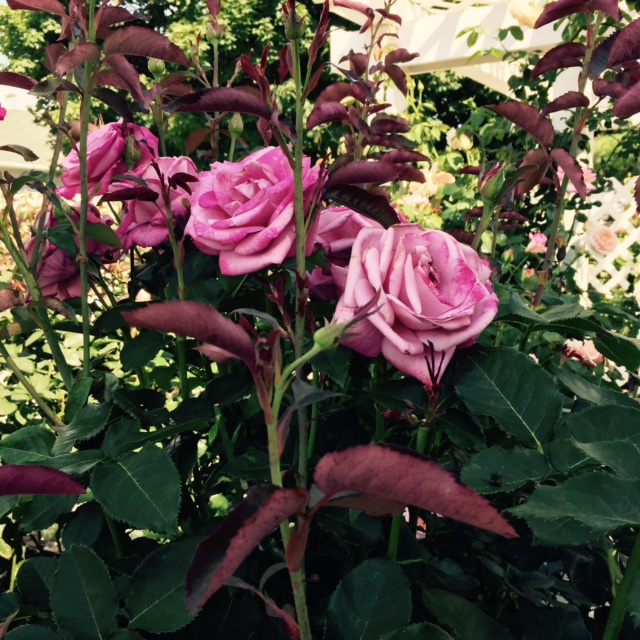 This lavender rose shown above was one of my favorites. If the beautiful color of the blossoms wasn't enough, the undersides of the leaves added to its appeal. 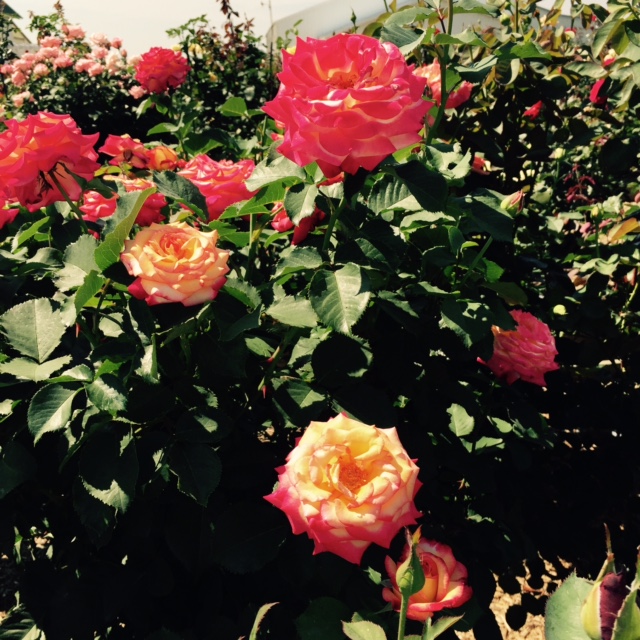 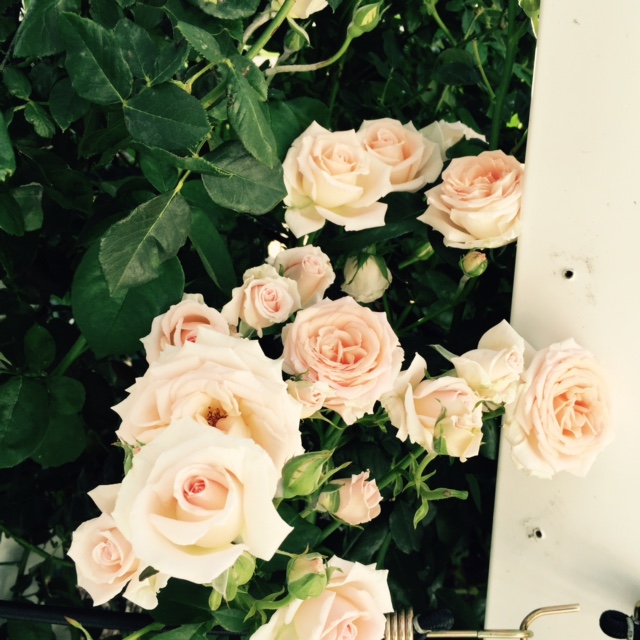 'Pearly Gates' (shown above) is appropriately located next to the entrance of the white lattice walkway. 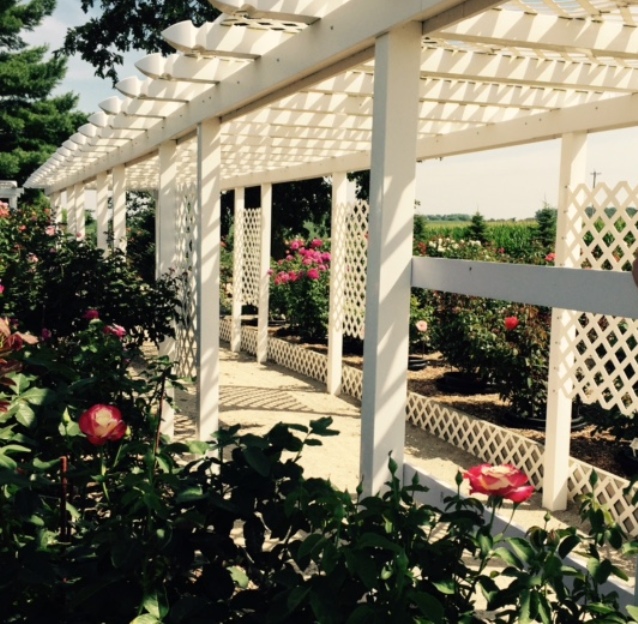 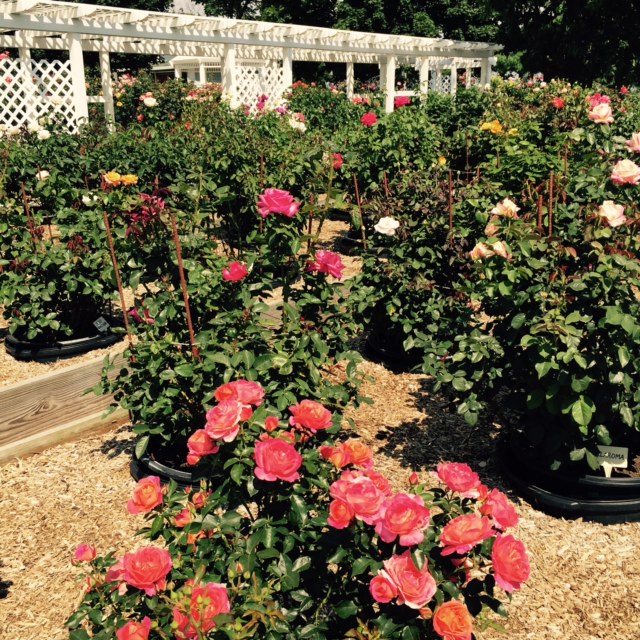 After losing 25 roses that first winter in 2006, Doug came up with this system. Each rose is grown in a large plastic pot placed inside another pot buried in the raised beds. Every fall, he hauls them inside the barn for the winter. 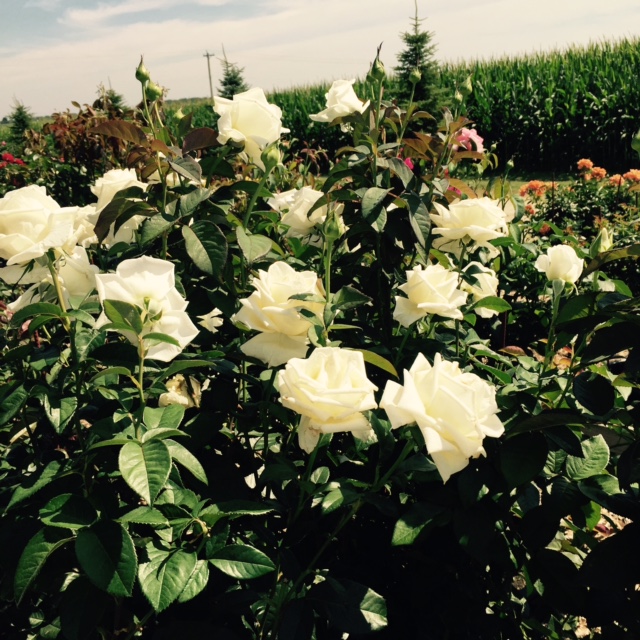 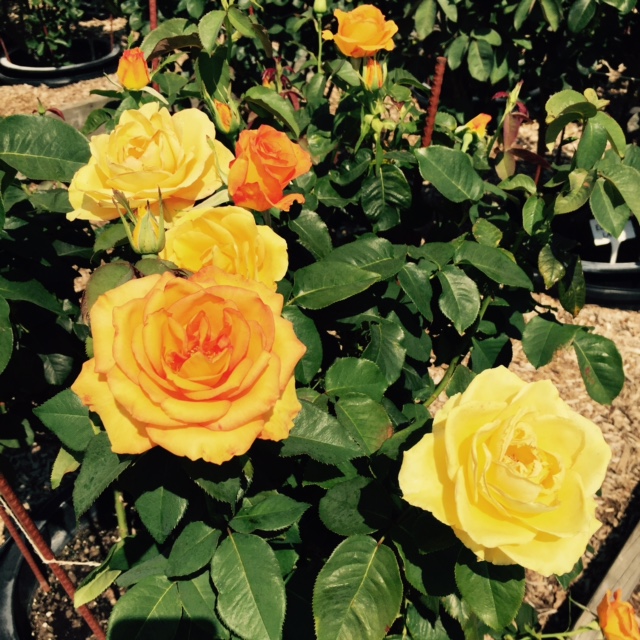 So many pretty shades of yellow and orange on 'Sundance' (above). 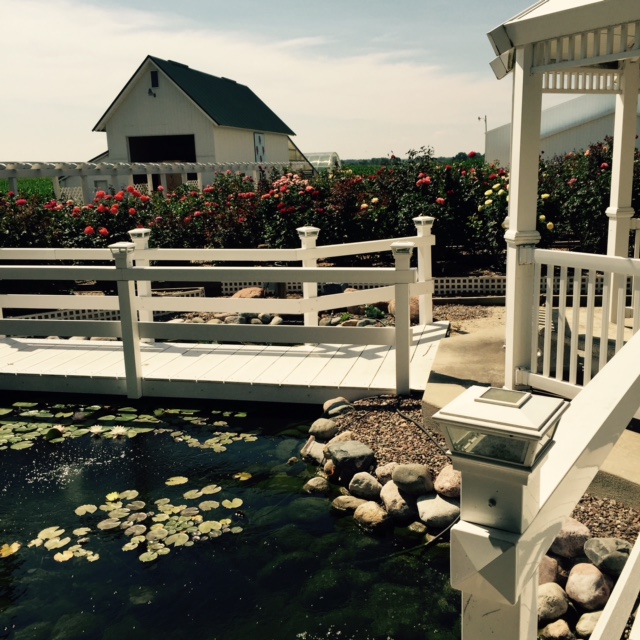  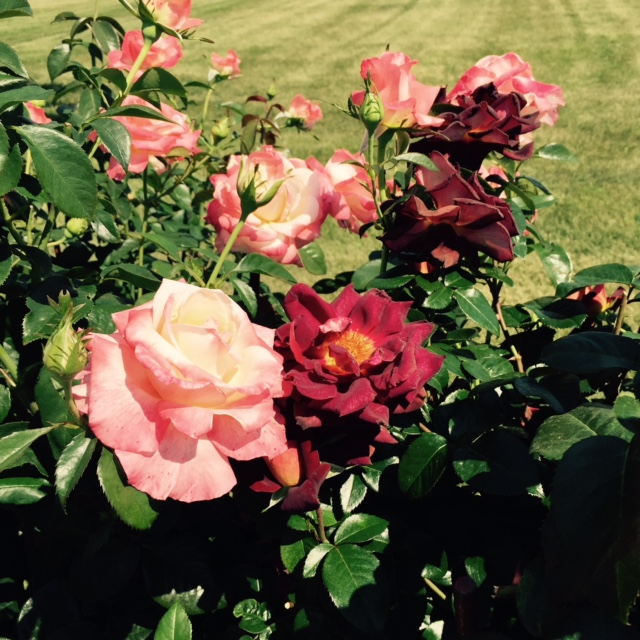 'Crescendo' (above left) begins as a white bud and opens to a light, blushing pink and smells like honeysuckle. 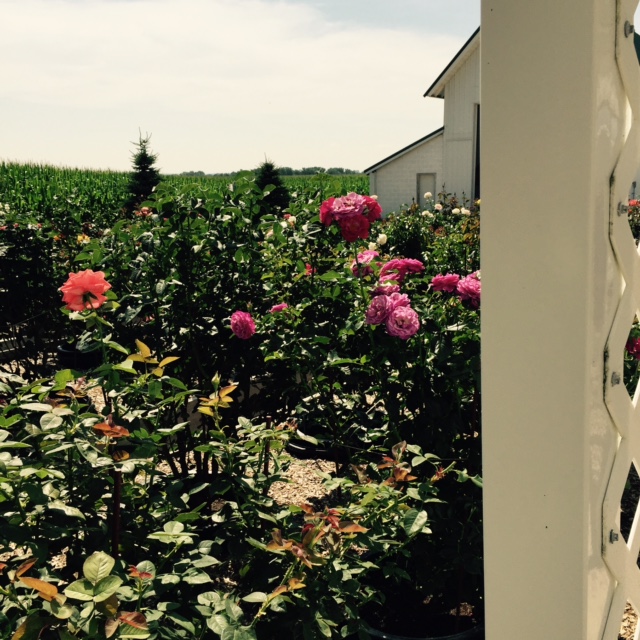 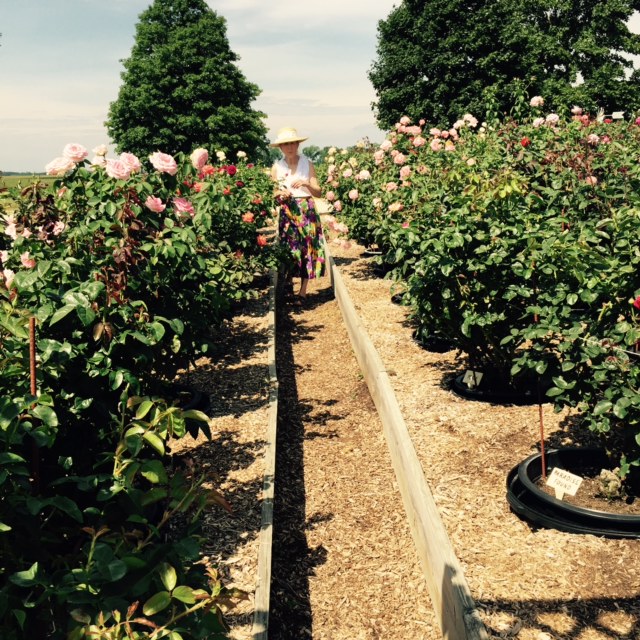 This is my friend and fellow gardener, Sandra, who probably wouldn't want me to include her picture, but it demonstrates how tall the roses are. Somehow she knew how much I needed this - to take time to stop and smell the intoxicating fragrance of each lovely rose. Thanks, Sandra. 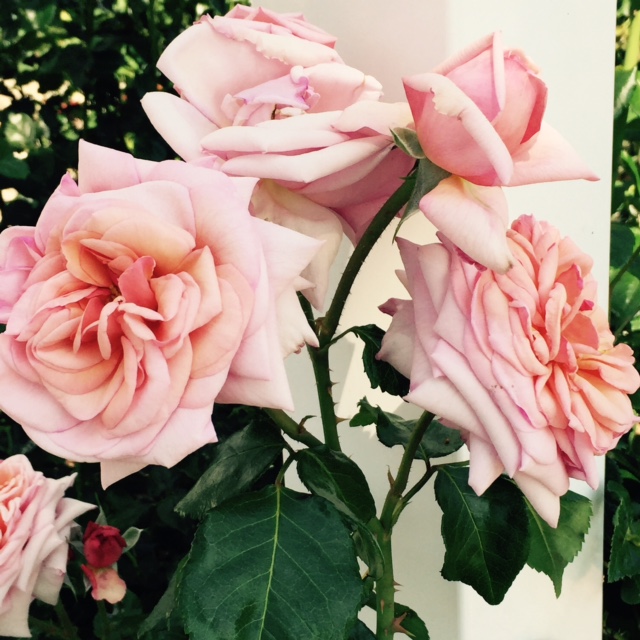 Another personal favorite, 'Lady Ashe' is so gorgeous I can hardly stand it!
If you decide to go, and I hope you do, check out the website www.stopnsmelltheroses.org. And be sure to take a friend along who needs to step away from the busyness for a while and walk among the roses. - Tracy Hankwitz BGC Store manager 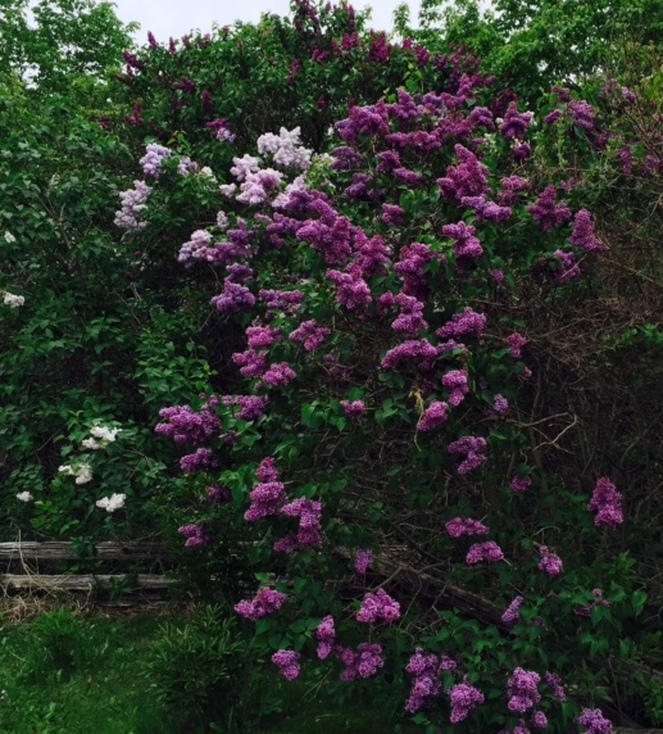 It's about now when I get itchy for spring. Scrolling through the many photos still on my iphone from last year, I found this lovely reminder of what we wait for all winter: Spring! I had the opportunity to visit the beautiful woodland garden of local plantsman, Tom Horner. Deb Polansky, our greenhouse manager, was with me, and no joke - every where we looked, beyond every path's turn, was a a breathtaking vista full of unusual plants, and rhododendrons, azaleas, and magnolias blooming their hearts out. What a delight to the eyes! Thought I'd share what I captured with you, as we all need a reminder of winter's sweet reward. So pour yourself a cup of coffee, get cozy, and enjoy this virtual garden tour captured in about 50 photos. 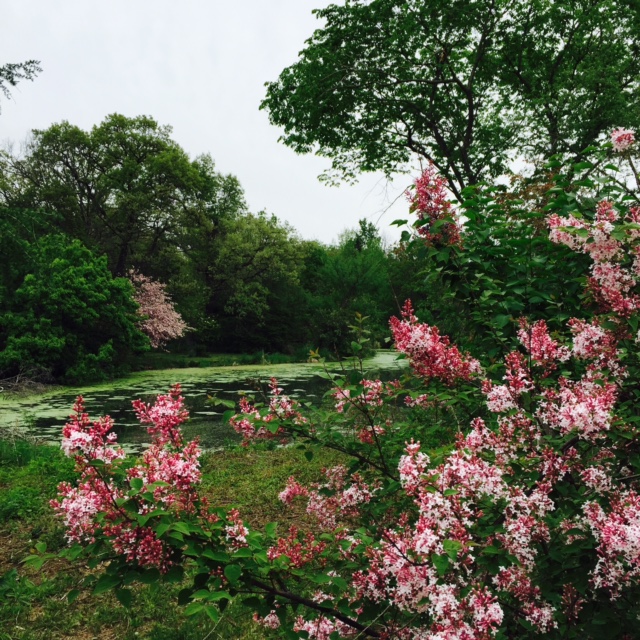 When you are greeted with this at the entrance of Tom's property, you know you are entering a special place. 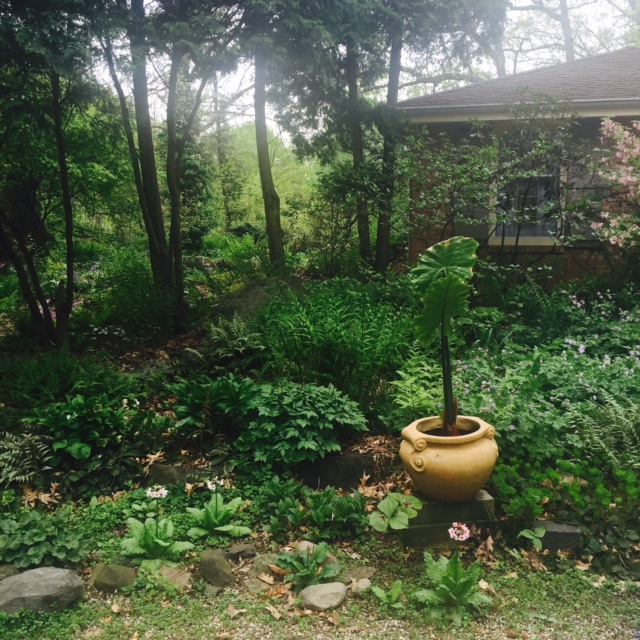 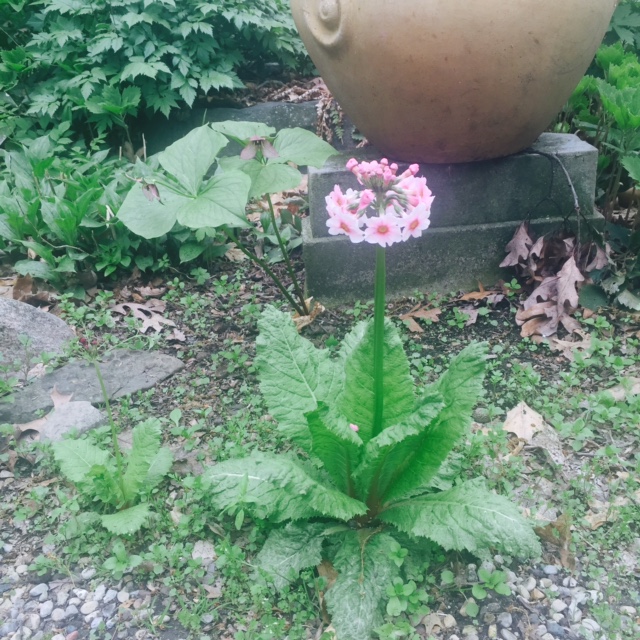 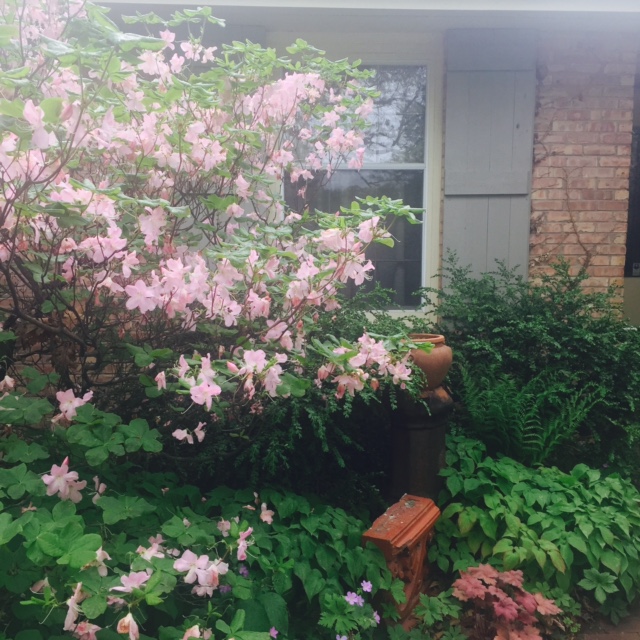 I must have had a funky setting on when I snapped several of these photos. The result is a hazy filter, but I'll share them despite the not-so-perfect exposure - it adds a bit of dreaminess to the whole tour. 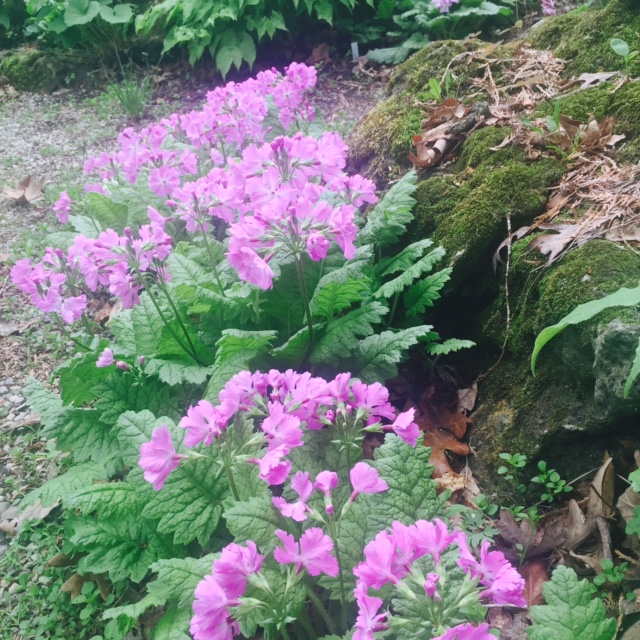 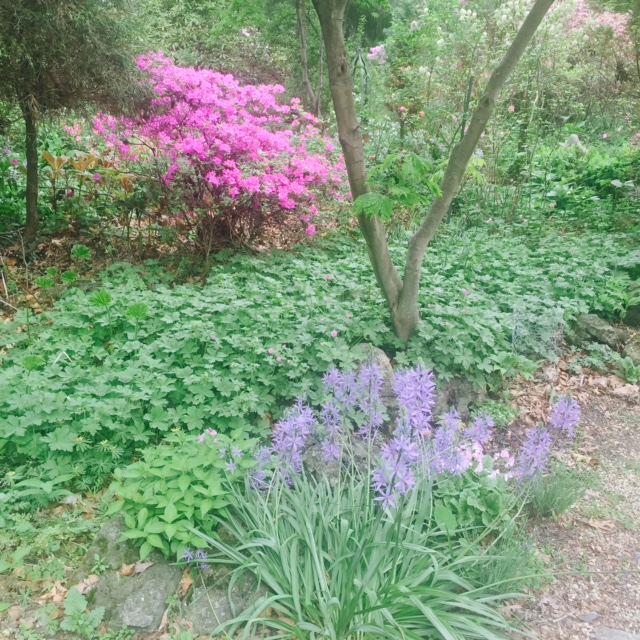 Tom has quite the collection of trees, shrubs, perennials and bulbs that are hard to find. I regret not taking notes on what many of these treasures are. If your curiosity is getting the best of you, let me know and I'll find a name for you. 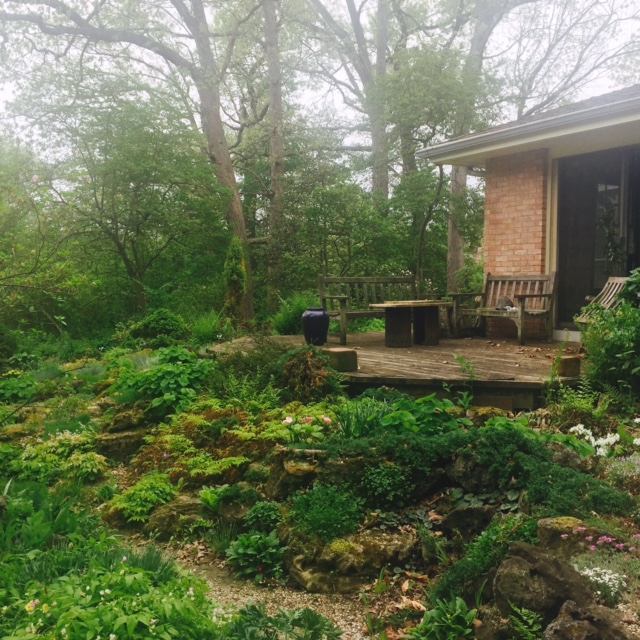 The area surrounding the deck houses an alpine collection of ferns, primrose, ginger and other fun perennials. 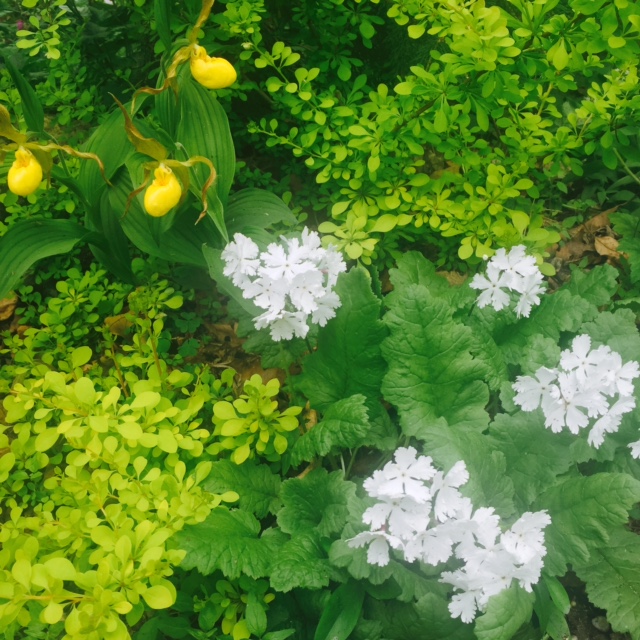 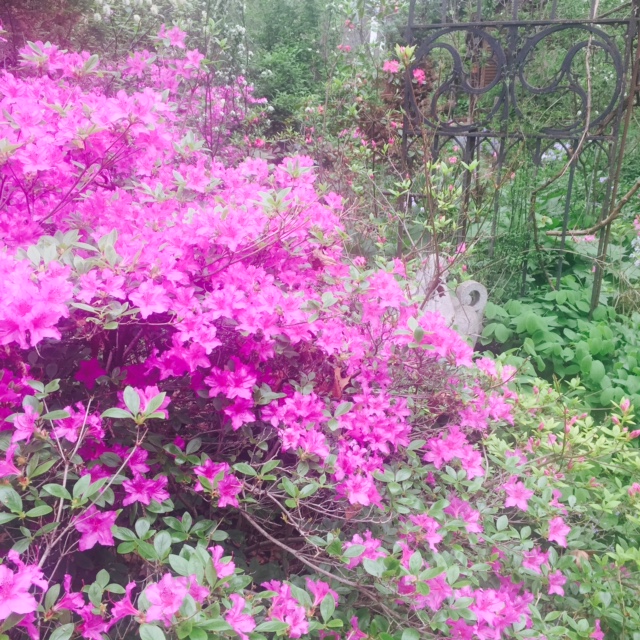 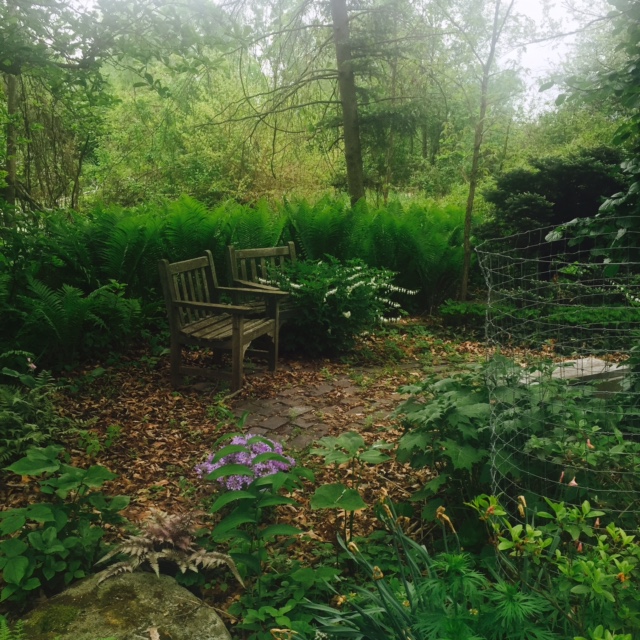 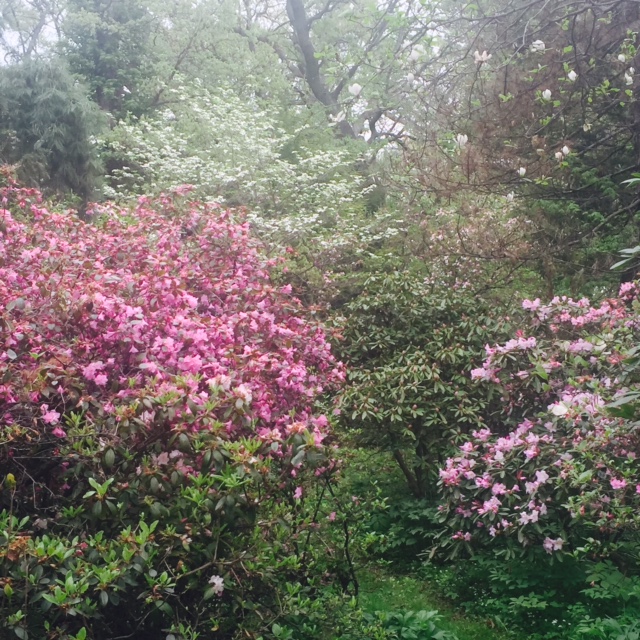 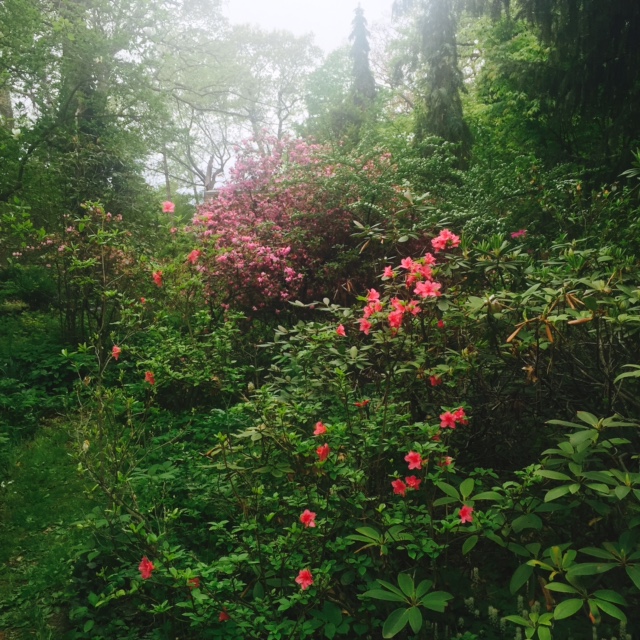 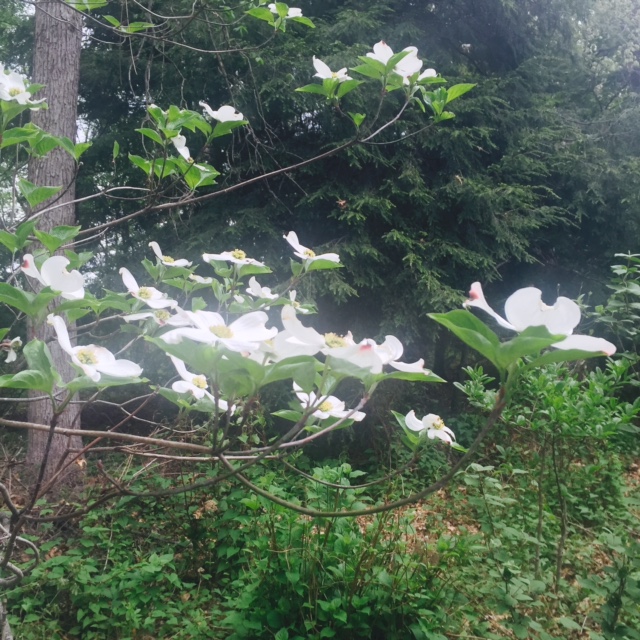 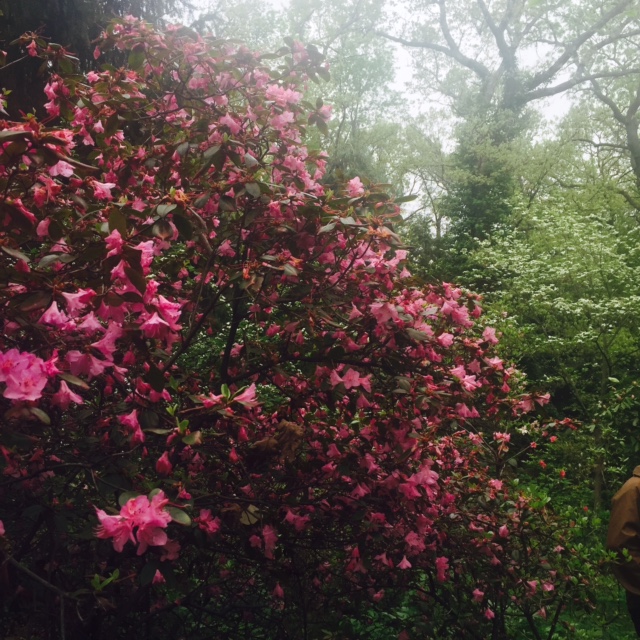 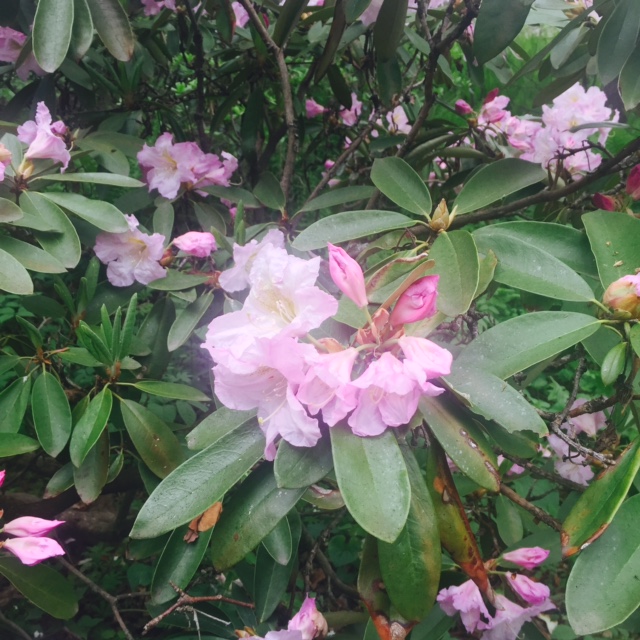 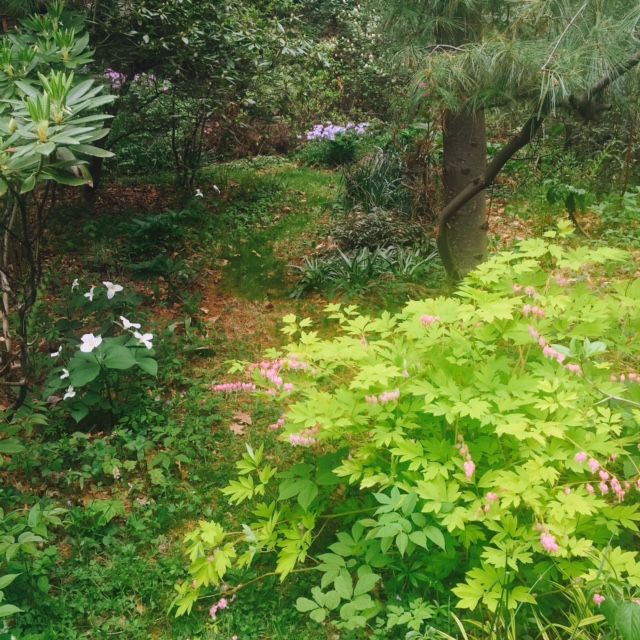 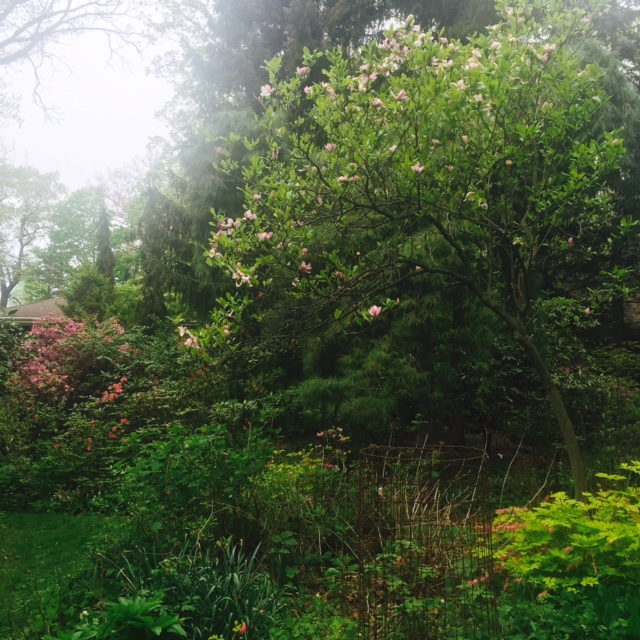 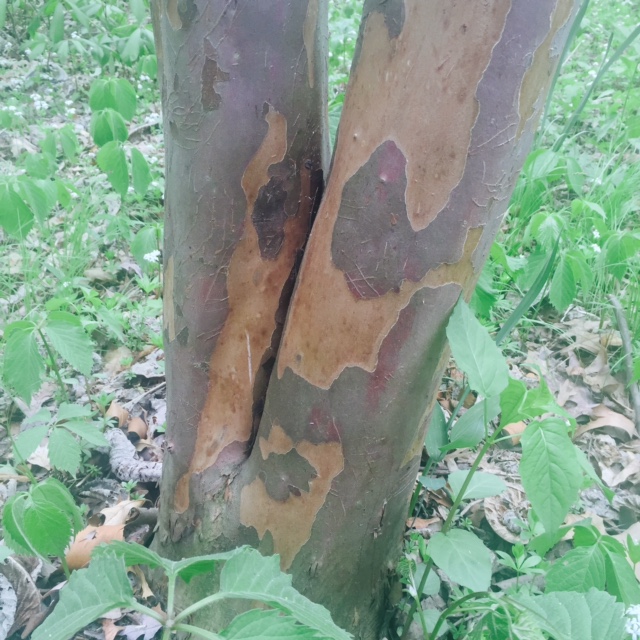 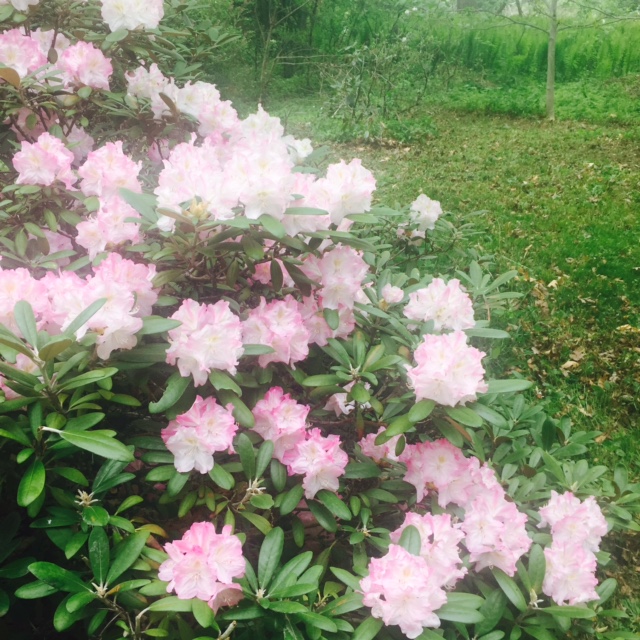 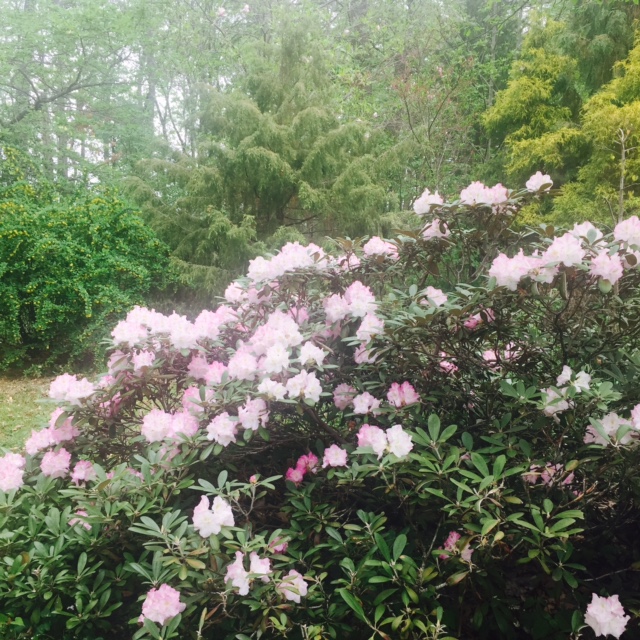 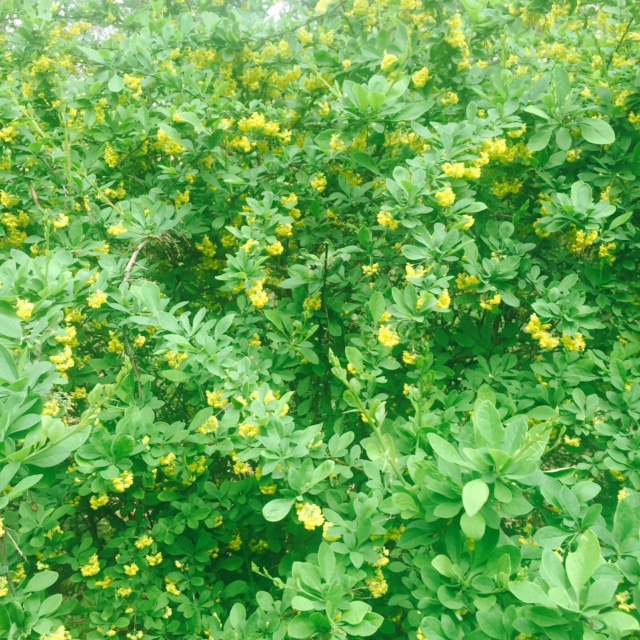 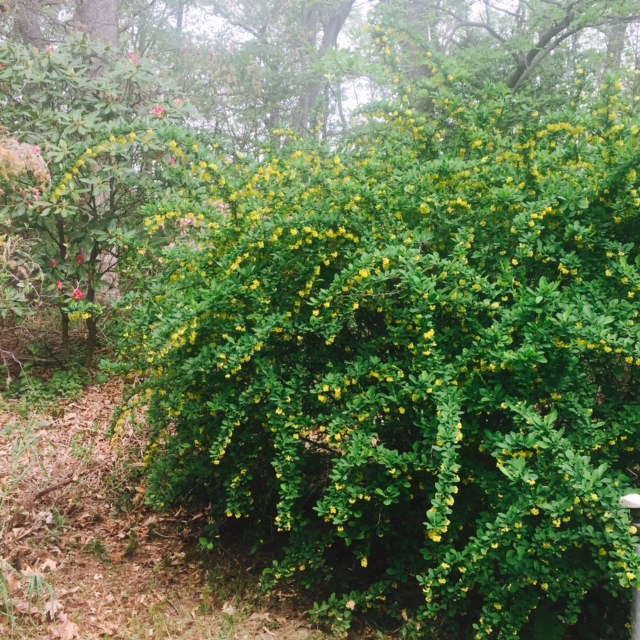 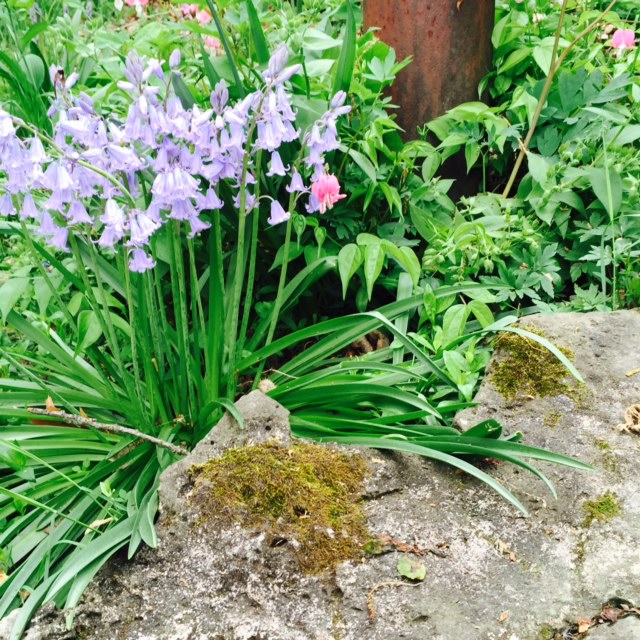 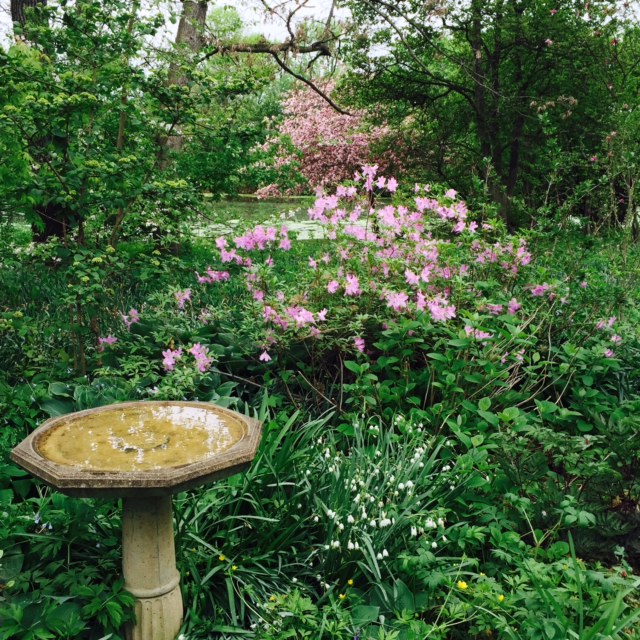 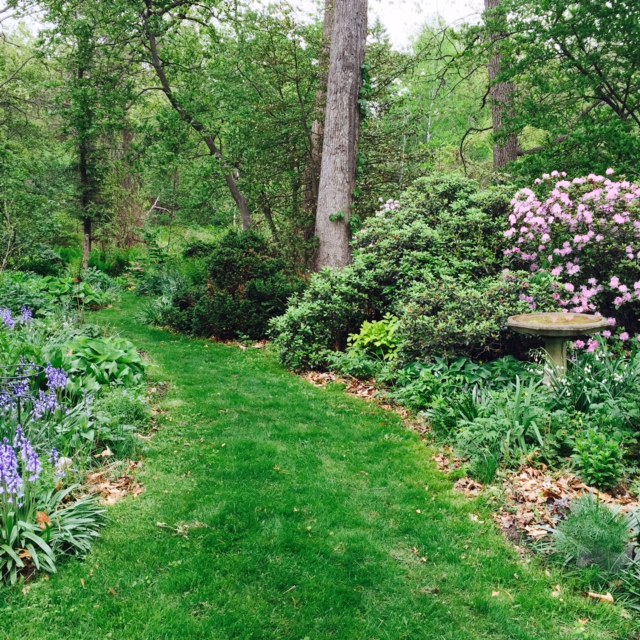 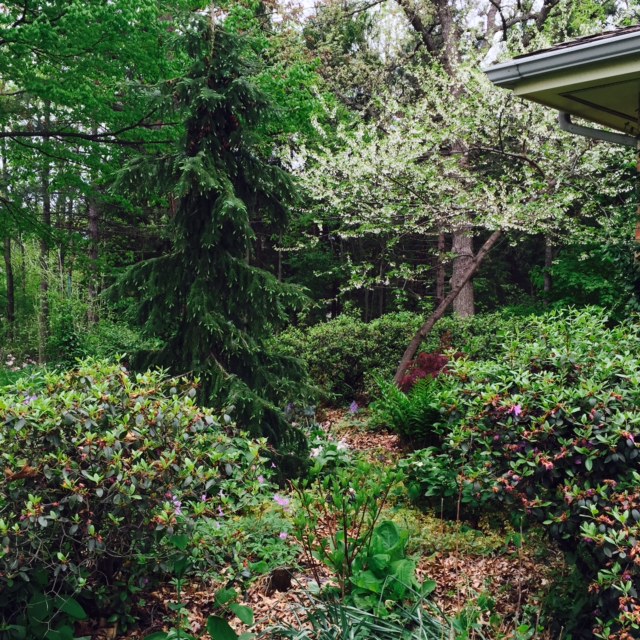 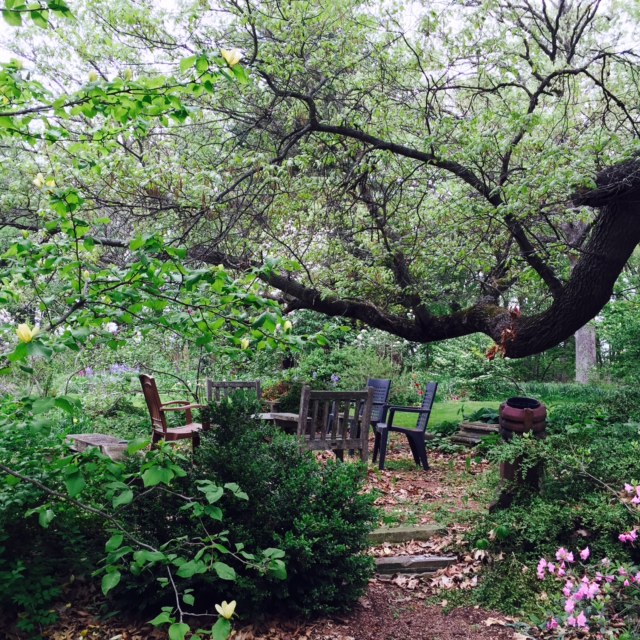 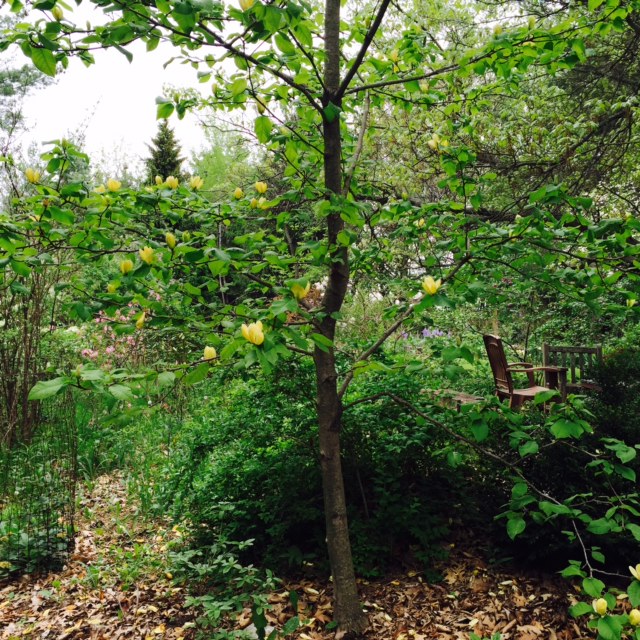 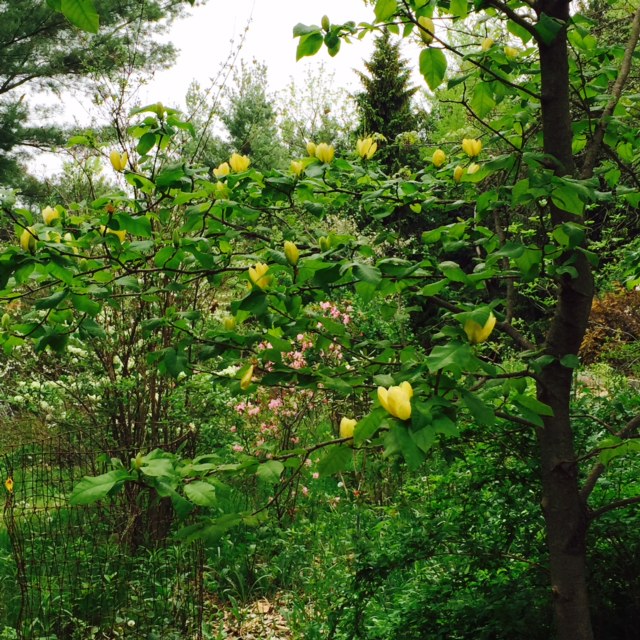 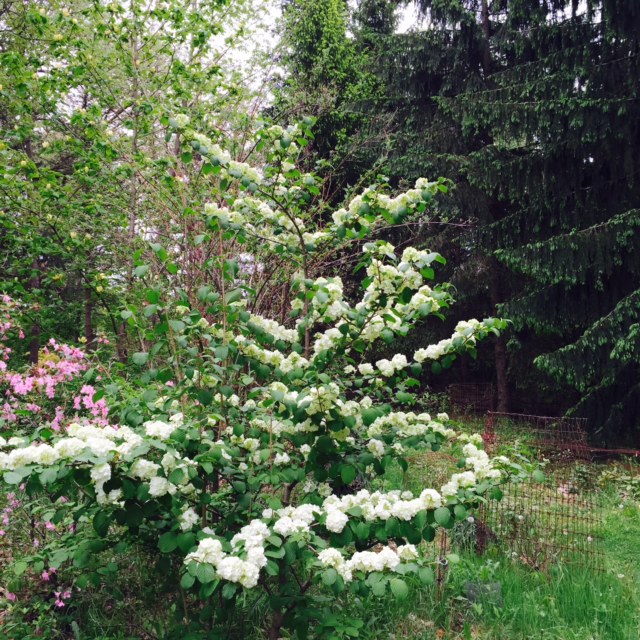 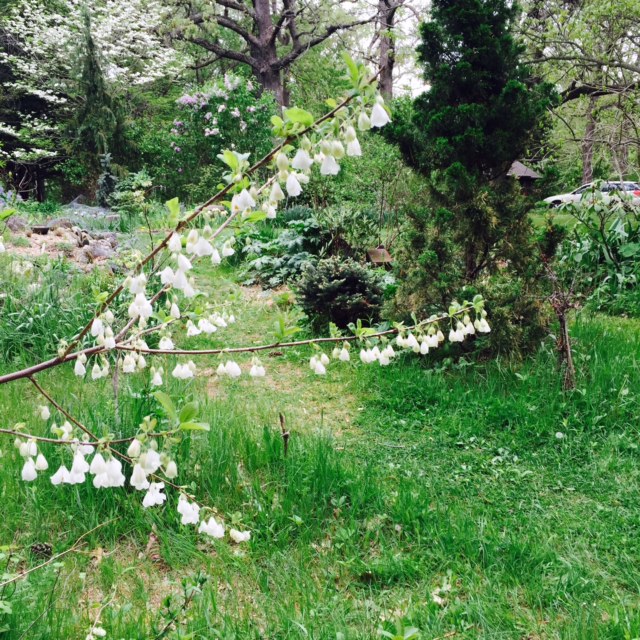 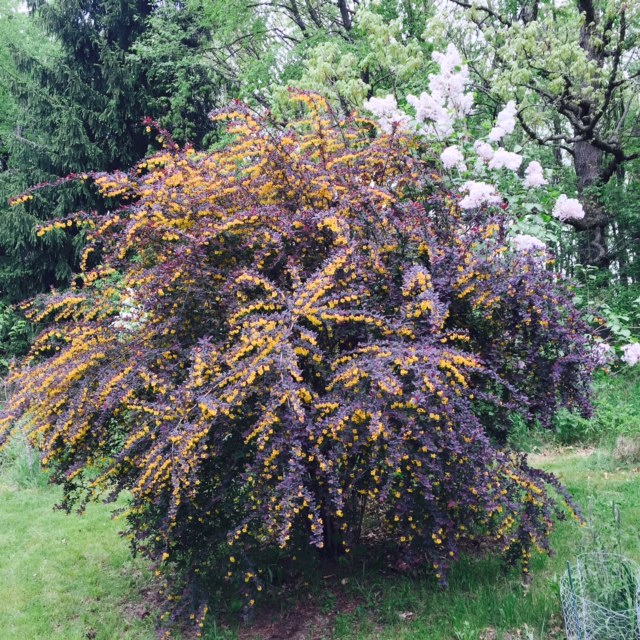 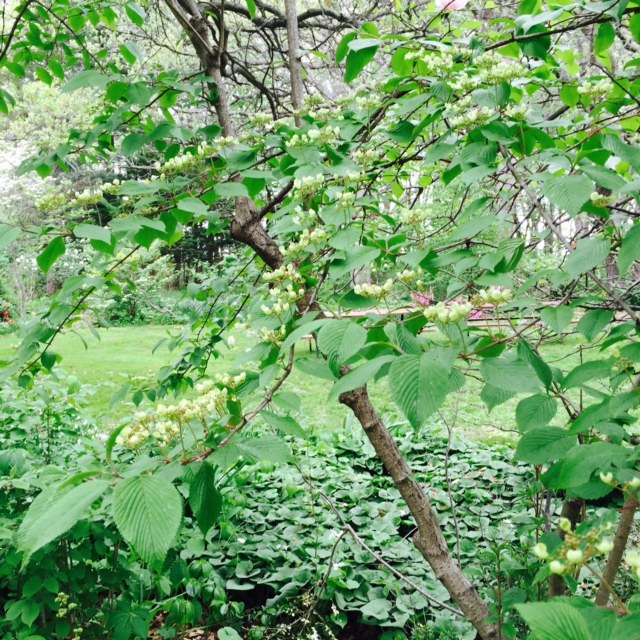 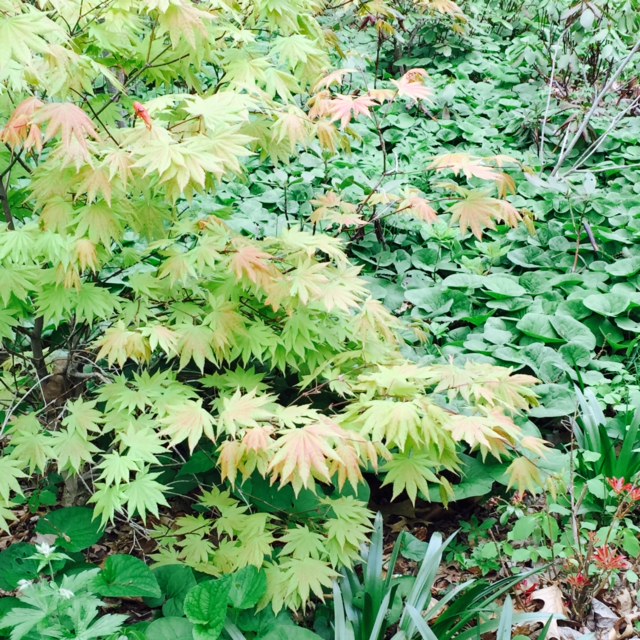 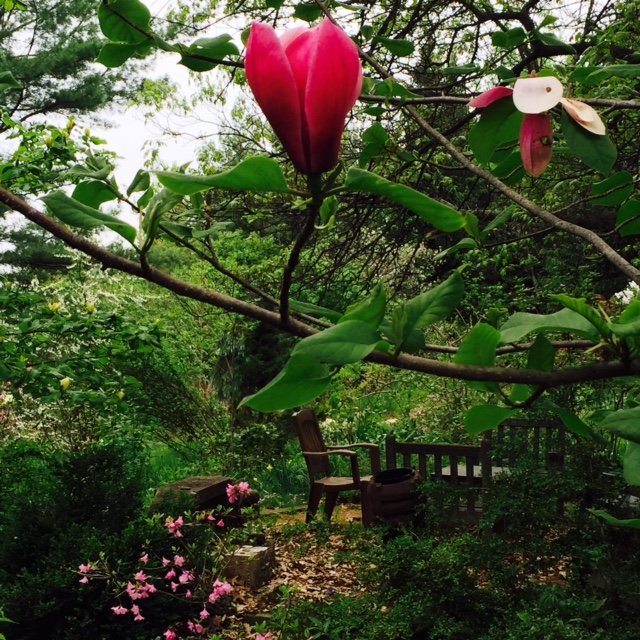 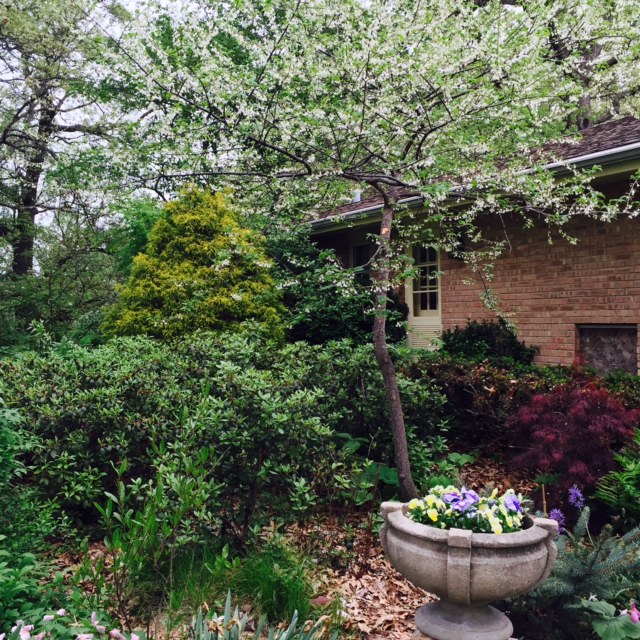 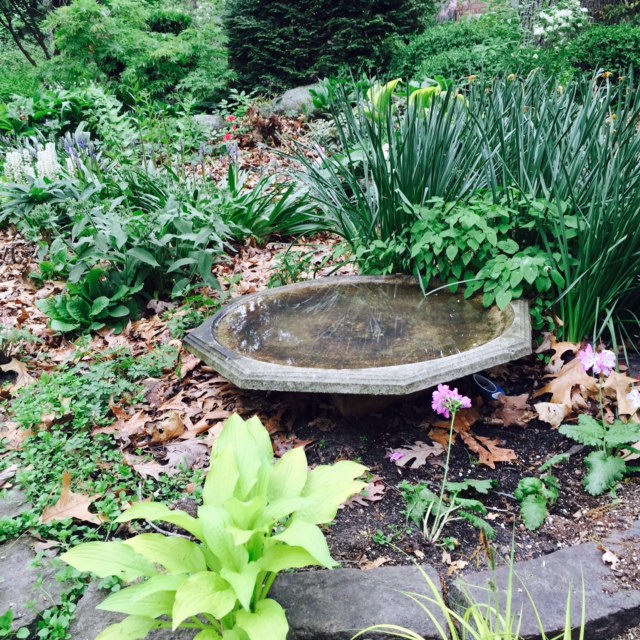 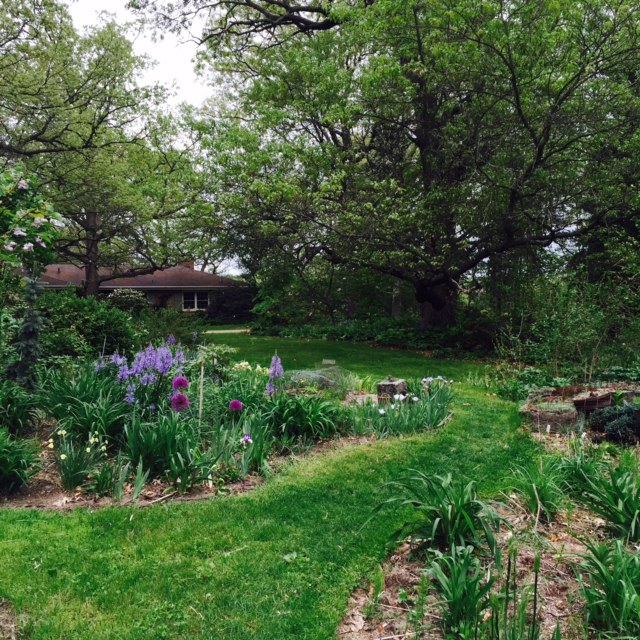 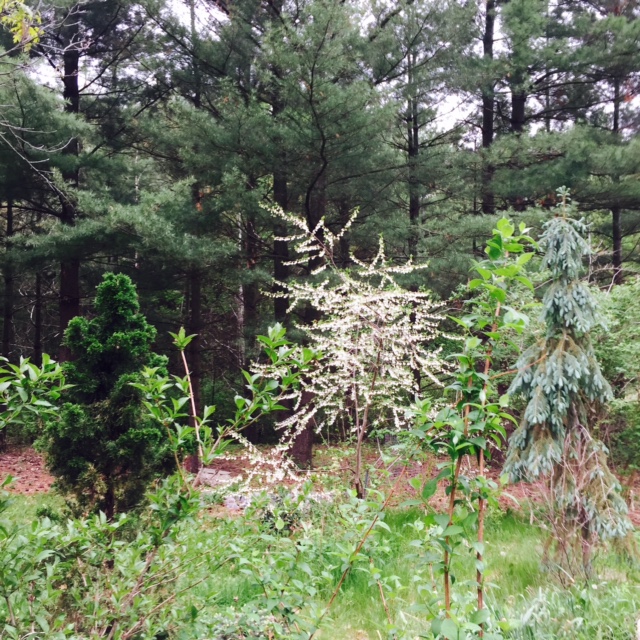 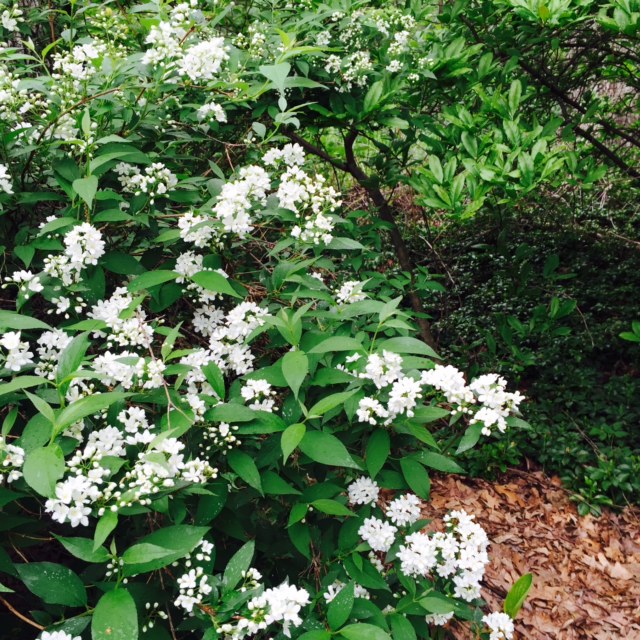  Beautiful, it's it? Like a little bit of paradise here in southwestern Wisconsin.
Hope you enjoyed the tour. Next week we'll visit a rose garden, so stay tuned! Think spring, Tracy Hankwitz BGC Store Manager & Horiculturist 10/30/2015 0 Comments Project: Fall Forage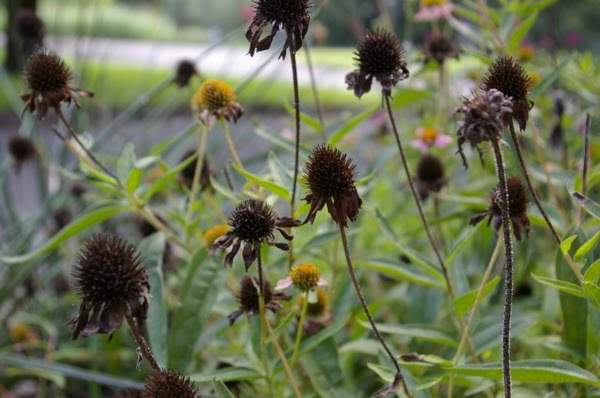 photo source: the-grackle.blogspot.com As October quietly slips into November, there is still much beauty in the fall landscape. Hunting for seed heads, nuts, leaves, and berries on an autumnal forage is a fun challenge. Here are two projects we recently did with the bounty we collected: 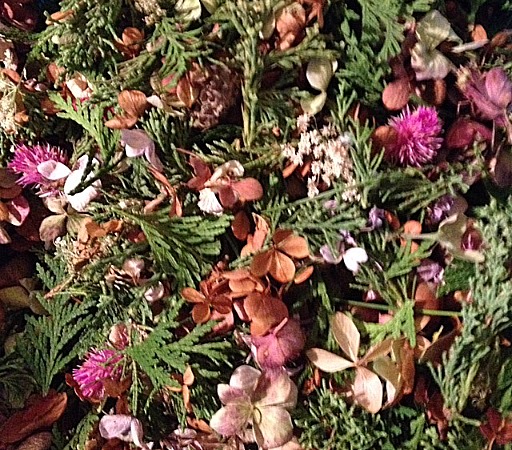 PROJECT: Woodland Potpourri Gather dried flower blossoms, berries, bark, evergreens, etc . . and dry completely. Mix together and add a favorite essential oil. BGC staffer, Barb Henken, has made the beautiful potpourri above. It will be available for purchase here at BGC in mid-November. * 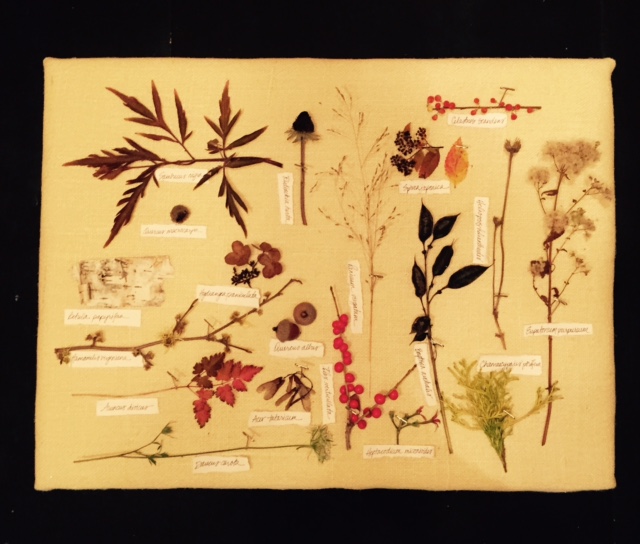 PROJECT: Fall Forage Collection Board
Gather interesting seed heads, berries, and other bits of nature. Using upholstery T-pins, attach each specimen to a bulletin board that has been covered with batting blanket and burlap. Some items may need to be pressed in a book for a few days first to dry flat. Others may need to be adhered with adhesive. Add botanical names written on torn pieces of paper. Enjoy! 9/18/2015 0 Comments Fall Container Gardening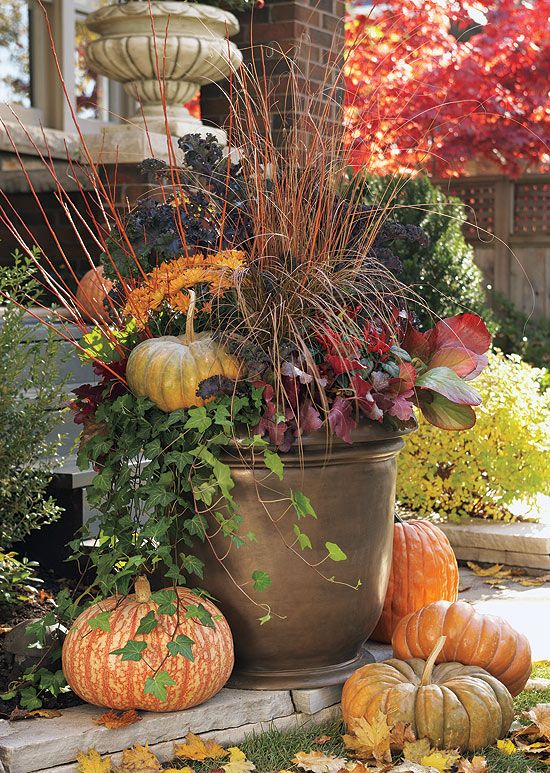 photo source: lifeonvirginiastreet.com Mums not the only word when it comes to fall color in containers. Refresh tired planters with kale . . . 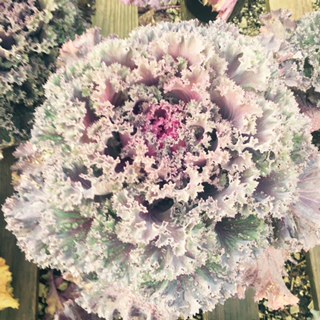 pansies . . . 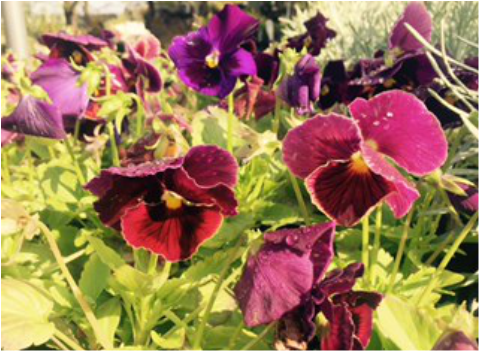 and grasses like this hardy 'Blonde Ambition'. 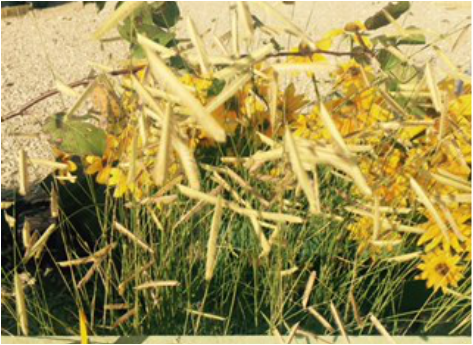 Fall Rudbeckias (Rudbeckia hirta) come in beautiful colors of rust, reds, and yellows. Though not hardy in Wisconsin, many will often reseed the following year. Some favorites we have at the shop are 'Prairie Sun' . . 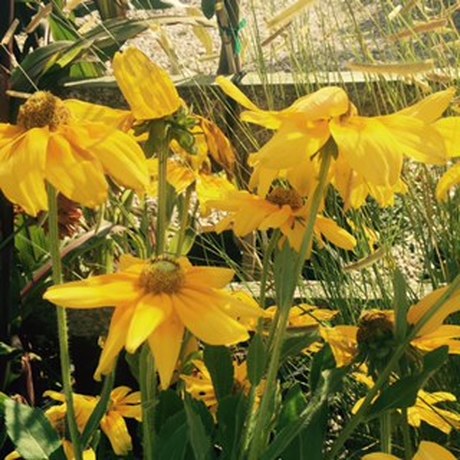 'Indian Summer' . . . 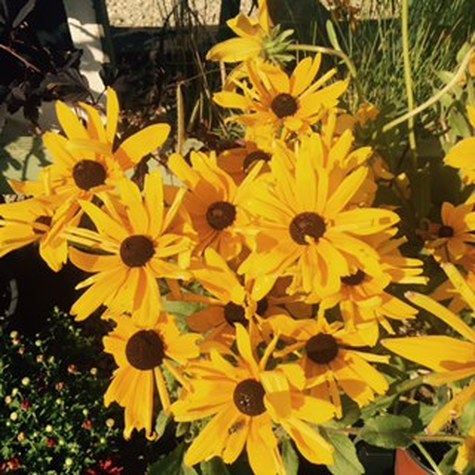 and 'Cherokee Sunset' which is a delightful mix of varieties. 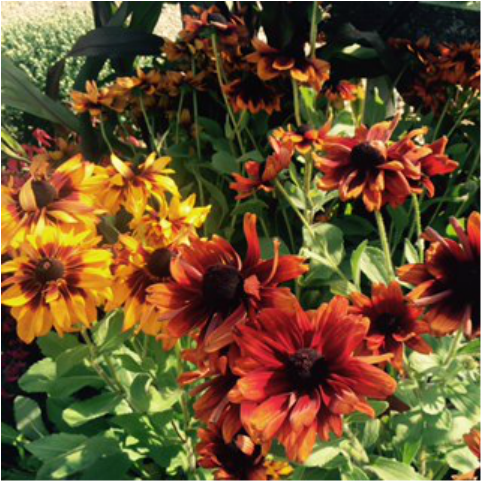 Add in an edible like leaf lettuce. Herbs such as rosemary, sage, and thyme bring scent and texture to the composition. 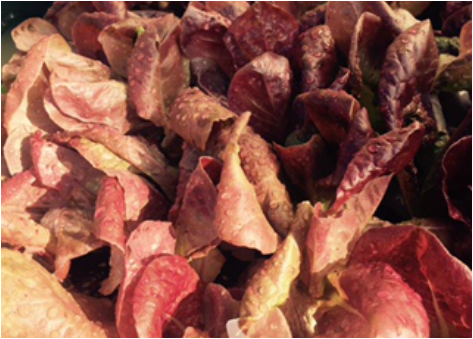 Even perennials should make their way into pots before being tucked into the ground for the winter. Coral bells (Heuchera) add shades of amber, chartreuse, and purple. Asters, ferns and sedums are reliable, end-of-season performers. 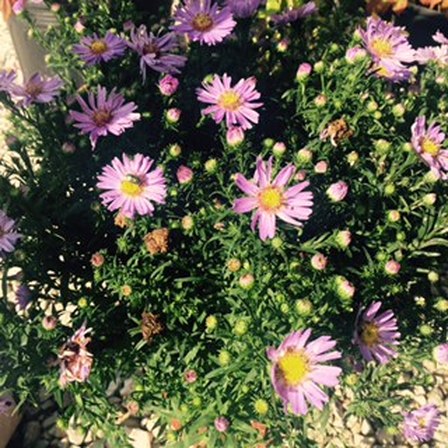 Garnish with a small pumpkin as a finishing touch and embellish the entire arrangement with wispy bittersweet vines or branches with architectural interest. 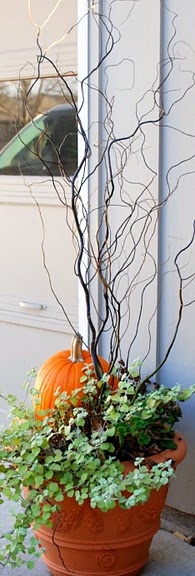 photo source: picasaweb.google.com 9/3/2015 0 Comments How to Use Ornamental Grasses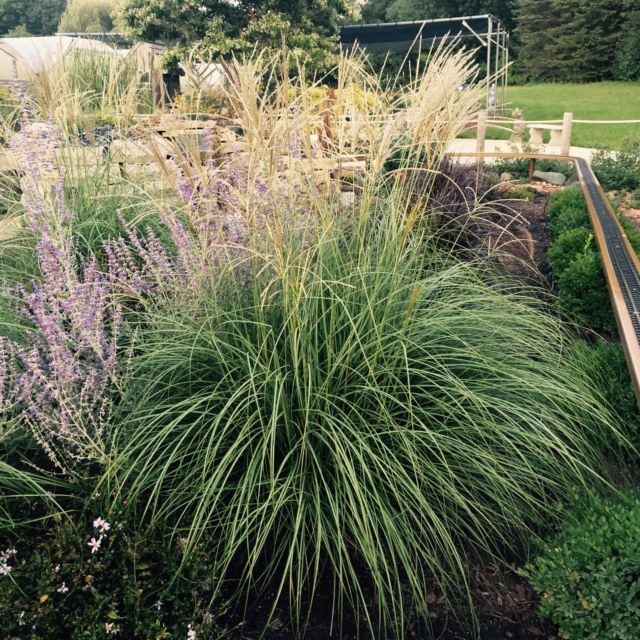 Miscanthus 'Adagio' Looking for something easy to care for, low-maintenance with little-to-no insect or disease problems? Hardy ornamental grasses are a no-brainer addition to the landscape. Unassuming in spring and summer, they come into their own in time for a spectacular autumnal show. But which one is right for you? At last count, we have 15 varieties to choose from and that's only a drop in an ocean of grasses out there. Read on to learn a little about a few of our favorites and their use in the landscape. One of our favorites is Miscanthus sinensis 'Adagio' (shown above and featured in our Railroad garden here at BGC). It's fine foliage grows 36" in an arching habit. Seed heads mature to white. Intermingle several 'Adagios' with Russian Sage. * 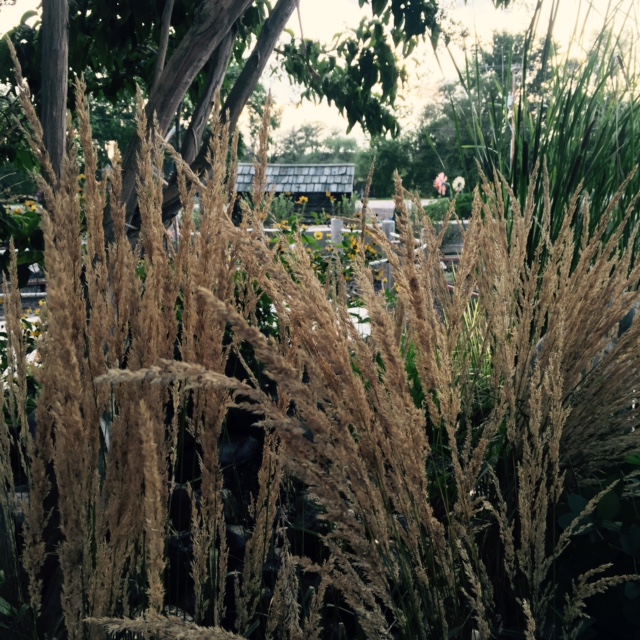 Calamagrostis 'Karl Foerster' This upright clumping grass, Calamagrostis 'Karl Foerster' (Feather Reed Grass) is one of the earliest flowering grasses. It's biggest problem is that it's overused because we all like it so much! Calamagrostis 'Overdam' is similar yet it's variegated foliage sets it apart (see below). Use with lower mounding perennials like 'Autumn Joy' Sedum. 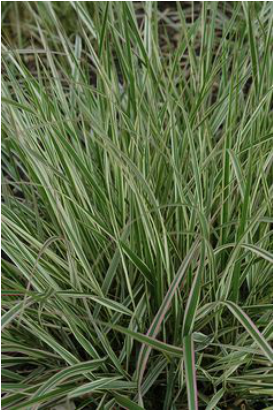 Calamagrostis 'Overdam' * Front-of-the-Border Grasses 12-24" tall This group of shorter grasses are good for along walkways and front of the border. Pair them with taller perennials like coneflowers (Echinacea), Black-eyed Susans (Rudbeckia), and Asters. 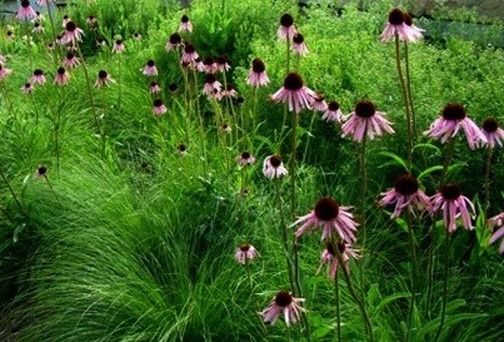 Prairie Dropseed (Sporobolus heterolepis) planted with coneflowers. photo source: wildones.org 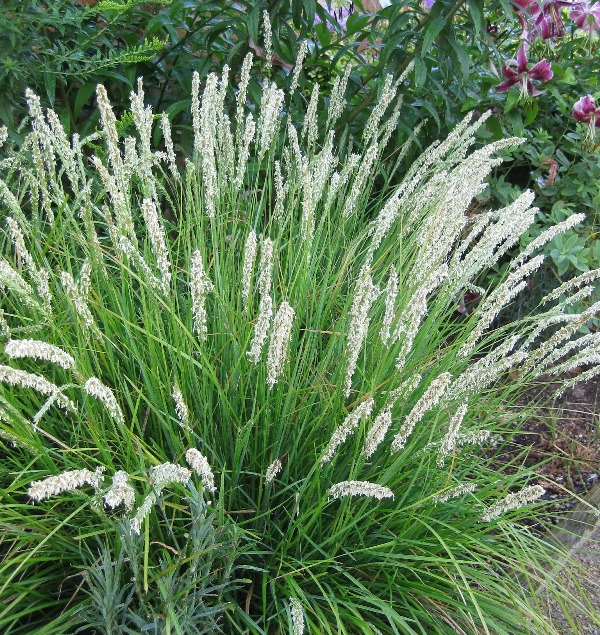 Autumn Moor Grass (Seslaria autumnalis) will grow in part shade and looks stunning when planted in drifts with purple salvias. photo source: rotarygardens.blogspot.com 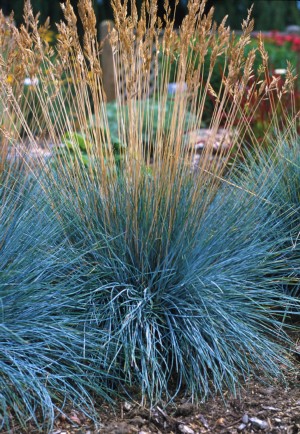 Pair Blue Oat Grass 'Sapphire' (Helictotrichon sempervirens) with lavender for a soft look or with burgundy-toned shrubs for more contrast. photo source: erisglobal.com * Middle-of-the-Border Grasses 24"-36" tall 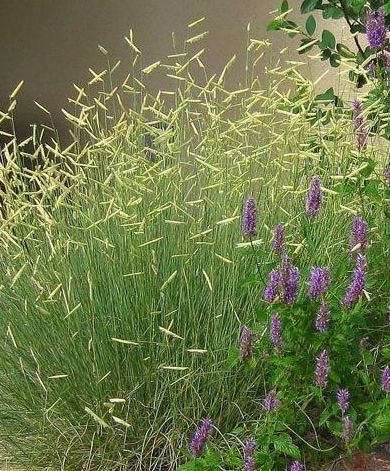 'Blonde Ambition' Blue Gramma Grass (Bouteloua gracilis) has interesting horizontal seed heads. Looks nice above planted with Agastache. photo source: pinterest.com 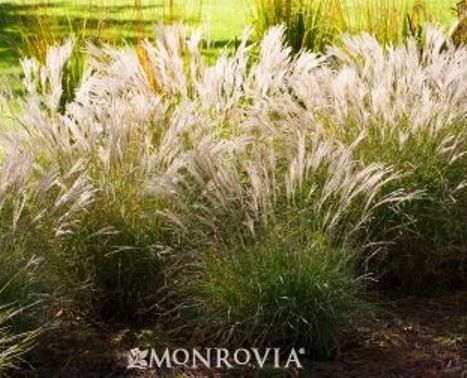 'Little Kitten' Maiden Grass (Miscanthus sinensis) grows 3 feet tall, can stand alone as a specimen or fabulous in drifts. Also works well planted in a container for fall. 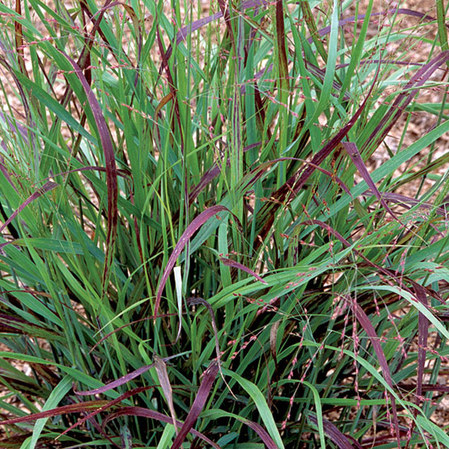 'Shenandoah' Switch Grass (Panicum virgatum) has burgundy seed heads and burgundy foliage. Pair it with blue-toned conifers like junipers, low-growing blue spruces, and burgundy coral bells (heuchera). photo source: grimmsgardens.com * Back-of-the-Border Grasses 48" and taller 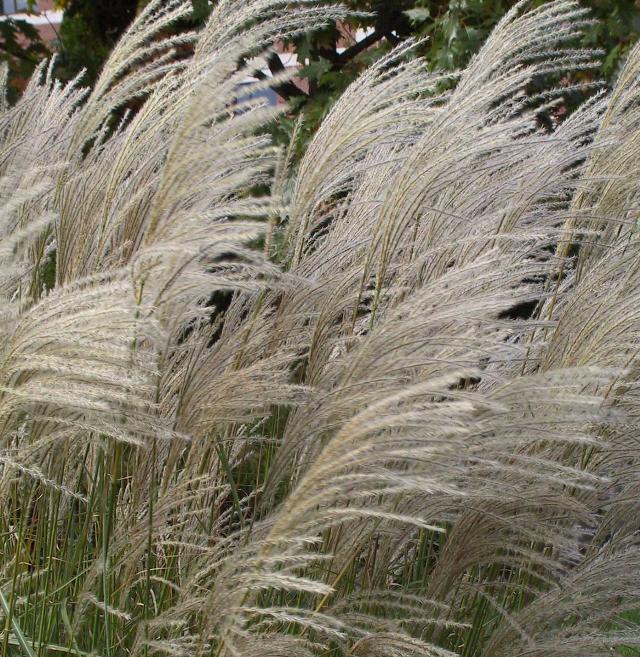 Graziella Silver Grass (Miscanthus sinensis) adds graceful movement to the landscape. Similar in looks to pampas grass, but Graziella is a clumping grass and does not spread. It grows 48-60" tall and makes a good screen in the summer and fall. photo source: thesitegardener.com 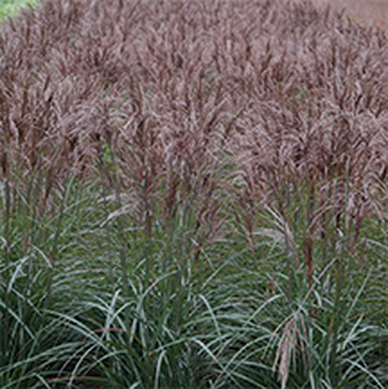 Oktoberfest (Miscanthus sinensis) has an upright habit that grows 6-7' tall. Burgundy flowers turn creamy tan as the season progresses. Plant with evergreens (3-4' tall) and drifts of fall blooming perennials like Rudbeckia and tall Sedum. photo source: rootsrhizomes.com 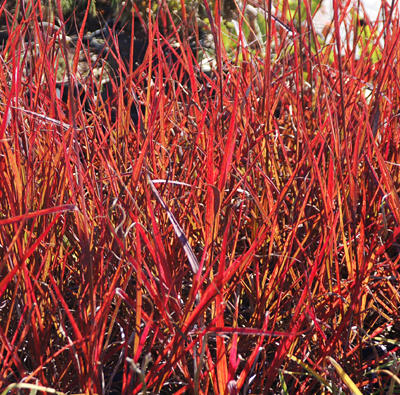 'Red October' Big Bluestem (Andropogon gerardii) has an upright habit up to 6'. Blue-green foliage has red tips that turn burgundy in August, then brilliant red after the first frost. Plant with shorter grasses and shrubs with mounding habits, goldenrod, helenium, and low-growing evergreens. photo source: songsparrow.com 8/20/2015 0 Comments 6 Cool Overlooked HostasOn a hot, summer day, why not garden in the shade? Following are six favorite hostas and why they deserve a spot in your garden. 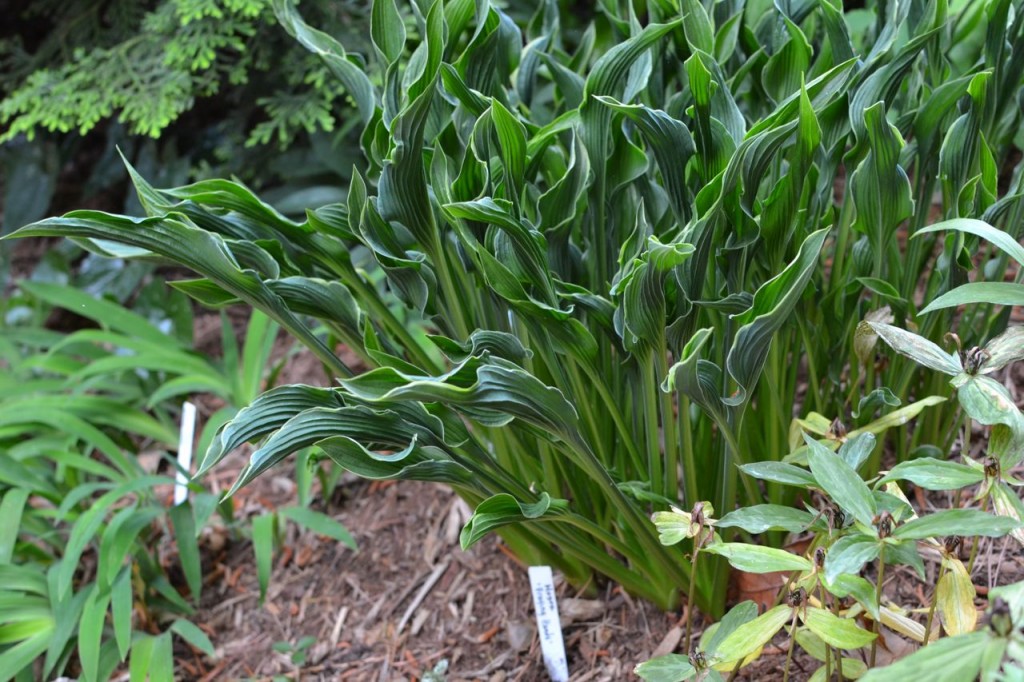 'Praying Hands' photo source: hvgardenjournal.com Hosta 'Praying Hands' Why it's worthy: unusual leaf shape, award-winning How to use it: along a path in the shade garden, in meditation garden, with religious statuary, planted with ferns * 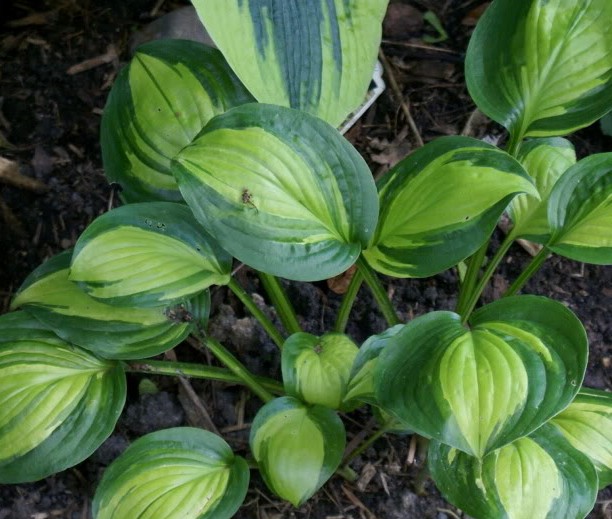 'Adorable' photo source: forum. gardenweb.com Hosta 'Adorable' Why it's worthy: compact color in the shade, fragrant white flowers How to use it: plant with chartreuse foliage of 'City Lights' or 'Sum and Sumstance' or Japanese Forest Grass (Hakonechloa) * 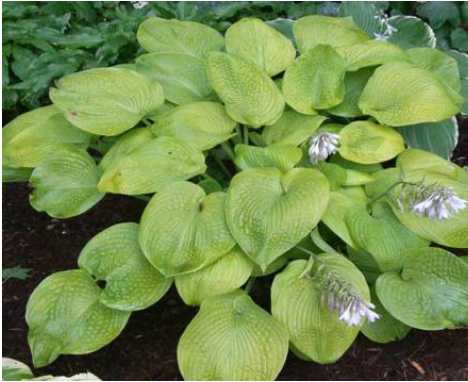 'City Lights' photo source: greenmountainhosta.com Hosta 'City Lights' Why it's worthy: thick, corrugated leaves, 24"x36" How to use it: give it a couple hours of morning sun for best coloring; pair with pink astilbe or purple heuchera (coral bells). * 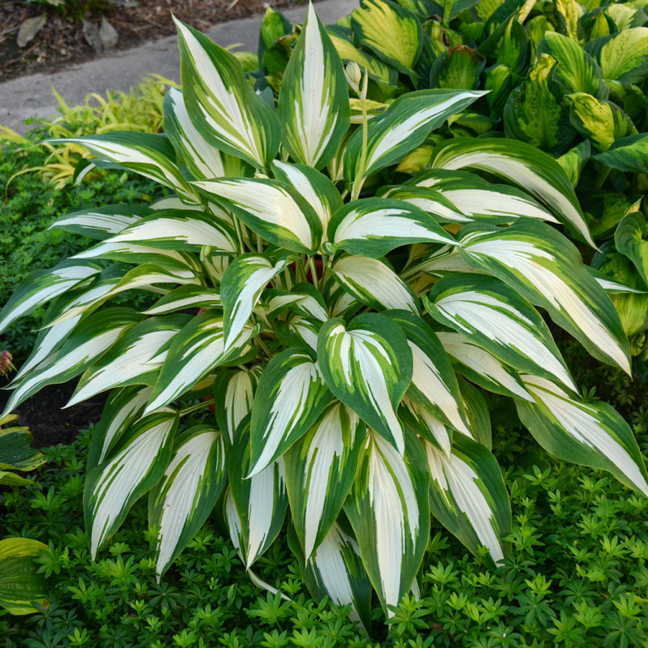 'Cool as a Cucumber' photo source: waysidegardens.com Hosta 'Cool as a Cucumber' Why it's worthy: elegant, arching habit, 28" tall x 48" wide How to use it: pair with solid green hostas, dark green ground cover (Sweet woodruff pictured above.) * 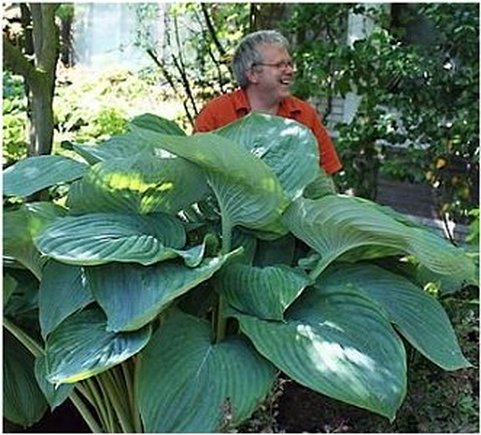 'Empress Wu' photo source: empresswuhosta.com Hosta 'Empress Wu'
Why it's worthy: Wow! Need we say more? How to use it: use as a specimen plant or back of the border- give it room! 4'tall x 6'wide.  BEFORE BEFORE I am always amazed when I drive by homes that have absolutely no foundation plantings around them. It not only diminishes the "curb appeal", but leaves the property lacking in personality. Whether the home is decades old or recently built, they all can be transformed with a little TLC (Tasteful Landscape Composition). CONSIDERATIONS I recently worked with a customer who purchased a home that had not been previously landscaped. For me it was a designer's dream...a blank canvas to work with. After viewing the property and taking photos, I also took notes as to what type of plants to specify, keeping in mind the following considerations:
Utilizing our new landscape design computer program here at Burlington Garden Center, I was able to make a list of plants that would work and set about creating a design that satisfied the above-mentioned criteria.  AFTER SOLUTIONS
Plants were also selected for the soil condition and ease of maintenance for the homeowner. If you would like more information on our Landscape Design Services, call 262.763.2153 or send an email to: info@burlingtongardencenter.com Belinda Abendschein Landscape Designer, Nursery Manager Burlington Garden Center 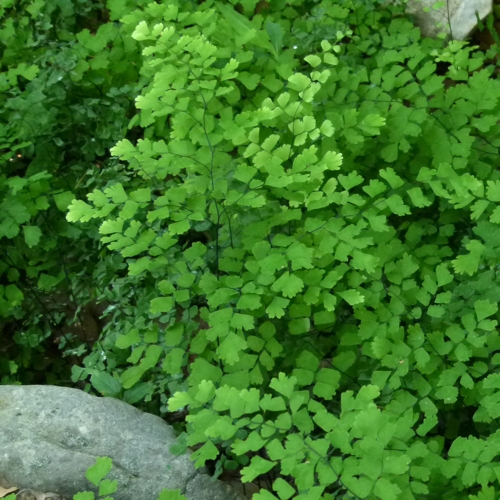 Back in the mid-1800's parts of England were gripped by 'pteridomania', also known as fern fever. Victorians were fascinated by the diversity in appearance, cultural requirements, and how they reproduced. Greenhouses and ferneries were constructed to house the vast collections brought from far travels. We've got a touch of pteridomania here at BGC and hope you'll catch it, too! Whether you intend to collect many varieties to create your own outdoor fernery, or simply enjoy a couple favorites, ferns can be mixed into the shade garden among broad-leaved hostas and other shade lovers. Ferns in general like moist, organic soil in part to full shade. We have ten varieties that are hardy here is Wisconsin to get you started. Here we feature seven of them. 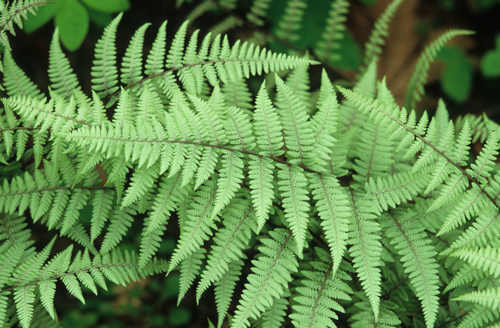 photo source: nurseryguide.com Let's begin with the Athyrium group of ferns which includes the popular Japanese painted fern. Above is Athyrium x 'Ghost' which is a cross between the Japanese Painted fern and the Lady fern. 'Ghost' has upright silver fronds that can reach 24". It really catches the eye in the shade garden. * 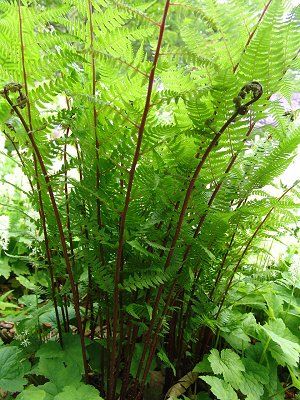 photo source: abnativeplants.com 'Lady in Red' (Athyrium filix-femina) is stunning when back lit by dappled sunlight. Grows 18-30". * 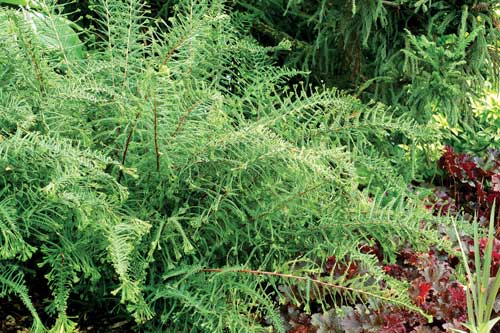 photo source: plantsforshade.co.uk If you want something unusual, Athyrium 'Ocean's Fury' is for you. Look carefully at the photo above and you'll see that the tips of each leaflet are forked or crested. 'Ocean's Fury' makes a lovely 3'x3' mound of gray-green lacy foliage. * 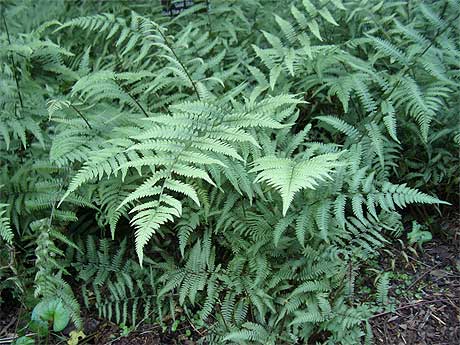 photo source: crownsvillenursery.com One more from the Athyrium group to mention is 'Branford Beauty'. A cross between the Japanese Painted and Lady ferns gives it colorful leaves and a soft look. Give this fern morning sun to get the best leaf coloring. Grows 18"x18". * 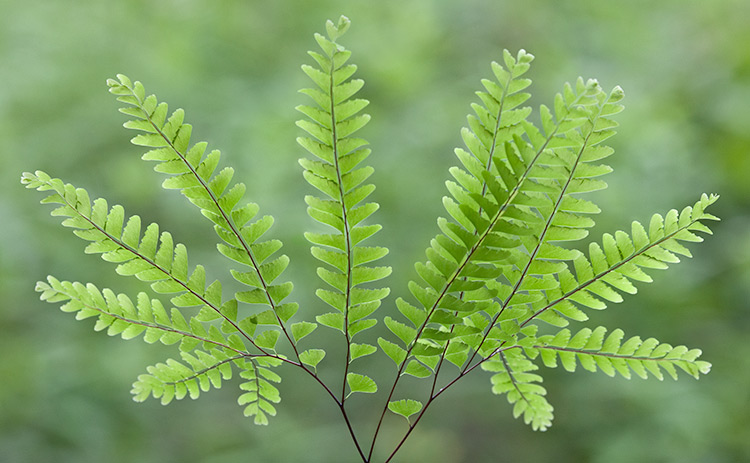 photo source: pgtnaturegarden.org Maidenhair Fern, Adiantum pedatum, is a Wisconsin native and has delicate fan-shaped fronds on wiry, black stems. Grows 12-16". * 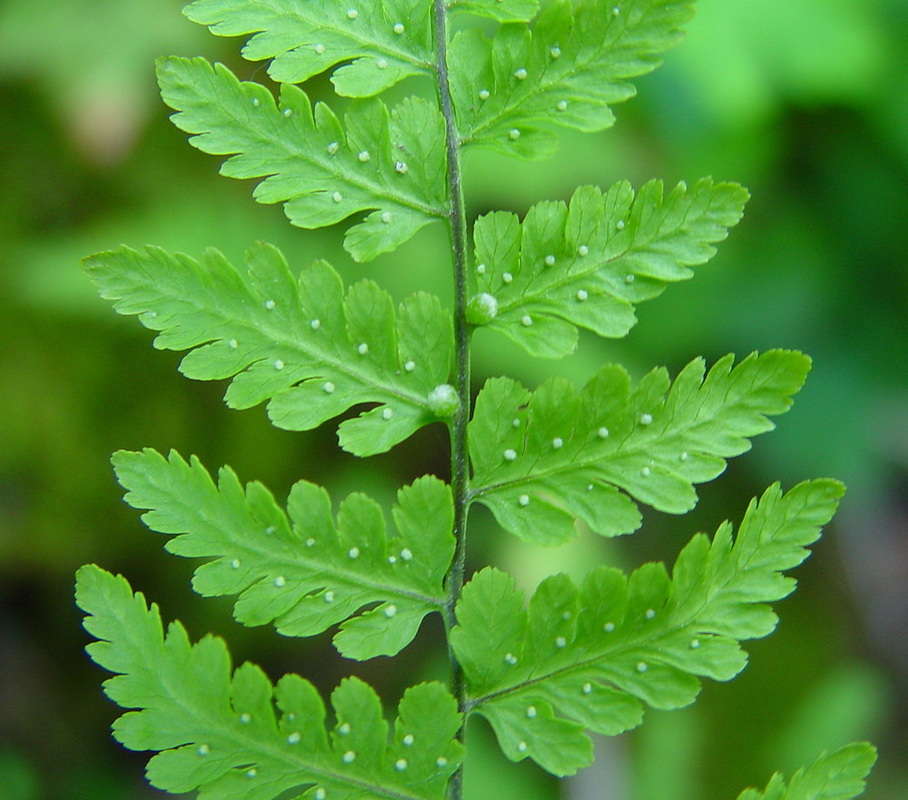 photo source: gobotany.newenglandwild.org Berry Bladder Fern, Cystopteris bulbifera, is a delicate looking fern that spreads by bulblets instead of spores and can grow to 12" tall. * 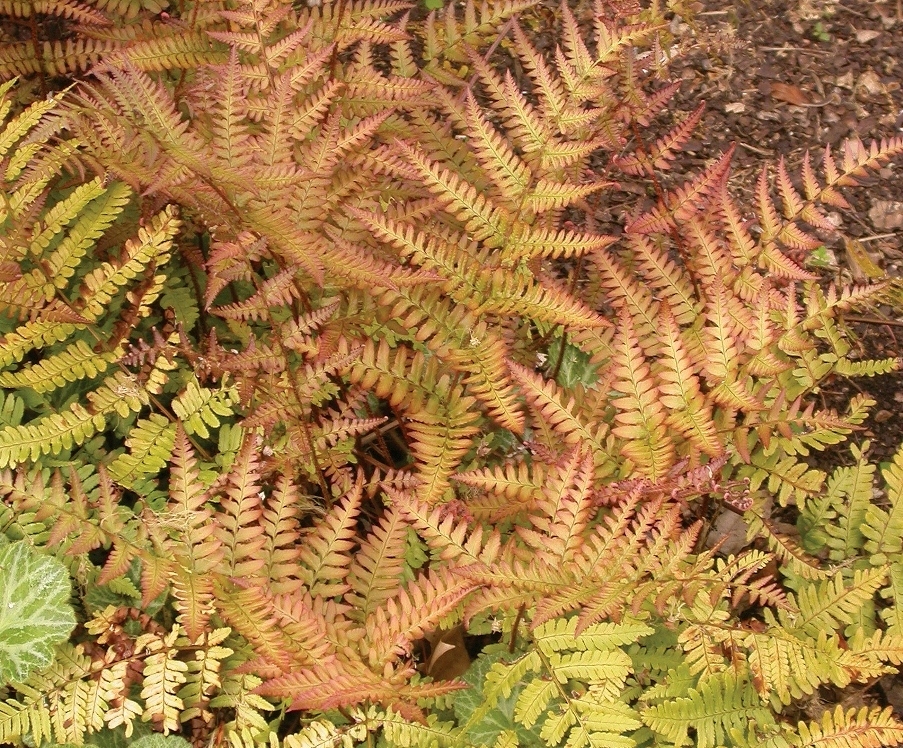 photo source: monrovia.com This last one is a staff favorite and sure to win you over. Brilliance Autumn Fern, Dryopteris erythrosora, has coppery-red new foliage that turns dark green when mature. Grows 18-24" and spreads by runners.
7/22/2015 0 Comments Perennial Pick: Summer Alliums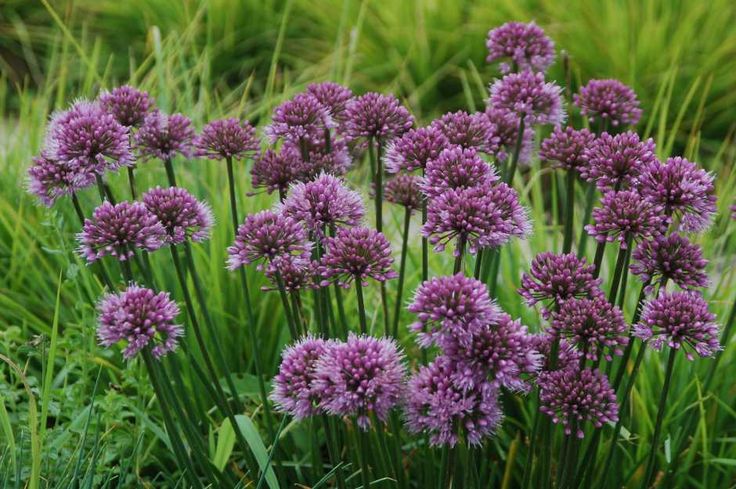 Lavender Lollipop photo source: greenhousemanagement.com Many of us are familiar with the spring-blooming alliums - the big purple balls atop of tall bare stems. With names like 'Gladiator', 'Globe Master', 'Mount Everest' and Allium giganteum, you can expect them to make a big impression in the garden. Planted as bulbs in the fall or potted perennials in the spring, they send up their leaves in early spring, followed by huge balls of purple or white that shoot up and open like fireworks. Even as they dry on the stem, the flowers add interest to the garden. Lesser known alliums include two of my favorites: Allium 'Summer Beauty'(shown below) and Allium 'Lavender Lollipop' (shown above). They bloom mid to late summer and though smaller in stature, they add a whimsical touch lasting well into the fall. 'Lavender Lollipop' (Allium x 'Windy City') is a new introduction from Brent Horvath from Intrinsic Perennial Gardens located in our backyard in Hebron, IL. It's a deeper shade of purple, floriferous, and stands tall on 15-18" stems. Like other alliums, they need full sun, are drought tolerant and deer resistant. 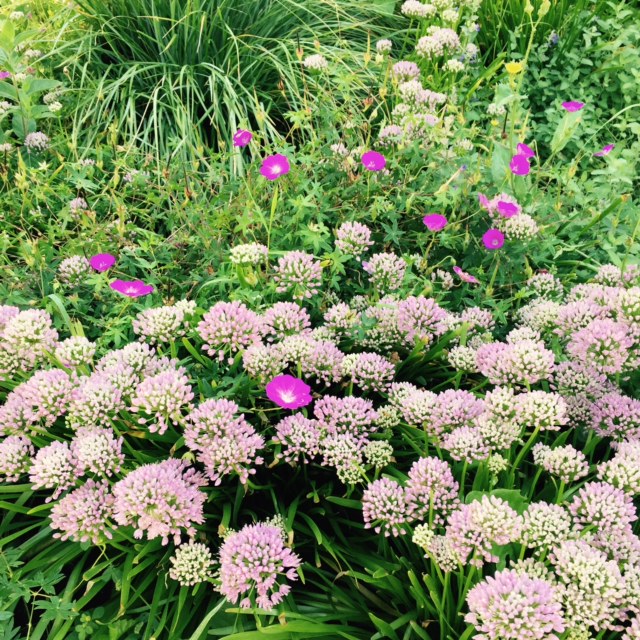 Allium x 'Summer Beauty' is a good companion to several other perennials such as hardy geraniums (above). * 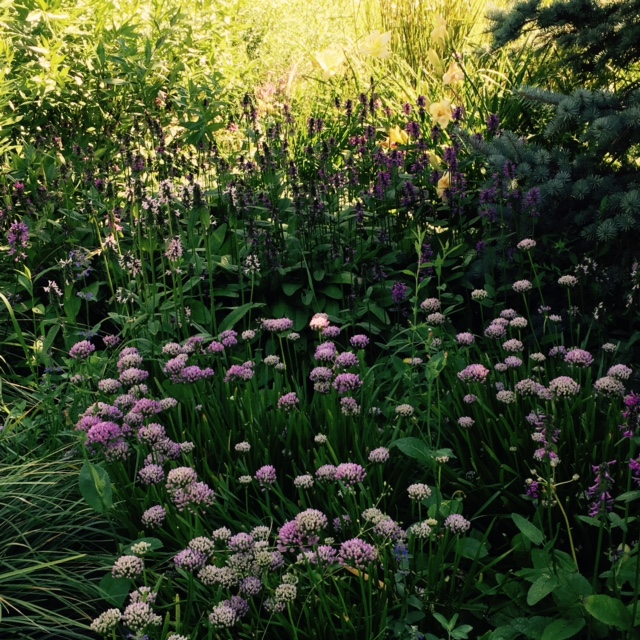 The deep purple of Stachys officinalis or Salvia 'Cardonna' along with the blue spruce make a nice backdrop for these allium clumps. * 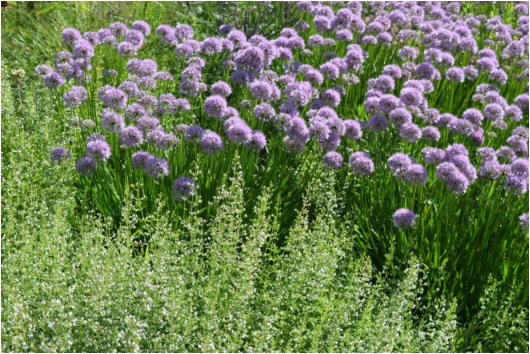 photo source: gardeninacity.wordpress.com Alliums planted in drifts with Calamintha nepeta 'White Cloud'. * 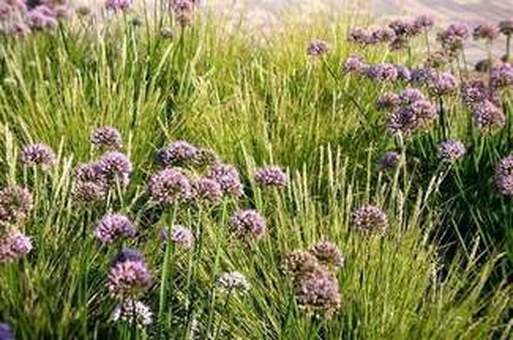 photo source: dailyherald.com Grasses like Seslaria autumnalis (Autumn moor grass) or Sporobolis heterolepis (Prairie dropseed), Echinacea (coneflowers), and Perovskia (Russian sage) create a natural prairie-like setting for summer alliums.
Though they look like their cousin, common chives, summer alliums are ornamental onions, not edible. They have a sterile seed so they stay well behaved in their clumps, Stop by and pick up an allium or two and add some whimsy to your garden. - Tracy Hankwitz, BGC Store Manager 7/15/2015 1 Comment Design Study: A Perennial Border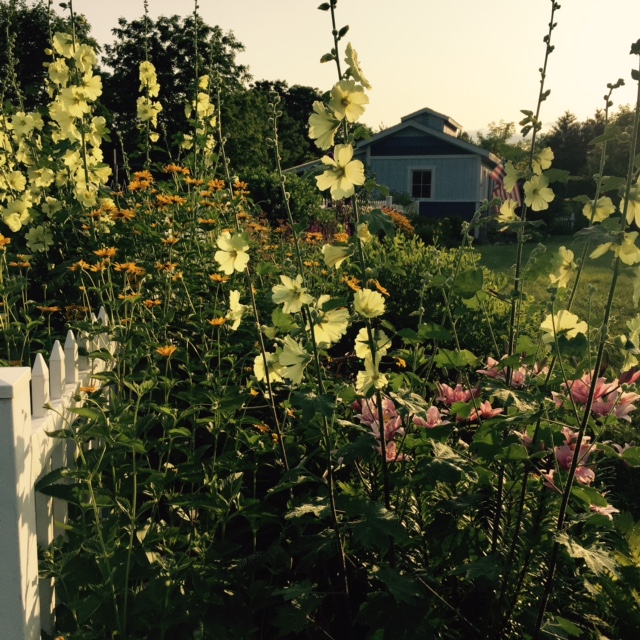 Midsummer finds many perennials at their peak, so I recently took the opportunity to visit a nearby perennial garden. The garden belongs to BGC Staff member, Sharon Marrano, and has a few design examples that we all can learn from and apply to our own perennial gardens. * 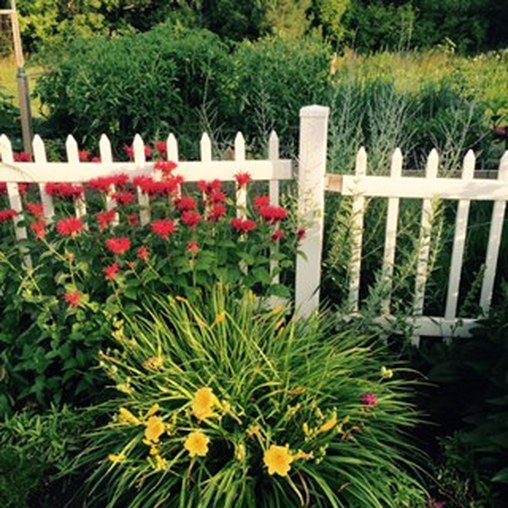 The white fence provides a clean backdrop showing off plantings on each side. DESIGN TIP #1: Spread out. Allow enough space for each type of perennial to do it's thing. Here, red monarda, yellow daylily, and almost-ready-to-bloom Russian sage, each have 2.5-3 feet of space to fill. Also notice the staggered height of the three plants. * 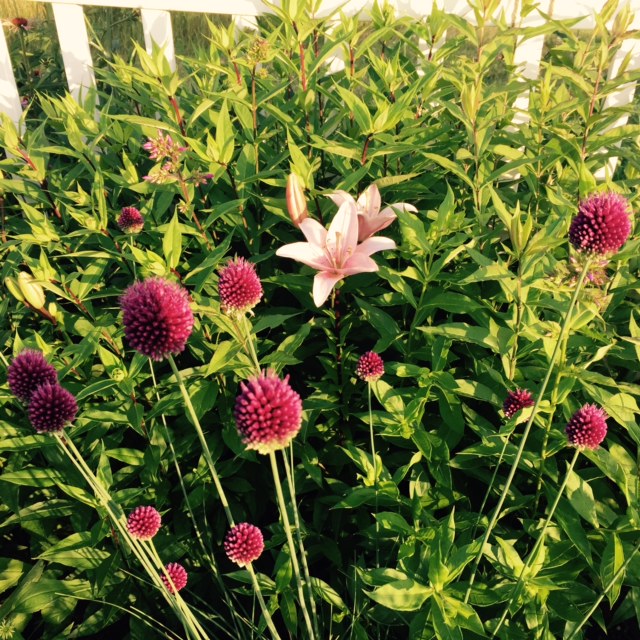 DESIGN TIP #2: Vary flower form. The flowers of the lily, allium, and phlox (in back) are all shades of pink. It works in this space because each variety has a different flower shape. * 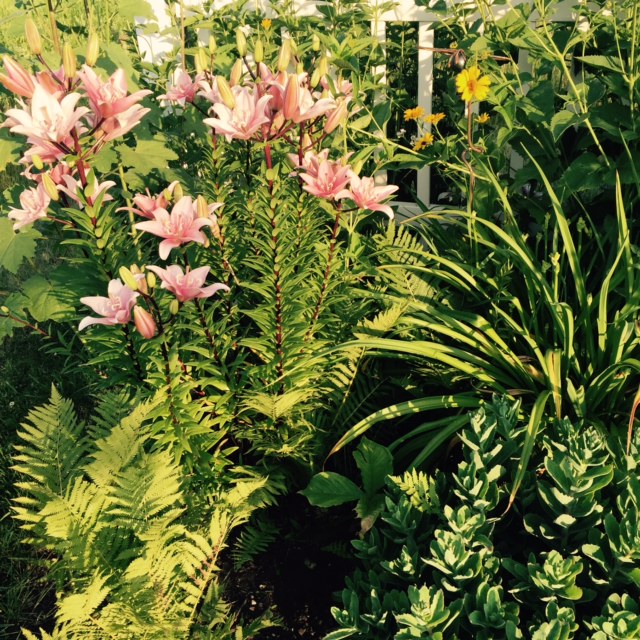 DESIGN TIP #3: Hide spent foliage. Oriental and Asiatic lilies are lovely when in bloom, but once they are finished, the foliage left behind can be an eyesore. Here Sharon has planted interplanted ferns with the lilies to disguise the declining leaves and stems of the lilies. * 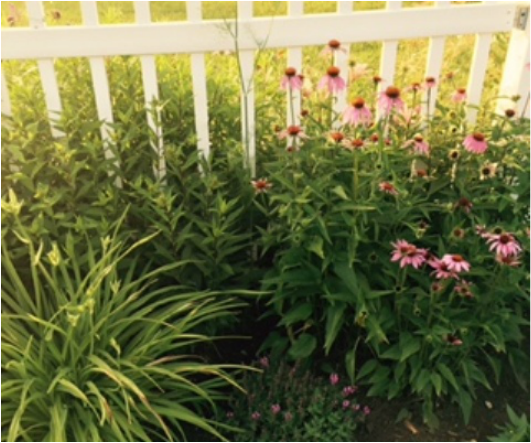 DESIGN TIP #4: Vary leaf texture. When pairing perennials in the garden, it's important to consider the leaf texture. If done well, the foliage will continue to be interesting long after the flowers are done blooming. The coneflowers (on the right in the photo above) have a medium leaf texture. The bright green grass-like leaves of the daylily on the left provide good contrast. To the left of the daylily is a large clump of tall sedum (shown below) bringing fall color as well as a round, fleshy leaf texture. 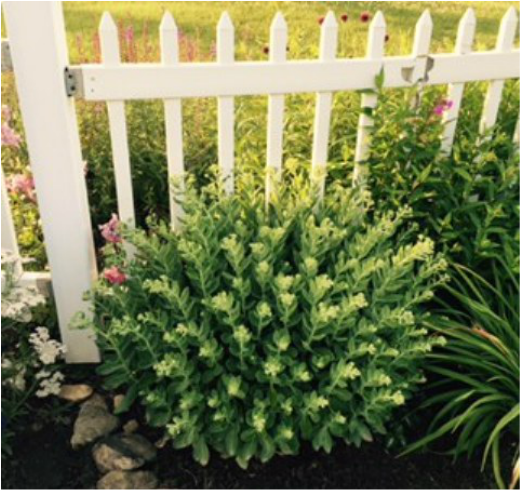 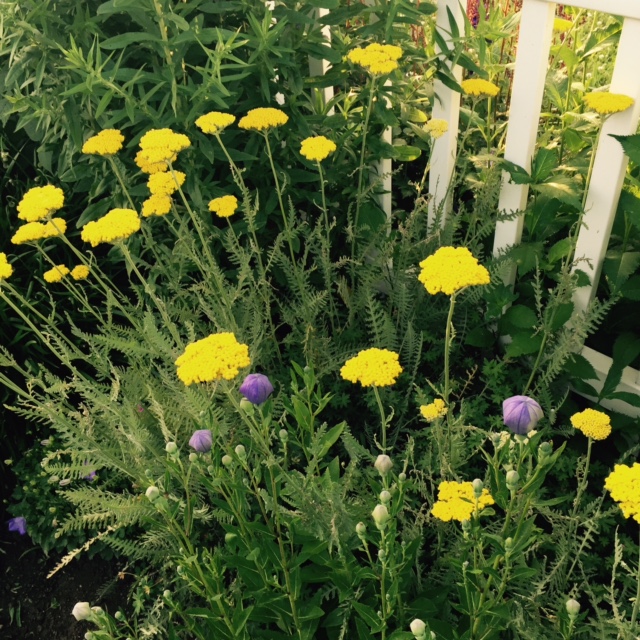 DESIGN TIP #5: Let plants intermingle. Yellow yarrow and blue balloon flowers (above) make good partners coming from opposite sides of the color wheel. Instead of manicuring them into their own clumps, Sharon has allowed them to intermingle for a cottage garden look. * 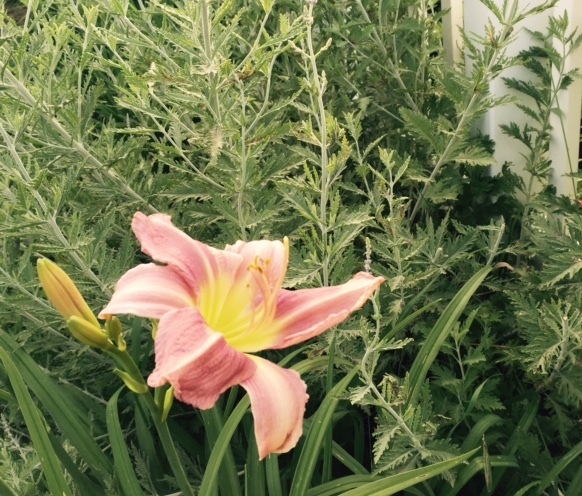 DESIGN TIP #6: Play with color. The soft gray foliage of Russian sage makes a nice background for the pastel pink and yellow daylily (above). Bold colors catch the eye in this grouping of red monarda, purple delphinium, and yellow coreopsis (below). 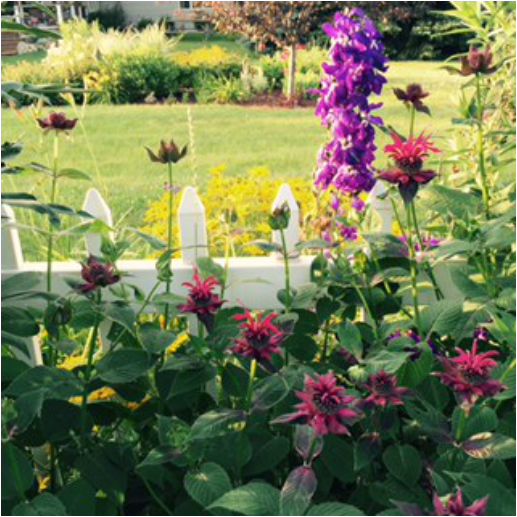 I'm off to the garden to move a few of my perennials. Until next time, happy gardening! - Tracy Hankwitz
Horticulturist & Store Manager of Burlington Garden Center 7/15/2015 1 Comment Project: Homemade Vanilla Extract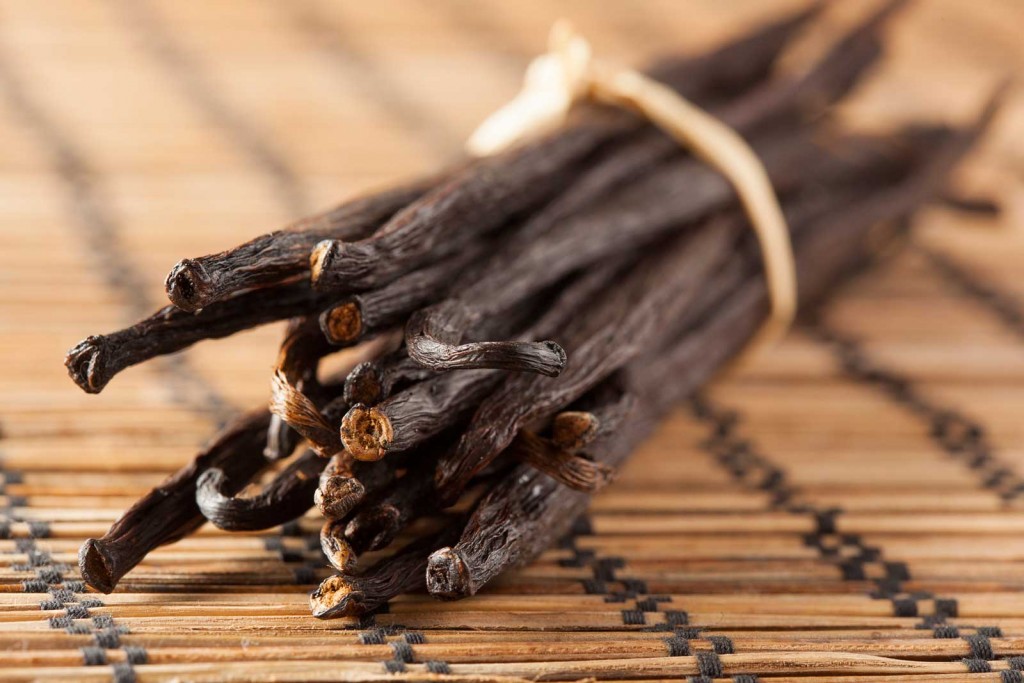 photo source: nutiana.com Do you want to know the secret for yummy baked goods?Homemade vanilla extract. It's easy to make and so worth the wait. 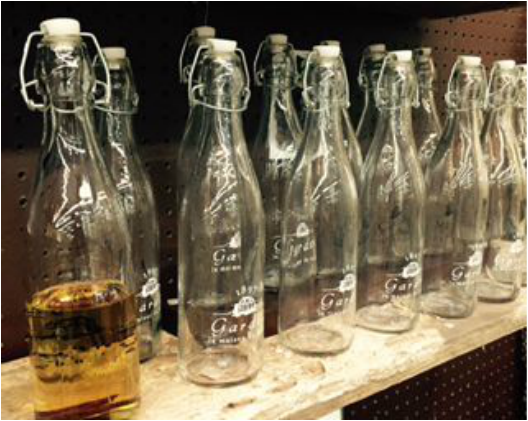 Cut two vanilla beans into thirds and place them in an airtight bottle or jar. We love these sealed, vintage-looking bottles that are perfect for this project (and available here at BGC.) 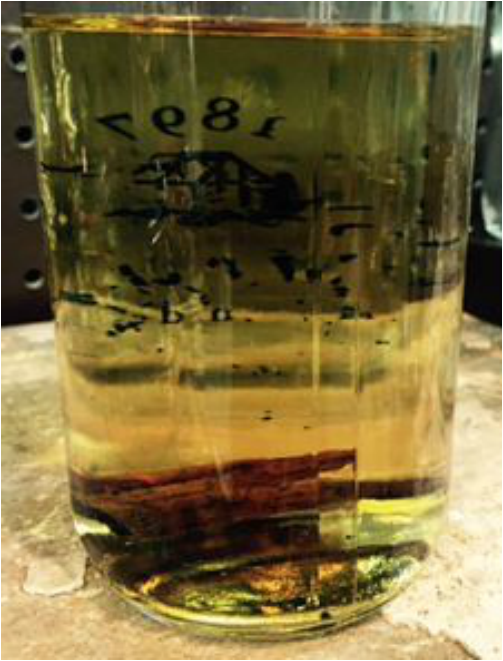 Fill the bottle with vodka, seal, and place in a cool, dry place for at least 4 months. Enjoy!
|
Search by typing & pressing enter